
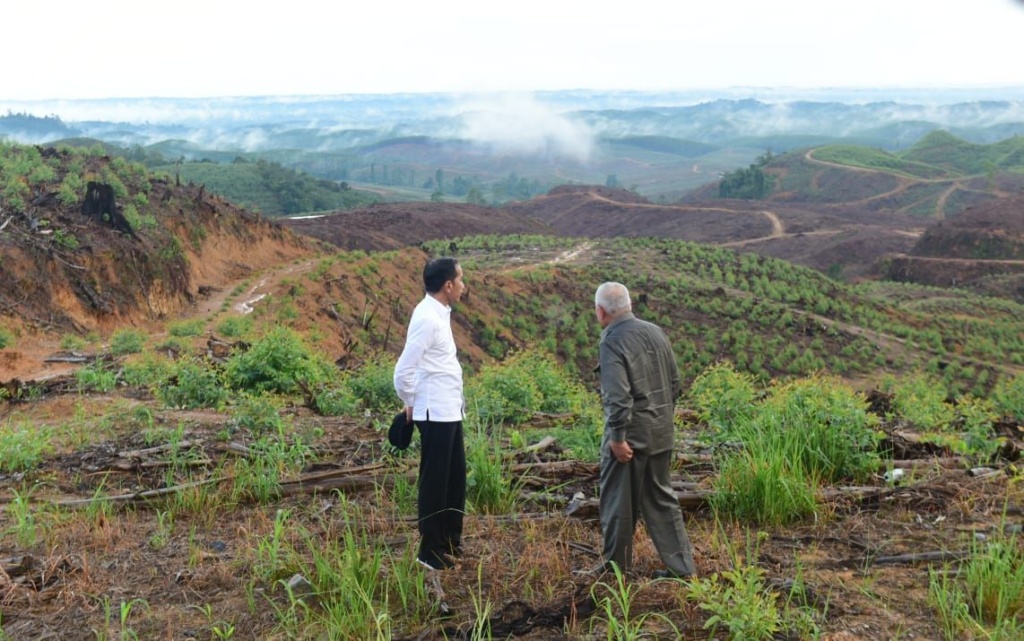
Aiming to be the nation’s green city of tomorrow, Nusantara’s construction has already had, and will continue to have, significant environmental impacts.
Indonesia’s capital city, Jakarta, has been bearing the burden of climate change and overcrowding for quite some time. With these factors overwhelming the population and government alike, the nation has begun the process of building a new capital city on the island of Borneo: Nusantara. The vision for the city is a zero-carbon, high-tech city where people and nature can thrive. However, the road to this utopian vision is long and complicated, and construction has already required mass deforestation and habitat destruction. The ambitious project points to questions about sustainable development, how it should take place, and if there really is a “right way.”
The Backstory and the Strategy
Jakarta, despite being Indonesia’s best-known and best-developed city, has its fair share of problems. The city is, quite literally, rapidly sinking, with some areas at a rate of almost 5 centimeters per year. Combined with overpopulation, flooding, and pollution, Jakarta is becoming too much of a burden to maintain.
Indonesia has floated around the idea of moving the location of its capital for quite a while now. Of course, creating an entirely new $35 billion (USD) city from scratch isn’t cheap, and as a result, the Indonesian government was skeptical of committing to the project before its economy could support it. After decades of deliberation and concept plans, then-president Joko Widodo finally ratified the plan for Nusantara in August 2019, and the formal law defining it as the national capital was approved in 2022.
The ability to plan and build a new capital and relocate an entire government is undoubtedly a projection of power. While Nusantra is intended to solve problems, it may also show the world what Indonesia is capable of in the modern age. On top of this, the project offers a chance for foreign investment, thereby building stronger relations with Indonesia and gravitating them to a certain sphere of influence. Former UK Prime Minister Tony Blair, via his institute, is assisting with strategic planning, consolidating ministry plans for the capital, and promoting the project to global investors. The US Trade and Development Agency is also involved, providing support for sustainable development and smart city technologies.
With incredible momentum behind the plan, it moved quickly, despite encountering setbacks due to the COVID-19 Pandemic, which delayed construction until 2022. Since then, however, Nusantara has already made a lot of progress. An international airport for the city and its surroundings was constructed in the span of just one year, and a brand new expressway is being built between the city, the aforementioned airport, and the nearby city of Balikpapan. Along with yet another new highway recently constructed from that city as well in 2019, progress is indeed fast, but blowing holes in the jungle to make room for highways comes with much controversy and environmental alarm bells.
From an Environmental Perspective
Aiming to be the nation’s green city of tomorrow, Nusantara’s construction has already had, and will continue to have, significant environmental impacts. Despite its eco-friendly branding, the project has already taken a massive toll on Borneo’s forests in its initial stages. Clearing land for the city has resulted in the loss of about 781,000 hectares of forest cover. Such mass destruction has fragmented habitats and threatens the critically endangered orangutan population on the island of Borneo. Organizations such as Save the Orangutan, the Borneo Nature Project, and Orangutan Foundation International are working to protect forest areas in Borneo and restore damaged habitats, but these areas remain vulnerable. Several construction sites are spread throughout the city, but their surrounding areas are littered with debris, and the land is left barren.
The only significant piece of infrastructure that has been completed so far is the Garuda Palace, an eagle-shaped building that architect and deputy chair of Indonesia’s Green Building Council Tiyok Prasetyoadi called “excessive” in its use of raw materials. The eagle’s wings contain 4,661 blades of steel, copper, and brass, each weighing about 1,400 metric tons. The mining required to extract such deposits is immense, and the carbon footprint falls quite short of Nusantara’s “green” vision.
Indonesia’s citizens are also grappling with Nusantara’s environmental impact. The materials required for construction, including sand and rock, are being sourced from the island of Sulawesi, off the eastern coast of Borneo. These minerals are harvested through quarrying, which involves extracting the material from a massive open-pit mine. The resulting dust clouds have affected Sulawesi’s residents’ ability to continue business as usual. In a 2024 report, WALHI, an Indonesian environmental NGO, revealed that residents can no longer leave doors or windows open, motorcyclists must wear masks and sealed goggles, and upper respiratory tract infections are becoming increasingly common; it is evident that people feel these impacts daily.
However, while Nusantara’s construction certainly has implications for the environment, the project raises questions about how it is meant to reconcile with overpopulation if not by building new urban areas. The 2025 United Nations’ report on Nusantara identifies the Indonesian government’s goal of creating “one of the world’s most sustainable cities,” highlighting its aspiration of building a forest city: one that is dominated by natural landscapes, takes ecological cycles into account, and coexists with nature. The end product will matter most in the long run; yet, for people and ecosystems, the impacts are being felt now.
Given the current state of climate change, setting these kinds of targets is both risky and a necessity. The impact of deforestation in Indonesia has been significant, but it has also faced pressures from overpopulation and poverty, both of which drive people towards cheaper, more environmentally harmful practices. The debate remains ongoing as to whether Nusantara will positively contribute to a more sustainable future, or if its only legacy will be the destruction faced today.
Indonesia is Not the First of Its Kind: Relating to Equatorial Guinea
This is not the first time environmental concerns have emerged about creating a new city. Equatorial Guinea, a country in west-central Africa, has also been steadily building a brand new capital city, “Ciudad de la Paz,” located within its sparsely populated jungle mainland. Similar to Nusantara in Indonesia, it too has prompted the need for a new highway, a new airport, and vast swaths of forest to be cleared. That project has also been advancing steadily, though it too has a long way to go before formal implementation.
Comparing the two makes the larger problems even clearer, being that not only does a large area need to be set aside for the city, but with a city comes an entire metropolitan area as well. Equatorial Guinea’s case for creating a capital city involves relocating to a more secure geographic position than rather than managing overpopulation, yet it raises the same question as Indonesia’s: if there is a need to build a new city, why put it in the middle of the rainforest? Whether it be for safety or to alleviate pressure elsewhere, neither city is being built just because its host country “feels like it;” they both have cause. They both have their reasons, yet in doing so, they wreak havoc on local ecosystems. Unfortunately, neither Indonesia nor Equatorial Guinea has many alternatives; any major development will inevitably have massive costs for nature. With both being heavily rainforested nations, any major new development will inevitably have massive costs for nature.
What Does This All Mean?
Building entirely new metropolises from scratch is not commonly discussed in global environmental debates, yet the limited examples reveal the gross consequences that reverberate farther than most people think. There is always more at stake than creating a new place to live and work. Cities and their construction have significant environmental impacts, disrupting ecosystems that have been maintained in these pristine biospheres for millions of years. Promising to live in balance with nature, as Nusantara does, could set a precedent for future human settlement, but the damage happening now remains unresolved. As Nusantara’s progress continues, and as the need for human resettlement due to climate change increases, it will be important to consider how development is conducted across contexts and attempt to find the most environmentally sound path forward.
Edited by Sofia Gobin
This is an article written by a Staff Writer. Catalyst is a student-led platform that fosters engagement with global issues from a learning perspective. The opinions expressed above do not necessarily reflect the views of the publication.
