
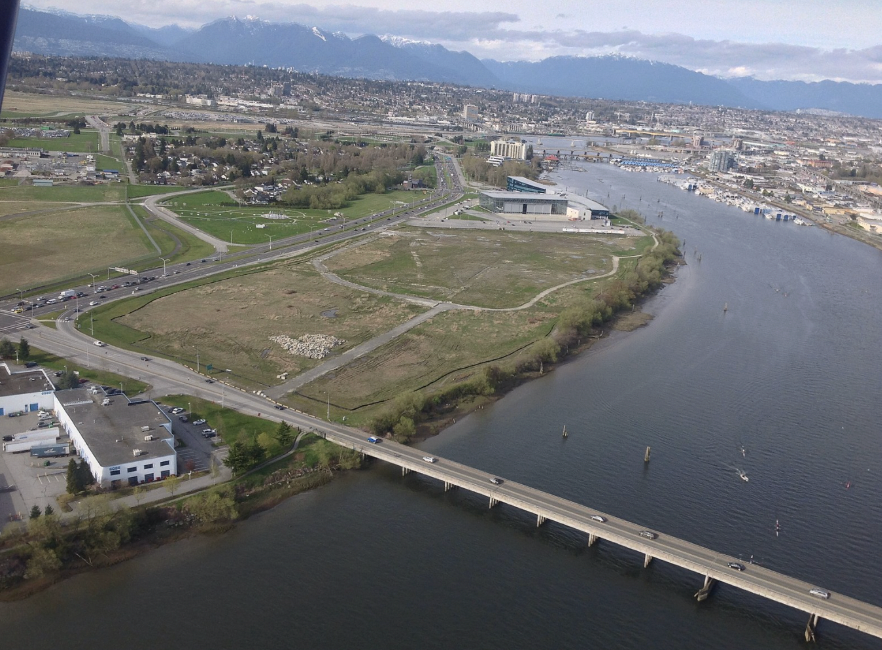
After the longest trial in Canadian history, the British Columbia Supreme Court issued a landmark decision in August 2025, proclaiming that the Cowichan Tribes of Vancouver Island have Aboriginal title to a portion of land in the South Richmond area. The announcement sparked public outcry across Canada and disputes between local governments, the Cowichan Tribes, the B.C. Supreme Court, and the residents of the rural stretch of No. 6 Road in Richmond.
The case began in 2014, when the Cowichan sued to reclaim their former fishing lands on the Fraser River, from which they were displaced in the 1800s. Justice Barbara Young ruled that the Cowichan had rights to approximately half of the 7.5 square kilometre portion of land they had claimed. While the Cowichan stated they were seeking title only to land held by the government, Justice Young did not officially comment on whether private lands were off-limits. Rather, she stated that “both interests in land may be valid, and the exercise of the rights that come with those interests should be reconciled.” Many take this to mean that Aboriginal title could have consequences for fee-simple titleholders and their land. Hence, it remains unclear how respecting both Indigenous and current property owners’ rights could look in practice, especially for homeowners.
Malcolm Brodie, the Mayor of Richmond, sent letters to approximately 150 property owners, warning them that their properties could be negatively impacted. In addressing residents, he writes, “the Court has declared Aboriginal title to your property, which may compromise the status and validity of your ownership.” Many residents are worried and even outraged by the news. Judy Kutny, a Richmond resident of 35 years, says, “It’s scary” that someone might have a claim to the property her family has lived on for three generations. Another resident stated that “for private property owners, it is certainly concerning.”
Cowichan Tribe leadership responded to Brodie’s statements, alleging that they are misleading and “deliberately inflammatory.” David Rosenberg, counsel for the Cowichan Tribes, adds that he is frustrated and disappointed with the misinformation surrounding the case. He asserts that his clients are not targeting private land, and that the likely outcome will be a treaty recognizing Aboriginal title while allowing private owners to hold fee-simple titles.
Currently, governments at all levels, as well as the Musqueam and Tsawwassen First Nations, are appealing the ruling. A spokesperson for the federal Crown-Indigenous Relations Minister, Rebecca Alty, told the press that “further legal clarity is required to address the decision’s potentially significant nationwide implications.” This clarity will not likely come quickly. Even if expedited, the appeal is expected to take several months in the B.C. Court of Appeal; longer if it reaches the Supreme Court of Canada. For now, the future of these homeowners will remain unsettled while the issue works its way through the courts.
The ruling marks the first time a court has declared Aboriginal title over private property in British Columbia. Decades ago, former B.C. Appeal Court Justice Mary Southin described the tensions between private property ownership and Aboriginal title as a “cloud” looming over the province. The controversy in Richmond is the result of decades of legal ambiguity surrounding the issue. The Court’s ruling in Cowichan Tribes v. Canada could set a precedent for Indigenous land claims across the country.
The case raises an important question: who pays the price of reconciliation? Richmond residents feel the ruling is unfair, as they fear the possibility of losing the property rights to their homes. However, Justice Young sees the situation differently. In her ruling, she wrote that the status quo must change to achieve reconciliation and that “sometimes the hardship will be borne by Indigenous peoples and First Nations, and sometimes it will be borne by non-Indigenous Canadians.” This local struggle highlights the broader dilemmas surrounding reconciliation and land rights in Canada. Ultimately, Cowichan Tribes v. Canada signifies the tensions between Indigenous rights to their ancestral lands, and the rights of homeowners to their purchased private property.
Edited by Lily Christopoulos
Disclaimer: This is an article written by a Staff Writer. Catalyst is a student-led platform that fosters engagement with global issues from a learning perspective. The opinions expressed above do not necessarily reflect the views of the publication.
