
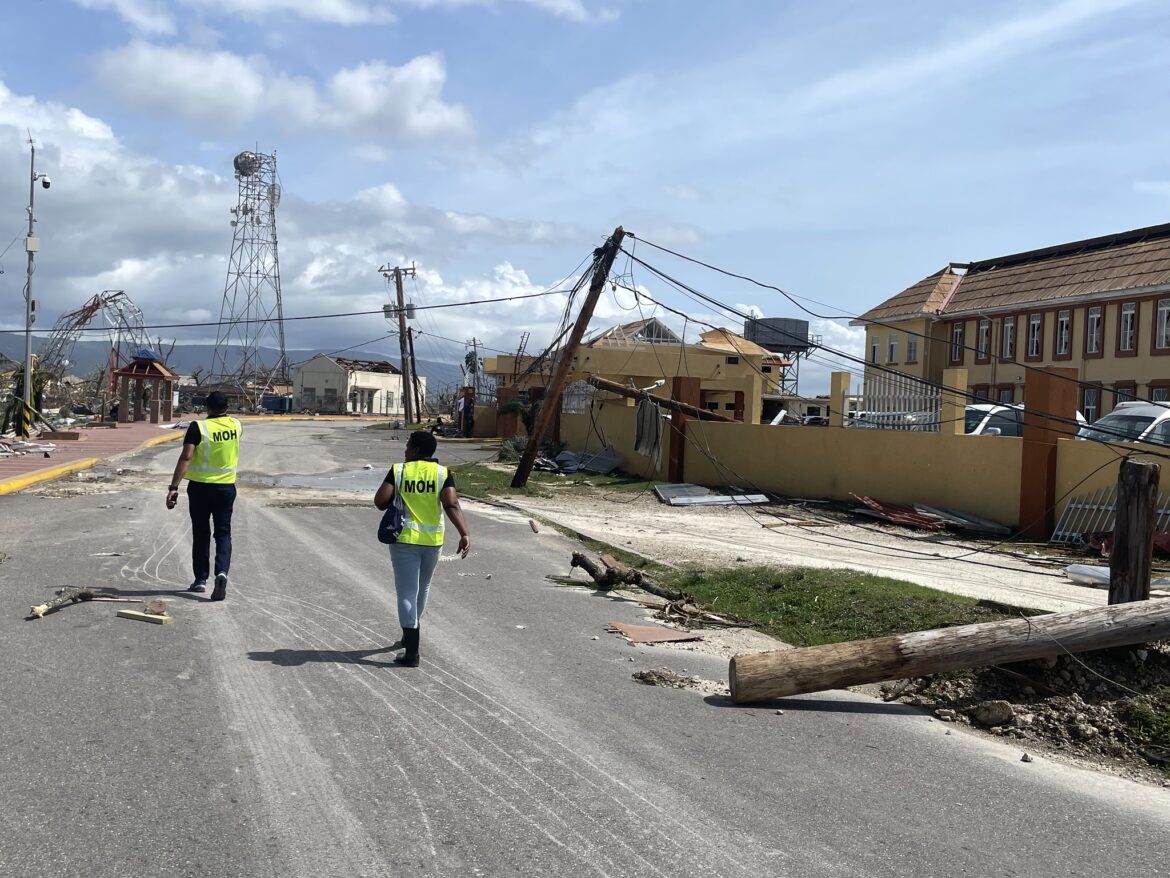
When Hurricane Melissa made landfall in Jamaica on October 21, 2025, it marked a dark milestone as the strongest hurricane to hit the Caribbean in modern history, and the third strongest to ever occur in the Atlantic. With sustained winds of 290 kilometres per hour, it was stronger than Hurricane Katrina, with around 280 kilometres at its peak. In Jamaica, nearly 1.6 million people have been affected by the storm, and large portions of the country remain underwater, isolated, or without power.
The scale and breadth of the destruction left in Melissa’s wake complicates relief efforts. The worst hit area –the western parishes– is difficult to access due to flooding and destroyed road infrastructure. According to the World Food Programme, up to 360,000 people across Jamaica require food assistance. The storm left 77% of the country without power, and communication systems across the country have been severely damaged, making coordination of relief difficult for both the Jamaican government and international aid organizations like the UN Office for the Coordination of Humanitarian Affairs.
The destruction of infrastructure is expected following a Hurricane like Melissa, but a new factor is complicating relief efforts further: images and videos generated by Artificial Intelligence (AI). The threat that AI-generated videos pose to a shared sense of reality or truth has been a hot topic since the release of Sora, OpenAI’s clip generation tool, to consumers. These videos have enabled the spread of difficult-to-distinguish misinformation, especially in the political sphere. For example, the shutdown of the U.S. government, now over a month long, has halted the country’s Supplemental Nutrition Assistance Program (SNAP), commonly referred to as food stamps. Racist AI generated videos of Black people selling food stamps have widely circulated in conservative circles to spread the idea that large-scale food assistance fraud is occurring. One AI-generated video of a Black woman describing how she sells food stamps to a reporter garnered over 1.7 million views on Elon Musk’s X (formerly Twitter). During Hurricane Melissa, AI videos claiming to show its impact spread rapidly and widely. These videos circulated on TikTok, Instagram, and on encrypted messaging apps.
The circulation of hoaxes, rumours, and false evidence is commonplace after a natural disaster, but emerging AI tools have amplified the issue by enabling anyone to produce and distribute convincing fake videos. These AI-generated videos now appear mixed in with authentic content from residents and journalists, and are racking up millions of views, leaving social media users unable to distinguish fact from fiction. One AI video depicts Jamaica’s Kingston Airport destroyed by the storm, and another shows sharks swimming in floodwaters. False information, especially when difficult to discern from reality, as in the case of AI-generated videos, undermines the dissemination of accurate safety information. This forces authorities to divert valuable resources and time to debunking false information, rather than combating the devastation of the disaster. At an October 27 press briefing, Jamaica’s education minister, Dana Morris Dixon, said she had been inundated with false videos on the encrypted messaging platform WhatsApp, and urged the public to pay attention to official channels.
Her experience highlights a key aspect of the spread of AI-generated content during disasters. Oftentimes, these videos circulate among family and friends on messaging services, which gives the false content a veneer of credibility. In a situation where telecommunications and power services may be inaccessible or unreliable, an individual has a limited window where they can access information such as public safety announcements or shelter-in-place warnings. Having to sift through false information consumes this finite time. One narrative review of nine studies analyzing the impact of misinformation in the context of natural disasters found that the spread of false information about aid distribution and safe zones created needless disorder, strained emergency services, and slowed help to affected individuals in multiple cases. The review also found that misinformation decreased trust in official sources and weakened community resilience during recovery.
Beyond this risk, false content confuses people’s understanding of their situation. An individual in an area not yet struck by the disaster, who has seen AI-generated content showing the disaster as a mild storm, for example, may ignore warnings to evacuate. The risks to public safety are twofold: diversion of resources to combat misinformation, and prevention of accurate information from reaching affected communities.
These outcomes are not theoretical. During natural disasters, time is of the essence. Failure to spread accurate information quickly and widely has real consequences of injury, destruction, and death. As of November 6, 2025, the direct death toll in Jamaica from Melissa is 32 people. This number is likely to rise as search and rescue efforts continue. Indirect deaths, caused by disease, traffic accidents, and fire, are not included in this toll. As of now, how to stop the spread of AI-generated content remains difficult and unclear. As climate change progresses and intensifies the incidence and severity of natural disasters around the globe, stopping the spread of misinformation will become even more critical. Misinformation during natural disasters leaves people confused and unsafe, only sure of the force of nature once it confronts them, which by that point, may be inescapable.
Edited by Natasha Bhimji
Disclaimer: This is an article written by a Staff Writer. Catalyst is a student-led platform that fosters engagement with global issues from a learning perspective. The opinions expressed above do not necessarily reflect the views of the publication.

I’m a writer for Catalyst and the McGill Journal of Political Science. I am passionate about topics such as politics, sustainability and geography!