
Over the past three years of William Ruto’s presidency, Kenya has rapidly ascended into a more prominent role on the global stage. Under Ruto’s leadership, the East African country has undergone a significant rebranding, positioning itself as a nation focused on peacekeeping, from negotiating with warring parties in Sudan to the deployment of Kenyan troops in the Democratic Republic of Congo (DRC). Ruto has proved Kenya to be an indispensable resource for peacekeeping in Africa. However, as Haiti descended into rampant gang violence halfway across the Atlantic Ocean, Ruto’s next feat of peacekeeping has now taken a whole new turn.
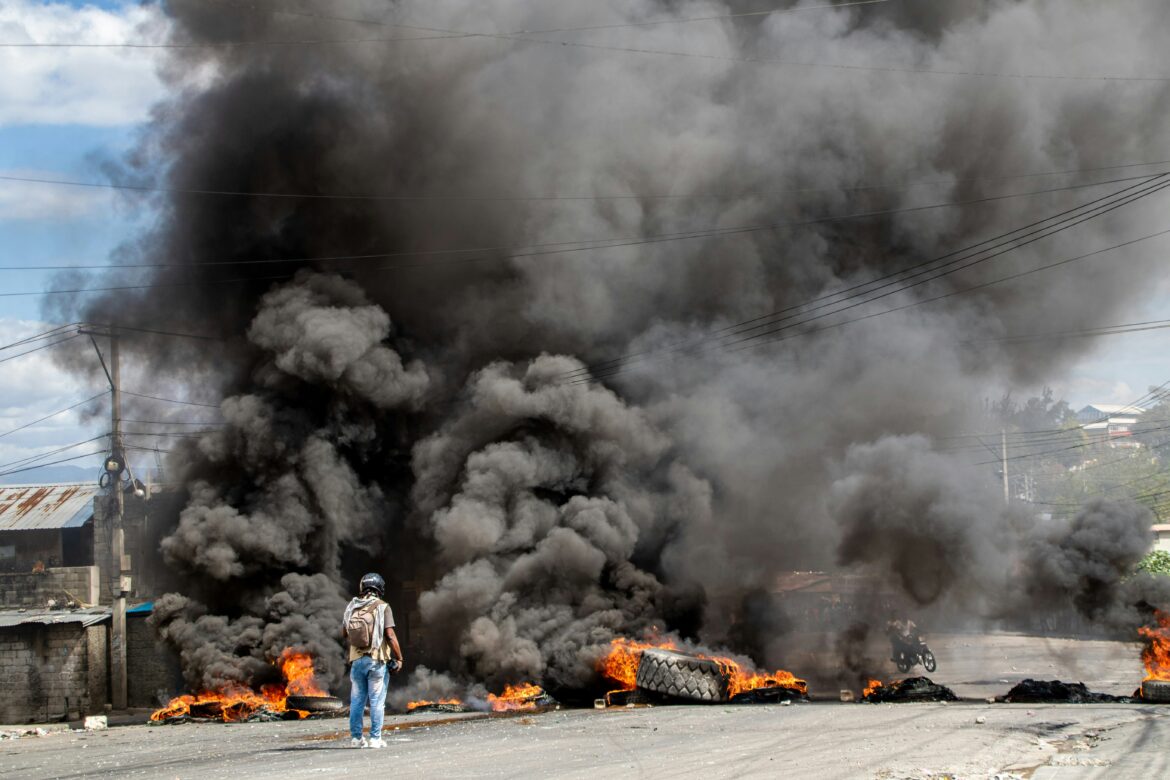
Following the assassination of President Jovenel Moïse on July 7, 2021, Haiti plummeted into disarray—the Caribbean nation reckoned with the absence of governance, with no single elected official in office. Armed gangs seized the power vacuum and gained control of nearly 85 percent of the capital, Port-au-Prince. According to United Nations reports (UN), gangs are responsible for grave human rights violations, such as a 50% increase in sexual violence against women and girls, 1.3 million civilians internally displaced, mass murders, and child exploitation through gang recruitment.
Thirteen days later, after Moïse’s assassination, Ariel Henry was sworn in as Haiti’s Acting Prime Minister as an effort to restore order in the conflict-torn nation. With Haiti’s police force outgunned and outmanned, Henry called on the international community to wrest power back from gangs, further gripping their control over the country. Haiti’s plight garnered international attention, notably during the presidency of William Ruto, who took a particular interest.
In October 2023, the United Nations Security Council (UNSC) authorized the Multinational Security Support Mission (MSS), a UN-backed initiative specifically designed to squelch Haiti’s escalating gang crisis. Kenya volunteered to lead the mission, pledging 1,000 of its police officers to neutralize Haiti’s gangs and restore stability. The Security Council agreed on the Kenyan-led initiative, with the United States as the primary financial backer, pledging $300 million, and Canada pledging $80.5 million.
The sudden emergence of Kenya’s advocacy for Haiti has some questioning what’s in it for Kenya. Foreign Minister Alfred Mutua framed Kenya’s mission as a higher calling, aiding their brothers and sisters of African ancestry, stating in a press conference, “Haiti looked around and said: ‘Kenya, please help us’. They did not ask any other countries. We have decided to do God’s will and assist our brothers and sisters.”
However, Haitian political activist Velina Charlier opposes Mutua’s altruistic perspective. Instead, she offers a pragmatic reason why Kenya has taken an interest in Haiti, it’s simple: “For Kenya, the [MSS] was purely a business transaction”.
Over a phone call, I interviewed Charlier to grasp whether Kenyan officers ameliorated the gang crisis after two years. As an activist, she observed the inverse: despite more officers on the ground, armed gangs have contributed “more massacres, more displacement, more rapes, more violence” than ever before.
To Charlier, this reality is not surprising; in fact, the Kenya-led initiative is indicative of a legacy of poorly thought-out UN missions.
For years, the island of Haiti has been a revolving door for UN missions. “Since the 1990s, there has been a [continuous] cycle.” The impact of each preceding mission has rendered Haiti worse off than it was before. Instead of the UNSC addressing the core of the armed gangs crisis, such as the lack of social services, disparate wealth gaps, and rampant corruption, the UNSC fails “to put on their thinking caps” and choose the easier solution, suggesting to “bring in more guns.”
Charlier explained why Kenya opts for the easier route by injecting more guns into the already volatile crisis, illustrating how the MSS was just a “business transaction.” Due to Kenya’s leadership of the UNSC initiative, the East African country received substantial funding from the United States to support its security logistics.
Aside from economic incentives, the MSS provided Kenya with geopolitical advantages. In May 2024, Former US President Joe Biden welcomed President Ruto to an official state visit, marking the first time in 15 years that a US president invited an African head of state to Washington. More importantly, Charlier notes, Biden pledged to designate Kenya as a “non-NATO” ally; if selected, it would be the first sub-Saharan country to receive this title. Kenya’s intervention in Haiti can be attributed to this symbolic title. Biden applauded Ruto for deploying Kenyan forces; if American troops were deployed, it would raise “all kinds of questions that can easily be misrepresented” by critics of the US.
Haiti’s gang crisis can be seen as a window of opportunity for Kenya to gain political clout. By contracting its peacekeeping services as an attempt to resolve Haiti’s gang crisis, Kenya sought to enhance its image on the global stage as a capable ally, one that is readily deployable. Kenya’s involvement in spearheading the MSS initiative was intentional, as Ruto proved to the US that it is an indispensable resource in the Caribbean region. In turn, Kenya utilized Haiti’s crisis to strengthen its diplomatic ties with the US, potentially securing a non-NATO ally designation and enhancing its geopolitical influence. For Charlier, Ruto’s goal of “putting Kenya on the map” has succeeded. But at what cost?
This October, the UNSC approved yet another initiative, under the title of the Gang Suppression Force (GSF); yet, nothing has changed in Haiti. The UNSC believes Kenya can lead the way; however, Haiti’s army demonstrated that it may be ready to tackle the gang crisis on its own.
Recently, in September, 143 Haitian soldiers returned from training with the Mexican army, ready to combat gang violence. These recent developments are a step in the right direction. Charlier contended that to fight gangs, the country must “integrate a strong Haitian army serving the interests of the Haitian people.” While this development is in its early stages, there is a sense that Haiti is trying to break free from continuous foreign intervention.
Haiti’s future with gangs is unknown, but one thing is certain: on the other side of the phone, Charlier urged me to remember that “No country can survive with its security outsourced”.
I paused and thought, so why should Haiti?
Edited by Lindsay Hayes
Disclaimer: This is an article written by a Staff Writer. Catalyst is a student-led platform that fosters engagement with global issues from a learning perspective. The opinions expressed above do not necessarily reflect the views of the publication.

Ava Francin is a third-year student majoring in International Development. She has a particular interest in international conflicts, humanitarianism, and social justice, with a focus on the Americas and the African region. As a contributor, she takes pride in grounding her stories through a people-centered approach.