
Imagine having a 15 to 1 advantage, and you still lose.
That’s how some people described what happened to Bashar Al-Assad’s Syrian regime when it was rapidly overrun by rebel factions in December 2024. While those exact odds are an exaggeration, what is evident is that a dictator who once seemed like he’d managed to keep himself in power was proven very wrong, very quickly. Since Assad’s fall, Syria has been navigating a fragile transition toward democracy. So how is the country holding up now, one year later?
For context, the Assad family ruled Syria from 1971 through the Arab nationalist Ba’ath Party. Reformist protests in 2011, as part of the wider Arab Spring movement, were met with violent repression by Bashar Al-Assad’s government, triggering a vicious civil war between pro- and anti-government forces. After years of fighting, Russian and American intervention, the rise and collapse of ISIS, and a temporary resurgence of the regime, the conflict settled into a stalemate by 2020. By that point, the broader consensus was that Syria would be stuck like that forever. That changed in late November 2024, when rebel forces led by Hay’at Tahrir al-Sham (HTS) cut through Assad’s defences and captured the city of Aleppo. HTS continued driving south until they reached the capital of Damascus just a week and a half later. Assad fled to Russia, while Ahmed al-Sharaa, the man who led HTS to victory, became the nation’s transitional President.
In the months since, Syrians have been navigating something they haven’t experienced in over half a century: genuine political uncertainty. Not the choreographed version of authoritarian governments’ stage to make “elections” or “reforms” look spontaneous, but the type that emerges when decades of state control abruptly collapse, and the vacuum begins to fill with competing visions for the future. For Syrians, that vacuum has been exhilarating and terrifying.
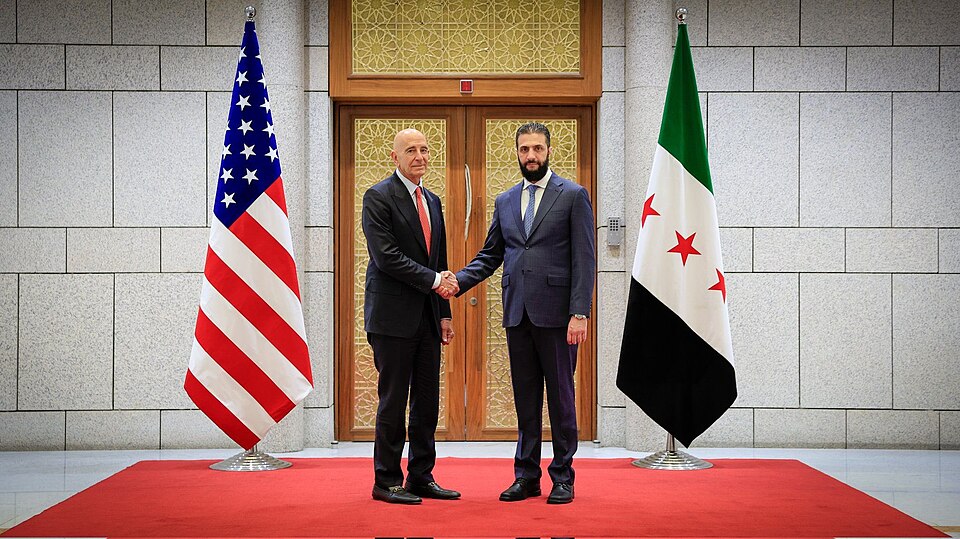
HTS’s sudden capture of the country posed its own problems. Although the group rebranded itself years earlier and sought to distance its leadership from its jihadist roots, critics argue that its ideology remains incompatible with the pluralistic democracy Syrians were promised. International observers and domestic opponents alike question whether a faction born out of al-Qaeda’s Syrian branch can truly steward a democratic transition. President al-Sharaa insists it can, framing HTS not as a hardline Islamist movement but as a nationalist force that simply “outlasted the dictatorship.” He has pledged to hold elections within eighteen months and to dissolve HTS’s military structures once a permanent government takes power.
But promises are easier to offer than to implement. Almost immediately after Assad fled, regional power brokers began jockeying for influence over Syria’s newly forming political order. Turkey and Qatar pushed to ensure the new government remained friendly to their expanding influence. Russia, publicly humiliated by Assad’s collapse despite years of military backing, continued to maintain a military presence at its bases in Tartus and Latakia, raising concerns about how much sovereignty the new administration actually exercises. Meanwhile, the United States and European Union eased long-standing trade restrictions they had imposed during the war, hoping to stabilize the economy enough to prevent a power void that extremist groups could exploit.
Domestically, old wounds reopened quickly. Kurdish officials in the northeast, who had governed their own region and fought ISIS years before HTS rose to prominence, expressed suspicion toward the new leadership. Across the country, millions who had fled over the last decade watched from abroad, uncertain whether it was finally safe to return.
Yet despite the chaos and political friction, cracks of optimism have appeared. Journalists and activists report being able to speak more freely than they had in years. International negotiators, long accustomed to working around Assad’s inflexibility, now describe the new leadership as more flexible and more willing to prove its legitimacy. Whether that flexibility leads to a durable democratic framework or simply a different style of authoritarian rule remains Syria’s central question.
As 2025 unfolded, the new Syria found itself pulled between the urgent need for stability and the equally urgent demand for accountability. The transitional government’s first major challenge was economic. Years of war, sanctions, corruption, and infrastructural collapse had drained state revenues and left entire cities reliant on humanitarian assistance. With Assad gone, the United States announced a partial easing of sanctions, allowing foreign investment in electricity, water reconstruction, and medical imports while keeping targeted sanctions on former regime officials and HTS commanders. European states followed cautiously, allowing limited economic cooperation on the condition that Syria adhered to a clear democratic roadmap.
Political life, meanwhile, began to reawaken in ways once entirely unimaginable under Assad. In March 2025, the transitional administration announced the formation of a seven-member constitutional committee, including two women, aiming for a more gender equality-based body of representation. Its task is to draft a new constitution that addresses decades of centralized rule, ensures minority protections, and sets the framework for open elections projected for mid-2026. Political pluralism has also started to take root. A forthcoming “party law” aims to form a legal framework for a new multi-party Syria. Kurdish political organizations now negotiate openly with the transitional government for a federalized model with more regional authority. Even exiled opposition figures are slowly returning, hoping to take part in shaping the transition. The most surprising development has been the rise of independent local activists and civic organizers who never previously held formal political roles but are now shaping debates on governance and transitional justice.
Security remains Syria’s most fragile challenge. Local militias loyal to the Assad era still resist the new order, particularly in the coastal Alawite heartlands. ISIS cells continue to stage sporadic attacks in the desert south of Deir ez-Zor. HTS’s internal security forces have clashed with suspected regime holdouts, stirring accusations that the movement is simply replacing one autocratic intelligence apparatus with another. The new government denies these claims and frames such operations as necessary counterinsurgency measures during the transition period.
What all this adds up to is not a success story, or at least not yet. Syria today is attempting to rebuild from scratch while balancing competing pressures from its own population and from outside actors. The transitional government argues that its progress shows Syria is on a solid path to democracy. Critics warn that HTS’s dominance, even softened by rebranding and power-sharing agreements, could eventually lead Syria into a controlled “managed democracy” or a new form of Islamist authoritarianism.
For many Syrians, though, the mere fact that political debate exists at all feels historic. After decades defined by conflict and repression, the country stands at a threshold it has not crossed before. Whether that threshold leads to a genuinely open political system remains the defining question of the post-Assad era.
Edited by Sofia Gobin
This is an article written by a Staff Writer. Catalyst is a student-led platform that fosters engagement with global issues from a learning perspective. The opinions expressed above do not necessarily reflect the views of the publication.

Oliver “Ollie” Scott-Hansen is an undergraduate student at McGill University studying history and Russian language, hailing from just outside New York City, yet maintaining similarly strong ties to his familial heritage in north and central Italy. He joined the Catalyst team in Fall 2024 as a staff writer, something he enjoys doing as a hobby as well. With a particularly vested interest in Eastern Europe, the post-USSR world, and the Russo-Ukrainian war, coupled with his various connections throughout the global international relations space, Ollie reports on issues throughout the world that mostly center around key geopolitical developments in contentious places mostly involving war/conflict, and domestic affairs within the United States. He has experience mainly reporting from Telegram, carefully analyzing the Russian Invasion of Ukraine through his updates forum there, but also spends considerable amounts of his free time glued to maps and statistics trying to make sense of the crazy world that surrounds our day-to-day lives.