
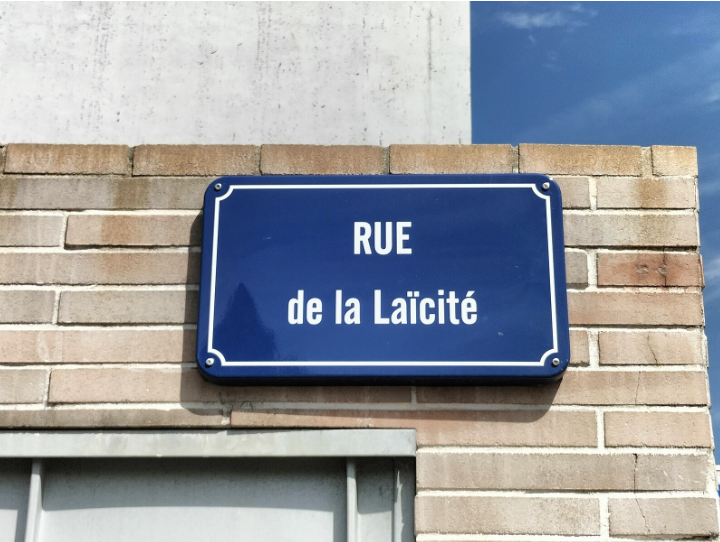
In early September, the French government moved to ban the wearing of long robes known as abayas in state-run schools. An abaya is a long, loose outer garment traditionally worn by some Muslim women as an expression of modesty in accordance with Islamic cultural and religious norms. The country’s highest administrative court, the Conseil d’État, upheld the measure, ruling that such garments could constitute a “conspicuous manifestation of religious affiliation” and therefore violate the 2004 law on religious symbols in schools. The controversy revealed a paradox at the heart of laïcité: a principle designed to unite citizens through neutrality that now often divides them along lines of belief. President Emmanuel Macron has asserted, “Secularism is the cement of a united France.” The move reignited an old debate in France: can a law meant to guarantee neutrality end up deepening social divides? This question gets to the heart of France’s desire to maintain a strong democracy.
The Historical Roots of Laïcité
The idea of laïcité is not new. It grew out of France’s long struggle to separate the Church’s power from that of the state, a conflict that has helped shape modern French identity. The 1905 Law on the ‘Separation of the Churches and the State’ marked a turning point; it ended the Catholic Church’s privileged status. It enshrined the Republic’s commitment to freedom of conscience. For the early republicans, secularism was never simply about religion: it was about dismantling clerical influence in politics and creating a neutral public space where all citizens could practice their religion equally. At its core, laïcité was built on the ideals of universalism and republicanism, the belief that the state recognises individuals rather than communities and protects their rights regardless of religion. This was meant to guarantee unity through equality by ensuring that no faith (or lack of faith) could dictate how citizens participate in civic life. Over the decades, high-profile court rulings sharpened how laïcité is applied. For example, the Conseil d’État, France’s highest administrative court, has ruled multiple times on how religious signs and the principle of neutrality interact in public institutions. Originally, laïcité was intended to protect freedom of belief and expression without privileging religious views over non-religious ones. It was never meant solely as a tool to silence expression— a safeguard for pluralism itself.
The Contemporary Flashpoints
Over the past two decades, laïcité has evolved from a constitutional principle into a political battleground. A series of high-profile laws and controversies has continued to test the limits of secularism, revealing how a doctrine once meant to ensure neutrality can also deepen social divisions.
The first major turning point came in 2004, when France passed a law banning “conspicuous religious symbols” in public schools. While the measure was presented as a defense of secular education, it overwhelmingly affected Muslim girls who wore headscarves. Supporters argued that the law preserved the neutrality of public institutions; critics countered that it imposed a narrow vision of French identity, disproportionately restricted expressions of faith, and impacted the constitutional right of freedom of religion.
A few years later, the 2010 niqab ban extended the debate beyond classrooms. The government justified the nationwide prohibition on face coverings as a matter of “women’s dignity” and “public order.” The Conseil Constitutionnel upheld the ban, citing republican values and social cohesion. Human rights organizations questioned whether the law truly empowered women or instead policed their autonomy.
Most recently, the 2023 abaya controversy reignited these tensions. Education Minister Gabriel Attal announced the ban on the long robe worn by some Muslim girls in public schools, claiming it violated the principle of neutrality. The Conseil d’État again sided with the government, reaffirming that laïcité applies not only to institutions but to visible signs of faith within them.
Court rulings and political narratives have consistently reinforced the idea that secularism is essential to civic unity. President Macron has positioned himself firmly in favor of stricter secularism, describing laïcité as “a struggle for the Republic” against what he labels “Islamist separatism.” Yet, many observers note how laïcité has shifted from protecting freedom of belief to regulating religion itself. Public opinion remains divided. Prominent intellectuals such as Élisabeth Badinter and Alain Finkielkraut defend strict secularism as essential to preserving equality and civic order, while others argue that such rigidity systematically excludes religious minorities from public life. The debate now mirrors broader anxieties about immigration, feminism, and postcolonial identity, making laïcitéan ongoing question of belonging rather than a settled principle.
Laïcité in Practice: Neutrality or Cultural Blindness?
In practice, laïcité often reflects more than the separation of religion and state. It raises a deeper question: who gets to define neutrality? Critics argue that France’s brand of secularism functions as a form of majoritarian secularism, one that reflects dominant Christian-secular cultural norms. Public schools, for example, forbid headscarves and abayas in the name of neutrality, yet Christian holidays remain national celebrations, and Christmas markets light up city squares each winter.
From a sociological and anthropological perspective, laïcité is not simply a legal doctrine but a cultural system that shapes belonging. Scholars such as Joan Wallach Scott and Jocelyne Cesari have shown that the enforcement of secularism often intersects with race, gender, and postcolonial identity. Anthropologist John Bowen similarly argues that France’s debates over Islam are less about religion itself and more about how the state imagines social cohesion, showing that laïcité often reflects cultural anxieties rather than genuine neutrality. Muslim women, in particular, are caught at the intersection of feminist rhetoric and state control. Their clothing is simultaneously framed as a sign of oppression and as a threat to national values, which disregards their agency.
Comparing France to Anglo multicultural models like Canada or the United Kingdom underscores this contrast: Canada’s 1971 Multiculturalism Policy and the 1988 Multiculturalism Act formally recognize cultural diversity as a national value, while the UK’s Race Relations Acts (1965–2000) require public institutions to accommodate minority identities. These frameworks stand in sharp contrast to France’s republican universalism, which prioritizes sameness as the route to equality. Both aim for inclusion, yet France’s approach risks erasing the cultural visibility of its minorities in the process.
As Talal Asad notes, modern secularism is never fully neutral; it creates boundaries around which forms of public expression are acceptable and which are seen as threats to social order. Ultimately, the question remains: can laïcité truly be neutral when its application reflects the traditions of the majority? The persistence of Christmas markets and state holidays alongside bans on the hijab and abaya illustrates how neutrality, in practice, can become selective, an expression of culture disguised as its absence.
Global and Generational Reflections
France’s struggle over laïcité is not unique: it echoes tensions seen across the world as societies balance neutrality, faith, and freedom. In India, a secular constitution designed to protect religious pluralism has increasingly been tested by Hindu nationalist politics, raising questions about whether official neutrality can survive majoritarian pressures. In Turkey, the state has swung between militant secularism and religious revival, illustrating how governments often redefine “neutrality” to suit political ends. Closer to home, Quebec’s Bill 21, which bans certain public employees from wearing religious symbols, reveals how the French model has influenced North American debates on diversity and public identity.
Across these contexts, secularism is less a settled doctrine than a mirror of societal change, reflecting how nations define belonging and modernity. In France, younger generations are beginning to challenge traditional interpretations of laïcité. On social-media platforms like TikTok and Instagram, second-generation immigrants and students share personal stories about discrimination in schools or workplaces, reframing the conversation around lived experience rather than legal theory. Youth movements such as Lallab and Les Hijabeuses have also used online activism and street protests to question whether secularism can coexist with visibility.
For many of these young activists, neutrality is not the problem: exclusion is. They argue that laïcité should adapt to France’s plural reality rather than freeze in a 20th-century vision of sameness. Whether the principle evolves or fossilizes may depend on how the Republic chooses to reconcile its universal ideals with the diversity that already defines it
The Future of Neutrality
As France continues to debate what laïcité means in the twenty-first century, the question has become less about religion and more about representation, about who defines neutrality and whose experience counts. A principle once meant to protect equality now risks excluding those it was designed to include.
For laïcité to remain a force for unity, it has to evolve alongside the pluralism of modern France. Neutrality cannot simply be declared from above; it must be built through recognition, dialogue, and respect for difference. The Republic’s strength lies not in asking people to shed their identities, but in ensuring that all citizens are equal.
In its effort to defend neutrality, France may have lost sight of something essential: freedom also rests on a quiet faith that coexistence remains possible. This marks a departure from the law’s original intent.
Edited by Alexandria Alikakos
This is an article written by a Staff Writer. Catalyst is a student-led platform that fosters engagement with global issues from a learning perspective. The opinions expressed above do not necessarily reflect the views of the publication.

Lou is a U3 student at McGill University majoring in Political Science with minors in Anthropology and Sociology. Originally from São Paulo and the south of France, she has lived in seven countries, fostering a deep interest in international affairs and global citizenship. At McGill, she has been involved with organizations including McGill Students for UNICEF, the McGill European Affairs Association, SSUNS, McMUN, WIIS, The Women’s Network, AIESEC, the McGill Artificial Intelligence Society, and Reform and Resettle. Externally, she has also contributed to the NATO Association of Canada and Young Politicians of Canada. She is particularly passionate about international law, diplomacy, climate security, and the politics of development and social justice across the Global South.