
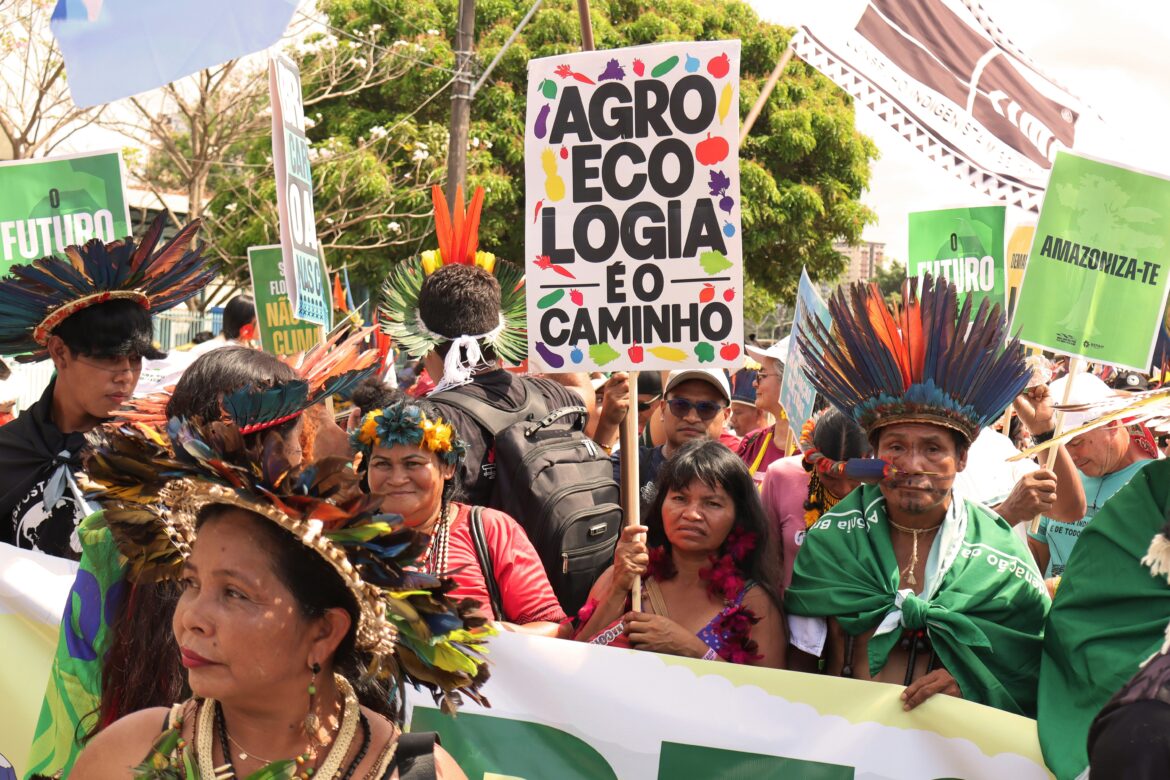
Climate change does not have an even impact across the globe; different people experience different effects, which in turn depend on where and who they are. Certain marginalized groups are more vulnerable to environmental damage, and such vulnerabilities can be exacerbated in a variety of ways. Indigenous peoples have long been subject to disproportionate environmental harm. At the same time, most of the world’s biodiversity lies within Indigenous territories. It is important to acknowledge that it is not the job of Indigenous peoples to solve a problem – climate change – that they did not cause. That being said, groups holding knowledge and understandings of nature that lead to its flourishing are on the receiving end of inequitable harm. What drives this, among other factors, is the degree to which these groups are given voice and representation at the global level. Indigenous groups are increasingly being made visible internationally, but few are truly listening to what these groups have to say.
The Conference of the Parties (COP) is an annual, multilateral body of the United Nations Framework Convention on Climate Change that meets to deliberate on global climate change treaties, policies, and findings. It is a major leverage point for change, given that most countries in the world attend. Despite the growing role of Indigenous representatives at the conference year after year, their true decision-making power and ability to effect change remain limited. Indigenous groups consistently face epistemic injustice at the global level. This can exacerbate the disproportionate climate impacts already being experienced by these groups because the solutions being developed ultimately do not consider Indigenous points of view. The COP illuminates how this has ensued over time and reveals how the ignoring of already marginalized voices perpetuates environmental harm.
Fahara Sultana’s paper, Repairing epistemic injustice and loss in the era of climate coloniality, frames epistemic injustice as the erasure of “worldviews, ontologies, and practices that are vital for just and sustainable climate futures.” Ultimately, epistemic injustice is a loss, and quite a personal one. It can manifest in several ways, including the silencing of marginalized voices, the ignoring and erasure of critical knowledge outside the scope of Western thought, and the denial of meaningful inclusion of Global South and Indigenous groups.
Given the global nature of climate change, deliberation at the global level is critical for bringing together varying experiences and perspectives on the issue. And it is at the global level that epistemic injustice persists with great intensity. Despite being among those most heavily impacted by climate change, Indigenous communities and island nations remain on the sidelines of global climate governance. The purpose of Indigenous presence at international climate conferences is not merely for show; their stories are not a spectacle, but a call to action.
The COP offers numerous examples of how injustice manifests, the most recent COP30 in particular. Institutions like the UNFCCC create gatekeeping mechanisms that delegitimize certain forms of knowledge. Structural barriers include limited venue access and influence over agenda-setting, visa restrictions, and travel costs. Barriers to meaningful participation include a lack of accreditation, access to negotiation zones, and inadequate media coverage of crucial speeches and events. Even when physically present, members of the Global South and Indigenous participants are marginalized by the system supposedly meant to address their problems.
Epistemic injustice is embedded in the structure of global climate governance, and this marginalization occurs by design. Indigenous perspectives and forms of knowledge are vastly different from the worldviews of growth and profit that dominate policy today. Ideas of slowness and reciprocity with nature fundamentally contradict capitalism. And it is because of such contrast that these perspectives must be amplified. As demonstrated previously, this simply does not happen in reality.
Vested interests of rich and powerful actors and countries in capital and growth continue to define climate change narratives and limit the scope of possible progress for the entire planet. As a result, Indigenous communities and other marginalized groups continue to experience environmental harm. Being physically present at a conference or in the negotiation room – which, in itself, has been a struggle – does not constitute sound representation. Even when at the discussion table, Indigenous representatives are often overlooked and silenced. As Sultana articulates, “Access and voice determine influence, and the ability to be heard is fundamental.” Current systems favor scientific knowledge and elite interests over Indigenous knowledge. This produces policy “solutions” tailored to Western powers. Forms of knowledge outside these arbitrary boundaries are required for a holistic understanding of the climate crisis and the formulation of truly just solutions.
Last year’s conference in Brazil, COP30, contained a series of cases that exemplify how Indigenous peoples are systemically marginalized. The conference proudly boasts a record-breaking attendance of Indigenous representatives. Over 5,000 Indigenous individuals indeed participated in the conference to some degree, with about 360 representatives present in the conference’s negotiation Blue Zone. There is triumph in these numbers. That being said, many have since reflected on how the COP fell short in creating opportunities for meaningful participation.
Some have voiced concerns over the COP’s focus on tokenism rather than real chances to contribute to negotiations. In an interview with PBS, Sara Olsvig, chair of the Inuit Corcumpolar Council, commented: “What we have seen at this COP is a focus on symbolic presence rather than enabling the full and effective participation of Indigenous People.” Further, within the first few days of the conference on November 14th, about 90 members of the Munduruku, a group indigenous to the Amazon River Basin, staged a peaceful protest and blocked the entrance to the Blue Zone – the negotiation area. Frustrated by continued industry presence in the Amazon, protestors called for “Nothing about us, without us.” Additionally, the Assembly of First Nations characterized last year’s COP as “militarized,” noting that the army, as well as federal and state police, were “regular features” of the conference for Indigenous peoples. Indigenous people were present, yes, but they were, and have been over time, forced to operate within these constraints of the COP. The conference is not designed to amplify their voices, but to contain them.
COP30 was not an isolated instance. Sultana references COP26 in her paper, during which Indigenous representatives, scholars, and activists found themselves facing significant constraints around their speeches. Comments of protest that “went too far” during speeches resulted in the cutting of microphones and a trip to the security office. Organizations could then face a ban from the conference for up to 5 years.
The Conference of the Parties portrays Indigenous presence as a goal and milestone, which it is. It is also not enough, given that the plug can be pulled (literally) at any time. These communities have no choice but to operate within systems built against them, in hopes of making their voices loud enough to make a difference. In the process, their knowledge and experiences are kept on the periphery, enduring ongoing epistemic injustice and environmental harm.
Edited by Lou Didelot
This is an article written by a Staff Writer. Catalyst is a student-led platform that fosters engagement with global issues from a learning perspective. The opinions expressed above do not necessarily reflect the views of the publication.
