
As AI usage continues to surge globally, system automation and the promise of AI performing tasks faster and more efficiently than humans have become increasingly attractive. For many corporations, the prospect of AI operating with a degree of autonomy makes it an especially enticing investment. However, AI is not ‘autonomous’ and requires human training to reach the level of clarity and accuracy expected by its users. This “invisible labour” is outsourced to centres and individuals around the world, giving people the opportunity to work from home with a level of flexibility and respectability that makes it an enticing alternative to other forms of labour available to them.
Yet beneath this narrative of technological progress and flexible employment lies a more complex reality. The global expansion of AI has not eliminated human labour but instead reorganized it into fragmented and largely invisible forms of digital work that sustain systems marketed as autonomous. This emerging workforce raises important questions about power, knowledge production, and inequality within the digital economy, challenging whether data annotation represents a genuine pathway toward development or is simply a new form of outsourced precarity embedded within global technological supply chains.
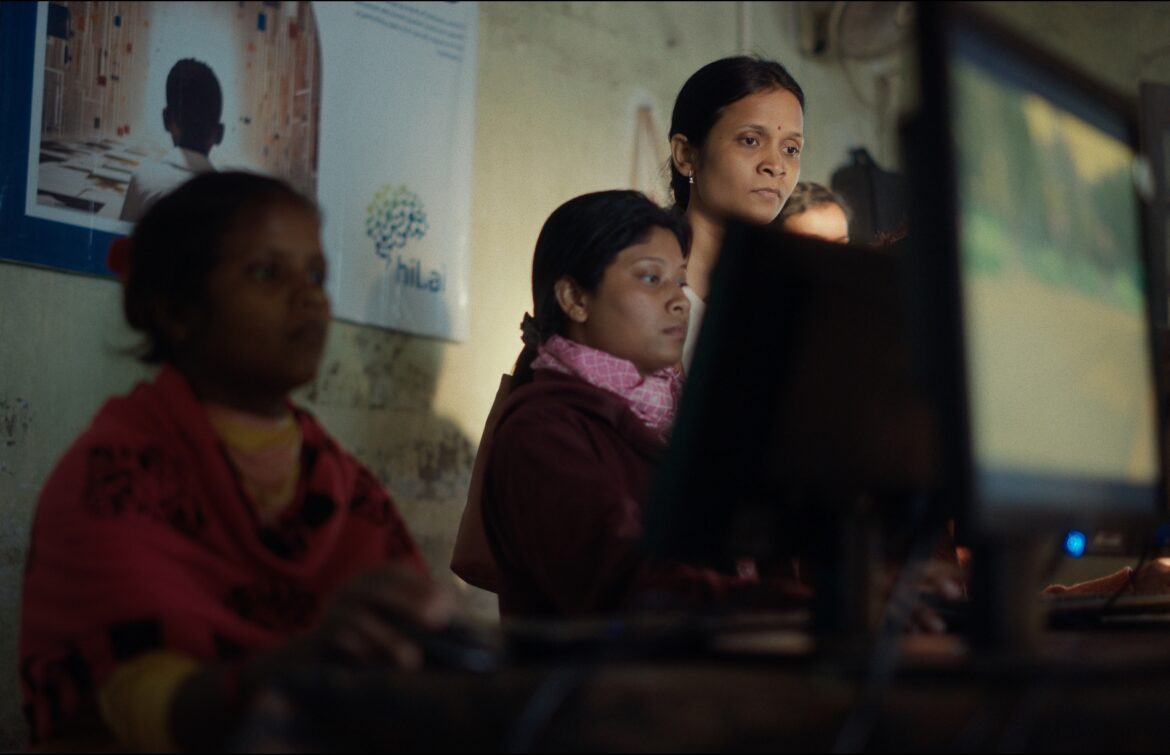
“Humans in the Loop”, a film directed by Aranya Sahay, depicts the lives of Adivasi, or Indigenous, women working at a data labelling centre in a village in Jharkhand, India. Employees at this centre annotate images and videos used to train artificial intelligence systems for international corporations. Sahay focuses on Nehma’s experiences; Nehma compares this process to raising an infant as workers label human outlines, identify facial features such as eyes, mouths, and lips, and refine datasets that enable facial recognition systems to function. Concurrent with her work at the centre, she teaches her young son how to walk, reinforcing her perception of technology as something she helps shape and guide.
However, this sense of agency is challenged when she is assigned to a project aimed at developing an AI to detect and eliminate agricultural pests. When asked to categorize insects according to corporate guidelines, Nehma experiences dissonance between her ecological knowledge and the system’s rigid classifications. Recognizing that one insect benefits plant health, she refuses to label it as a pest, intentionally skewing the data. This moment reveals the limits of her influence; despite viewing AI as something she nurtures, she realizes that its outcomes are ultimately determined by corporate directives rather than her lived expertise.
As she continues experimenting with the software, she realizes that not only are the outcomes out of her control, but they also represent a solely Western point of view. She inputs “Nehma—a beautiful tribal woman from Jharkhand” into an art-generating software, only to receive stereotypical images reflecting North American conceptions of Indigeneity, exposing how AI systems reproduce biases embedded within their training data, and further enforcing her lack of influence on something she works so closely on.
The notion that AI is autonomous and can “think” is one that ignores the real people behind its training. Throughout India and other parts of the world, data annotators are paid to sort through data for hours, tagging objects, identifying cancerous tumors, and verifying translations, in order to maintain the credibility of various AI platforms and help them perform the functions they are expected to for their clients. These annotators are paid a few cents per image and spend hours tagging, watching videos, and listening to audio recordings. It provides employment for college graduates struggling to find work and extra income for women managing households, and offers flexibility, but provides little opportunity for upward mobility. All the person needs to have is a computer and an internet connection.
This concept of invisible workers has existed in the tech industry for years. People who are hired, managed, and sometimes fired all through an online platform. The book Ghost Work (2019), by Mary L. Gray and Siddharth Suri, goes in-depth about the impacts of this economy and the complex web of gray areas involved in this work. Amazon, Google, Microsoft, and Uber depend on the work of these people to keep their services running smoothly. Due to the inherent flexibility, instability, and project-based structure of this type of employment, traditional labour laws and norms are evaded by the employers. Unlike other ‘gig workers,’ like Uber or food delivery drivers, the work done by these people remains unseen and untethered to specific locations. This places them in a “planetary labour market” with variable wages and working conditions. They remain hidden and earn close to nothing compared to the billions of dollars their work makes for the CEOs of these companies.
Women make up more than half of this workforce. The work is considered “respectable” and doesn’t require them to leave home, allowing them to manage the household simultaneously. Many of these workers also come from Dalit or Adivasi communities, like Nehma, for whom digital work represents an upward movement in social status and offers better pay than agricultural work or mining. However, the apparent accessibility and respectability of digital work obscure its darker realities. Content moderation, a significant component of data labelling, exposes workers to graphic violence, abuse, and traumatic imagery that must be carefully tagged and categorized, often with limited psychological support. The psychological dangers of being exposed to this kind of content without support leave many of these women with lasting trauma. Sociologist Milagros Miceli even categorizes content moderation as dangerous work, “comparable to any lethal industry.” These projects are assigned with little transparency, and workers are hired under vague job descriptions such as “data annotation.” After receiving training, they sign contracts without being fully informed about the nature of the material they may be required to process, effectively denying them the opportunity to give meaningful consent or decline psychologically harmful assignments.
Training algorithms to recognise abusive or violent content requires subjecting some workers to hours and hours of explicit and violent videos. Murmu works from her village in Jharkhand, India. She classifies images and texts that have been flagged by automated systems as violating the platform’s guidelines. She explained that, initially, these images prevented her from sleeping as she replayed these scenarios in her head. But eventually, content moderation results in emotional numbing and a delayed psychological fallout that Miceli says is a defining feature of this kind of work. Studies have shown that it can also lead to long-term cognitive and emotional strain, and even with support mechanisms and workplace interventions, trauma persists.
The other, and much smaller, side of this work is the formal employees who do receive adequate compensation and benefits from their employers. Amazon has data centres around the world dedicated to training its voice-activated virtual assistant, Alexa’s AI. Workers listen to audio and transcriptions, sorting them into different categories and evaluating Alexa’s responses to keep the millions of Alexas around the world flowing smoothly. A former employee says that they adhere to strict benchmarks of how long each assessment should take, completing around 700 assessments per day. Targets slowly increased during the time he was there, and eventually the monotony and volume became too much, and he had to quit. However, these employees are considered full-time Amazon employees and are paid as such, as well as offered opportunities to progress in their careers at Amazon.
Whether this form of digital employment constitutes meaningful development or simply a form of low-wage labour remains deeply contested. On one hand, data annotation offers access to the global digital economy for workers who may otherwise face limited employment opportunities, particularly women and individuals from marginalized communities. For workers like Nehma, this work offers a degree of autonomy and the chance to learn new skills, even if these remain limited in scope. The flexibility of remote work, relatively higher pay compared to agricultural or manual labour, and the symbolic association with “high-tech” industries can contribute to upward social mobility and increased financial independence. However, the structure of this work raises questions about its long-term developmental value. Data annotation tasks are highly standardized and fragmented, requiring precision but rarely enabling the development of transferable or advanced technical skills that would allow workers to transition into higher-level roles within the AI industry.
Opportunities for career progression are limited, and some companies treat the workforce as disposable, periodically replacing experienced annotators with newly trained workers as technological demands shift. This turnover reinforces the precarity rather than stability of the job, positioning workers at the lowest tier of the digital value chain while wealth and decision-making power remain concentrated elsewhere. In this sense, digital labour risks replicating familiar patterns of global outsourcing, where employment is created without opportunities for skill accumulation or economic advancement. While data labelling may generate income and short-term opportunity, it remains unclear whether it fosters sustainable development or simply embeds workers within a new form of technologically-mediated dependency.
Edited by Gita Kerwin
This is an article written by a Staff Writer. Catalyst is a student-led platform that fosters engagement with global issues from a learning perspective. The opinions expressed above do not necessarily reflect the views of the publication.

Suhani is in her fourth and final year at McGill University as an International Development student, with minors in Environmental Studies and Psychology. She is originally from New York City and is especially passionate about environmental issues and policy making that can have critical impacts on global communities.