
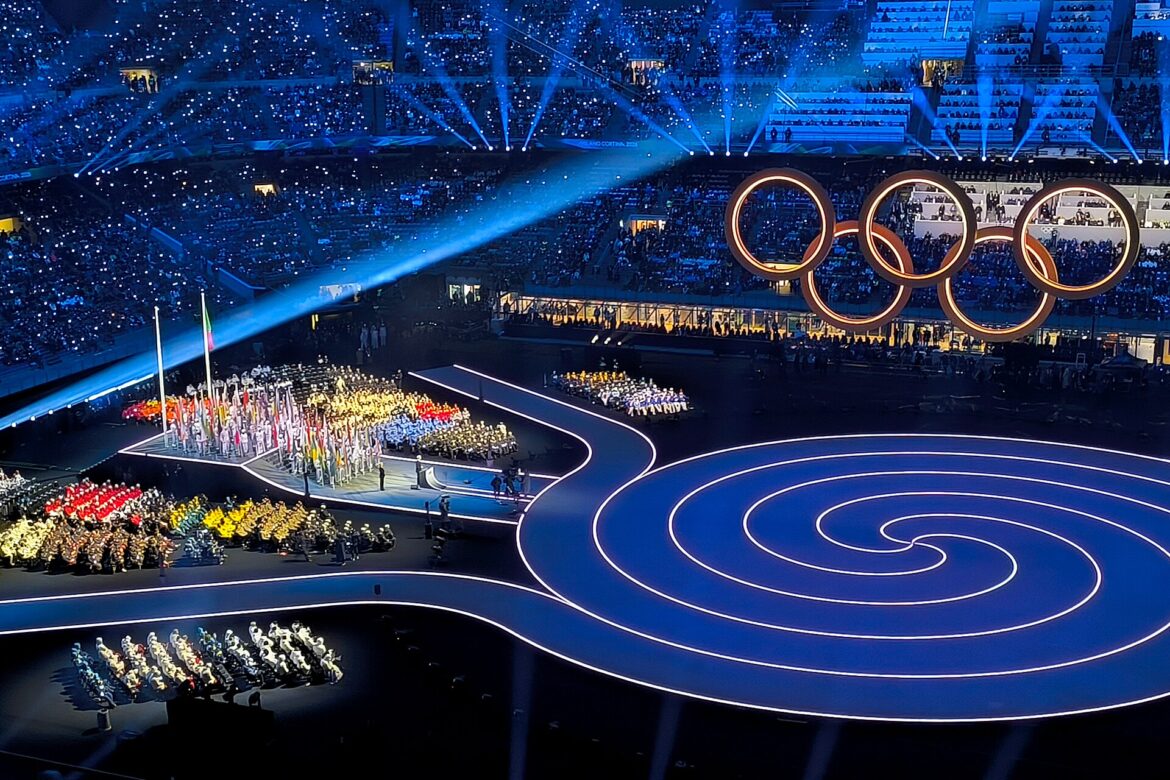
Politics has not evaded the presumably neutral Winter Olympic Games. While the International Olympic Committee (IOC) strives for the Games to be apolitical and forbids athletes from engaging in political statements during competition, athletes nonetheless used their platforms during press conferences and between competitions to voice their opinions on current political issues.
Due to Russia and Belarus’ involvement in the war in Ukraine, the IOC banned both countries from having athletes representing them at the Games, but the Committee published in September 2025 rules outlining the implementation of an Individual Neutral Athlete team. Belarusian and Russian athletes were thus able to compete, but without the possibility of flying their country’s flag or officially representing their country, and they were also required to meet certain criteria and be eligible. The athletes were also prohibited from competing if they took a public stance supporting the war. Russia and Belarus are also unable to have athletes representing them in team events, such as hockey.
American politics has also taken the stage at the 2026 Milano Cortina Winter Olympics. Amidst the recent violence and murders in Minnesota caused by Immigration and Customs Enforcement (ICE) officers, American athletes are faced with the difficult task of balancing representing their country, whose government policy they might not agree with. Several athletes have spoken out against the Trump administration and in condemnation of ICE, including freestyle skier Hunter Hess from Bend, OR, Californian snowboarder Chloe Kim, snowboarder Maddie Mastro, and skier Mikaela Shiffrin. After Hess voiced his opinion on what he is representing as an American athlete at the Olympics, President Trump claimed he was a “real loser” and should not have been on the team.
Hess, like Kim and Shiffrin, had stated he does not stand for the current administration and “doesn’t represent what’s going on”. The immediate attack by Trump was unprecedented, and many American and international Olympians voiced support for Hess. Faced with politically loaded questions from the press, these athletes’ responses showed diplomacy while staying true to their values. Kim and other athletes have said they are proud to represent their country, yet at the same time do not agree with the current government policy. Mastro also emphasized the importance of unity and compassion to combat injustice, highlighting the importance of not “turning a blind eye”.
Moreover, the IOC has taken action against athletes not respecting the rule to remain apolitical in competition. Ukrainian skeleton athlete Vladyslav Herskevych was banned from competing due to the images on his helmet showing war victims killed by the Russian invasion. Herskevych wore the helmet in competition despite the IOC’s warning, which caused the ban to be issued.
Herskevych’s ban also raises the broader question of what the IOC considers a political statement, and whether it is feasible for future Olympic Games to continue operating apolitically with athletes being punished for speaking out. Their position is inherently political as they represent their country on the global stage, and athletes want to maintain their right to free speech, yet with recent rules such as those of the IOC for these Olympics, athletes’ rights are up for debate.
Edited by Gita Kerwin
This is an article written by a Staff Writer. Catalyst is a student-led platform that fosters engagement with global issues from a learning perspective. The opinions expressed above do not necessarily reflect the views of the publication.
Sonia Modha is in her first year at McGill, pursuing a B.A. in International Development and a minor in Anthropology. She is interested in international political theory and public policy. Sonia is excited for her first term as a writer on Catalyst.