
In social science, gender is a crucial concept, as it addresses the link between social norms and one’s idea of masculinity or femininity, and holds an essential part in the construction of human beings as individuals, through gendered socialisation. However, the use of gender in understanding social dynamics does not stop at the individual or community level. In this article, I argue that gender is also relevant in terms of state and global-level affairs, and that it is a foundational network of norms on which wars, state identity, and international cooperation are built.
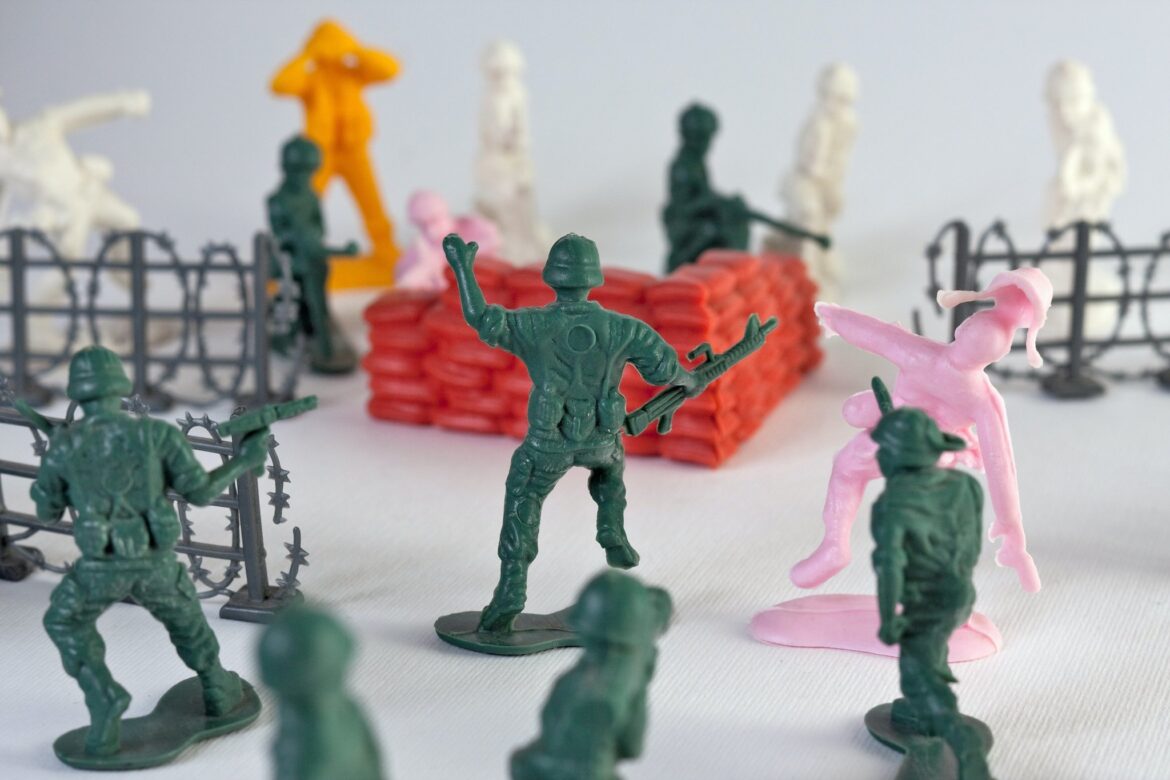
Gender is essential to understanding worldwide conflicts. The idea of men fighting wars seems to transcend cultural and temporal backgrounds. Yet, why would this idea be self-evident? Some argue it is based on biological factors; some disagree and say it’s only a social construct, and some argue it is a bit of both. What is useful to take away from these debates is the idea that gender is at the center of the notion of war, particularly through the notion of militarised masculinity, the process in which masculinity – what it means to be a man – is actively made compatible with the idea of fight, domination, and conflict. In concrete terms, one main step of the militarisation of men is getting rid of their natural reluctance to kill. Through appealing to their sense of manliness, but also to their patriotism, men are pushed to enter this process that makes them soldiers. The idea of militarised masculinity spreads to all aspects of society, making the military an essential part of institutions and something identities depend on. Militarised masculinity is significantly useful to understand interstate violence and how it is sustained, meaning how states can find men to replenish their ranks, despite war being known for its horrific aspects.
Beyond conflict, gender also shapes how states understand power and leadership. Indeed, it plays a central role in the construction of state identity. A notion that goes a long way here is hegemonic masculinity, which adds depth to the concept of masculinity by organising different conceptions of masculinity and femininity in a hierarchy. On top are the Western elites, and, below, are subordinated masculinities, such as those of the colonised man, of the man of colour, or of the gay man. The dominant masculinity is sustained through the oppression of these devalued masculinities, as well as that of subordinated femininities.
Hegemonic masculinity acts as an organising principle in decision-making. This concept is relevant both at the national and international levels. Hence, when a state leader takes office, they enter a world where their role has pre-existing expectations that go beyond their gender and race. They have to embrace the idea of hegemonic masculinity, using its codes as much as they can. This has consequences not only on how candidates and leaders present themselves, but also on the state-level decision-making, sometimes at the international level. In diplomacy, states are subjected to the same type of expectation – assertiveness, domination, protection – as one can find in individual-level ideas of masculinity. Their behaviour, both in front of other members of the parliament in domestic-level situations and in diplomacy, is an example of how a leader, despite not corresponding perfectly to the ideal image of hegemonic masculinity, can embrace and use its norms. The Falklands war, for example, characterised by Thatcher’s strong military response to the Argentine junta’s invasion of the islands, is an example of how norms that pertain to masculinity shape the world.
Gender also matters in moments of crisis and protection. Going beyond the idea of state behaviour, it plays a central role in shaping international perception and response to humanitarian crises. This is done most importantly through the notion of vulnerability, both directly linked to gender and a constitutive element of international law, having a direct impact on how crises are dealt with. Indeed, the assumption of women and children being more “vulnerable” to violence is central to the way aid is provided, in that it will often put the priority on protecting them. These assumptions must be nuanced with knowledge on the context, though, as shown in the case of the Srebrenica massacre, where the international community’s actions were focused on evacuating women and children from the zone when the ones who were at risk – and who ended up getting killed – were the men and boys.
Additionally, the notion of gender can deepen one’s understanding of how the international community perceives refugees. Indeed, in this situation, women tend to be seen as agency-less actors, and their experience tends to be reduced to sexual and gender-based violence, making it impossible to conceive a more complex experience of victimhood alongside agency. Gender helps shed light on how the approach to both humanitarian crises and refugee experience can oversimplify complex realities.
Gender holds an essential place in one’s understanding of today’s society, as state identity and behaviour, as well as the international community and law, are built on ideas of masculinity and femininity. We would collectively benefit from using gender as more than a simple “add-on” to the study of international relations. Overall, ignoring gender leads to a misunderstanding of global power.
Edited by Lou Didelot
This is an article written by a Staff Writer. Catalyst is a student-led platform that fosters engagement with global issues from a learning perspective. The opinions expressed above do not necessarily reflect the views of the publication.

I’m in my third and final year at McGill University, pursuing a B.A. in Political Science and International Development Studies. I’m particularly interested in social justice, political ecology, feminist theories, and the study of fascism.