
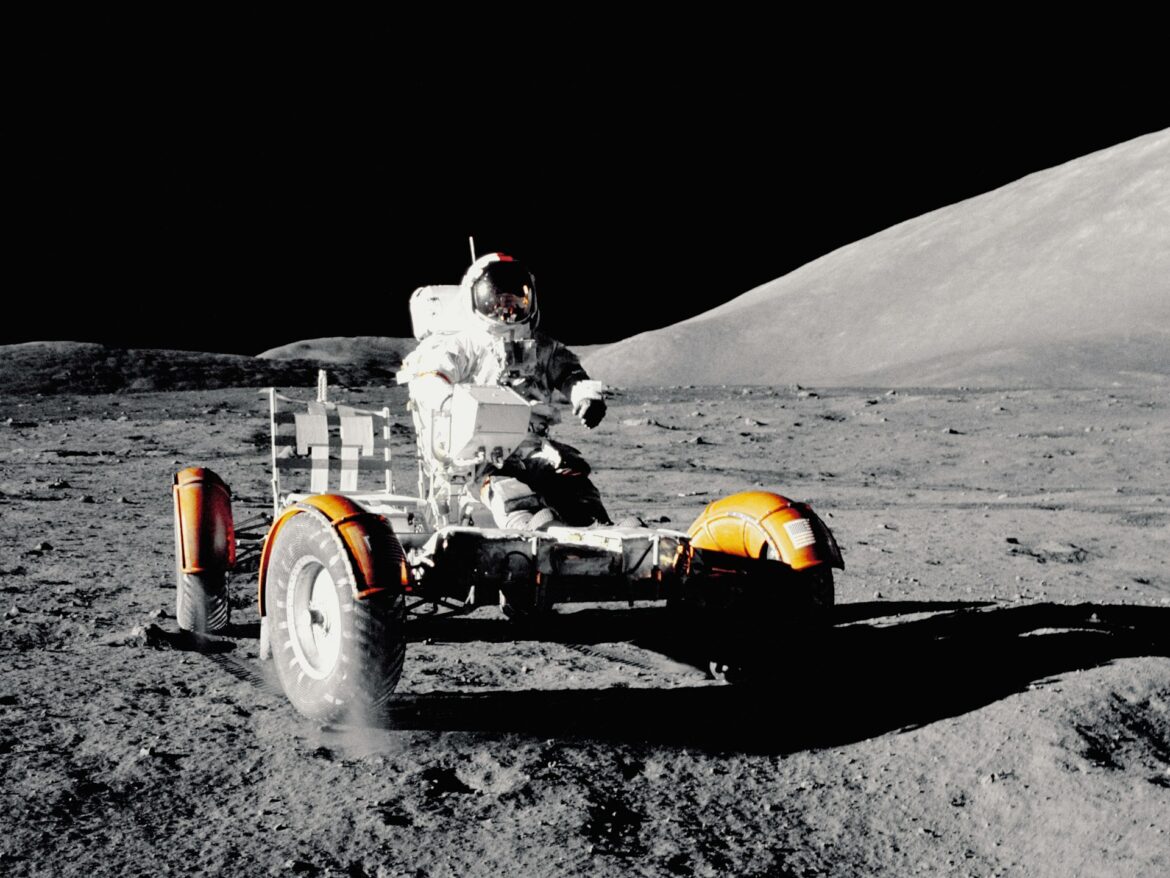
The 1967 Outer Space Treaty declared space as a “province of all mankind”. Fifty-nine years later, the head of NASA nominated by Donald Trump, Jared Isaacman, is promising that the United States will beat China to the moon before the end of President Trump’s term in 2028. This renewed space race began on April 1, 2026, when four astronauts boarded the Orion Capsule and completed a successful 10-day journey around the moon. The primary objective of the mission was to test key systems vital to a future moon landing.
Artemis II was the first crewed mission of NASA’s broader Ignition Moon Base Program, an ambitious effort to not only return humans to the moon’s surface, but to establish a sustained presence there and to lay the foundation for an eventual exploration of Mars. Media coverage of the mission certainly celebrated the crew’s impressive historic achievement, but less emphasized was the mission’s core implication: the moon is once again a contested priority, and who gets there first has consequences that reach far beyond purely scientific goals.
The United States and China are the clear front-runners of the renewed race. The two powers exemplify an interesting structural tension between their contrasting organizational models. While the U.S-led Artemis program represents a multinational partnership between NASA, the Canadian Space Agency, the European Space Agency, and the Japan Aerospace Exploration Agency (JAXA), China’s lunar program is characterized by centralized state leadership and long-term planning. Further, the American approach relies on partnerships with private aerospace companies, whereas China’s model reflects sustained government investment guided by national objectives. As funding is NASA’s foremost challenge in executing its projected ventures, the agency is relying heavily on the private industry. Billionaire Jeff Bezos’ company, Blue Origin, is contracted to construct robotic landers, and Elon Musk’s company, SpaceX, is contracted to build a spacecraft capable of safely transporting humans to the moon’s surface. Unlike the U.S, whose lunar deadlines have become more closely tied to political agendas rather than scientific performance, China has set a target of returning to the moon by 2030 that commands genuine credibility. China’s consistency is evident — since 2021, the country’s space agency has successfully sent a rotation of astronauts to its Tiangong space station for six-month stays.
Artemis not Apollo
During the Cold War “Space Race,” the United States and the Soviet Union competed to achieve symbolic milestones in order to assert their global supremacy. The brinkmanship inherent in the broader ideological rivalry between the two nations resulted in a series of landmark achievements: the launch of the first artificial satellite, the first crewed orbit of Earth, and ultimately, the first moonwalk. The renewed space race differs dramatically from the competition of the mid-twentieth century. The goal of the modern space race is permanence, not spectacle, advantage, not pride. Today, the contest is less of a “nationalist enterprise.” What is at stake reaches far beyond glory and reputation. The first country to establish a form of permanent settlement on the moon will enjoy a significant strategic advantage in defining the technical standards, data formats, and operational language of future space explorations.
Russia, once the dominating power in space, is now on the sidelines. Roscosmos, the Russian state corporation for space activities, is underfunded and largely stagnant. While Russia realistically cannot compete with American or Chinese ambitions to settle the moon, it may be able to meaningfully contribute to this evolved era of space exploration through its expertise in building nuclear power plants. Both the U.S and China plan to involve partners in the construction of their lunar bases, as transporting the materials for such an endeavour is far beyond the capabilities of any single country. Russia’s experience in building nuclear power plants may prove useful in either the U.S. or China’s efforts to generate nuclear power in space.
Furthemore, the rivalry is no longer ideological as it was during the Cold War. It is now material. The moon has re-emerged as contested territory for reasons that resemble almost every other competition for unclaimed territory in human history: resources and expansionism. Evidence of rare earth metals and substantial reserves of water ice have been identified near the moon’s south pole. These resources present the potential for considerable economic value through future extraction, but may also ease the pressure on space agencies to transport all necessary materials from Earth. Water ice, for example, can be broken down into hydrogen and oxygen, which is used in rocket fuel. The drive for resources, however, is inseparable from the broader impulse of expansionism. Establishing a permanent presence on the moon may serve as a critical stepping stone for deeper space exploration. Both the United States and China view the moon as a potential launch pad for future missions to Mars. Additionally, the moon is vital to military positioning. As satellites become increasingly essential to communication, navigation, warfare, and daily life on Earth, the ability to protect or potentially disrupt space-based assets has become a major geopolitical focus. Without satellites, international communication networks, emergency services, ship navigation, and countless everyday services would fail to operate.
Earthly Implications
Unfortunately, the narrative that space is a domain of miraculous unification, as often portrayed in sci-fi films and media, fails to reflect the geopolitical competition that currently defines the territory. As a civilization, we now stand at a pivotal juncture, attempting to extend human settlement beyond Earth. Will we produce the same territorial logic that has defined human politics for centuries? Or is there still a possibility of space becoming the common ground that we have failed to foster on Earth? Will humans continue along a disappointing trajectory of division and greed, or will they finally embrace collaboration in an unprecedented opportunity to confront the existential challenges facing civilization?
Edited by Abigail George
This is an article written by a Staff Writer. Catalyst is a student-led platform that fosters engagement with global issues from a learning perspective. The opinions expressed above do not necessarily reflect the views of the
publication.

Natalia Sodhi is in her third year at McGill University, currently pursuing an Honours B.A. in International Development Studies with a minor in Urban Geography. She serves as a staff writer for Catalyst and is particularly interested in the global refugee crisis, international migration flows, and sustainable urban development.