
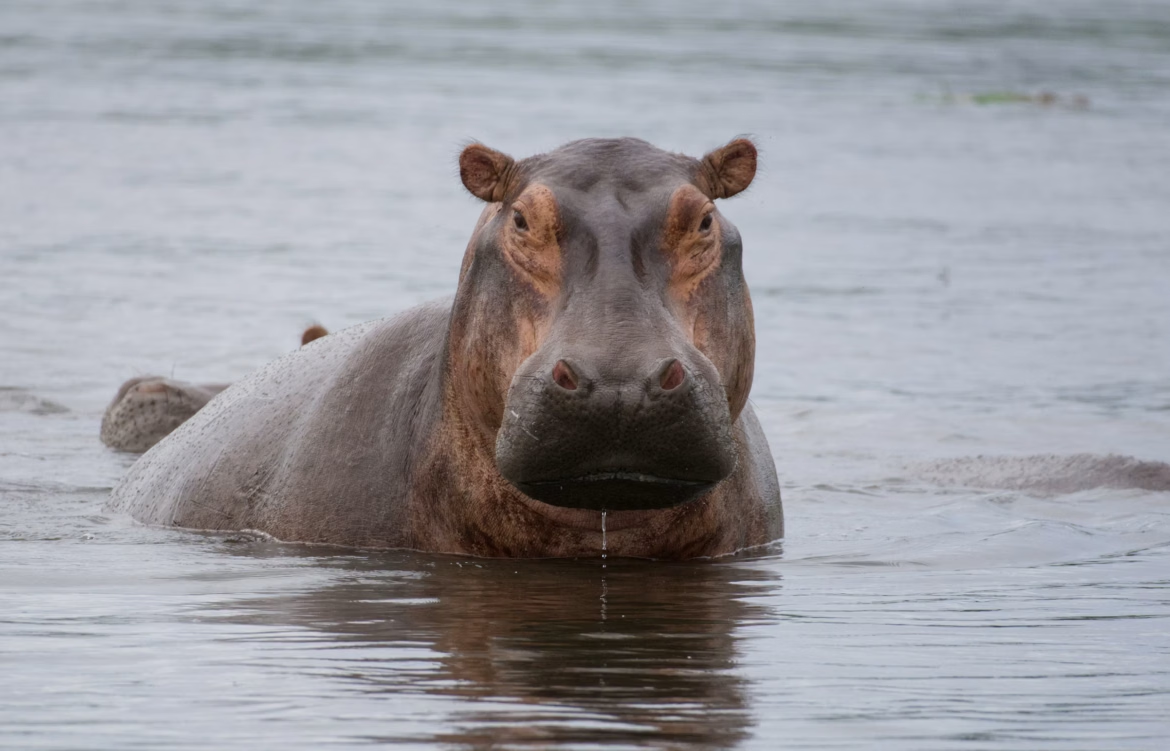
The “Cocaine Hippos” of Colombia have become an issue of increasing concern for government officials and civilians alike. The troubled history of these creatures evokes a certain sympathy, and must be understood to grasp the precarious position the Colombian government finds itself in today.
Pablo Escobar, the most powerful drug lord in the 1980s, had a long history of illegal involvement, from stealing cars to reselling tombstones. As the cocaine industry expanded into Colombia in the 1970s, he played a significant role in the formation of the Medellín cartel. At its peak, the cartel was responsible for 96 percent of the cocaine entering the United States, and profited around 100 million dollars per day. After taking over the organization, Escobar’s net worth was said to have settled around 25 billion dollars (USD). It was with these funds that Escobar initiated his menagerie, seen as a demonstration of status and power.
Amongst ostriches, lions, and other exotic creatures, four hippos were transported from the US to Hacienda Nápoles, where the menagerie was located. Three females and a single male reproduced to about 10 or 12 by the time of Escobar’s death in 1993. After his passing, the menagerie was raided by civilians looking for loot left behind by the convict. Staff fled the scene, and the animals were left to their own devices. Relocation efforts were initiated shortly after, addressing all animals besides the hippos.
Deemed too large and dangerous, no effort was made to remedy the hippos’ presence in the novel environment. Male hippos follow a cycle of attempting to become the alpha by attacking the leader of their “pod,” and are then ostracized from the group. As time went on, more hippo pods were initiated by the ostracized males, expanding across an unprecedented area. Over 40 years later, the numbers have increased to approximately 200 and have been found up to 60 miles away from where they were originally kept in Hacienda Nápoles. Evidently, the avoidance of the problem decades ago has resulted in something nearly impossible to tame.
It is generally acknowledged that hippos pose an immense threat to the people and native species settled along the Magdalena, carrying parasites and zoonotic diseases. On top of oxygen levels and sedimentation rates being affected, hippos compressing the bottom of rivers alters hydrology in the landscape. Local economies are threatened as well when agricultural products are destroyed or consumed by the creatures.
Alternative sources suggest that the hippos may, in fact, be benefitting the ecosystem and the economy. Colombian locals worry that the removal of the hippos will drive down tourism in the region. Proponents of leaving the hippos as they are claim that they exemplify a combination of traits that now-exstinct large herbivores once brought to the habitat. The type and quantity of the plants they eat, and the amount of nutrients they return to the environment through excretion, are remarkably similar to those of past native species. Despite these optimistic views, the consensus remains that these animals pose problems that must be dealt with.
Authorities and conservationists have attempted culling, chemical castration, and euthanasia to no avail. The hippos have expanded across such a great area that grouping them is infeasible. Chemical castration requires two doses months apart, and keeping track of the hippos that received the first dose has proven to be relatively impossible. Castration initiated by tranquillizers is likewise implausible as the drugs take time to take effect, and shadowing the animals would put the veterinary team at risk. In the 2000’s, a professional hunter was hired to kill one of the hippos, but chaos ensued. Protests took over the country, and officials got a taste of how beloved the creatures had become.
Hippos, according to the World Wildlife Fund, are classified as vulnerable. This adds an extra layer of consideration that must be applied to the handling of these animals. Humans and ecosystem destruction are their greatest threats, the combination of which has rendered hippos virtually extinct in three African countries. All things considered, relocation efforts may seem like the best course of action. However, past attempts have left much to be desired. In 2023, a relocation effort was initiated and projected to cost 3.5 million dollars. The plan fell through, and genetic problems due to inbreeding have since made the animals unattractive to zoos and other facilities.
It is worth noting that Hippos have seemingly thrived in this new environment, arguably even more so than in their native land. In Colombia, the hippos spend far more time out of the water, as their sensitive skin appreciates the humid climate. The region suits their lifestyles remarkably well, perpetuating rapid reproduction. Though valuable for the creatures, spending increased time out of the water means that human-hippo interactions are more frequent, prompting dangerous encounters. Excretion from the creatures lessens the water quality and kills off a variety of fish native to the area. Capybaras and manatees are amongst other species affected.
The presence of hippos in a non-native environment has brought about unique challenges that will require an unprecedented solution. The issue is, the more time is wasted, the less likely it is that a solution will be effective.
Edited by Sofia Figueredo Prieto.
This is an article written by a Staff Writer. Catalyst is a student-led platform that fosters engagement with global issues from a learning perspective. The opinions expressed above do not necessarily reflect the views of the publication.

Catherine Hearle is in her second year at McGill studying Philosophy and Economics. She has been a staff writer for Catalyst since February 2026, and is particularly interested in the intersection between religion and politics.