
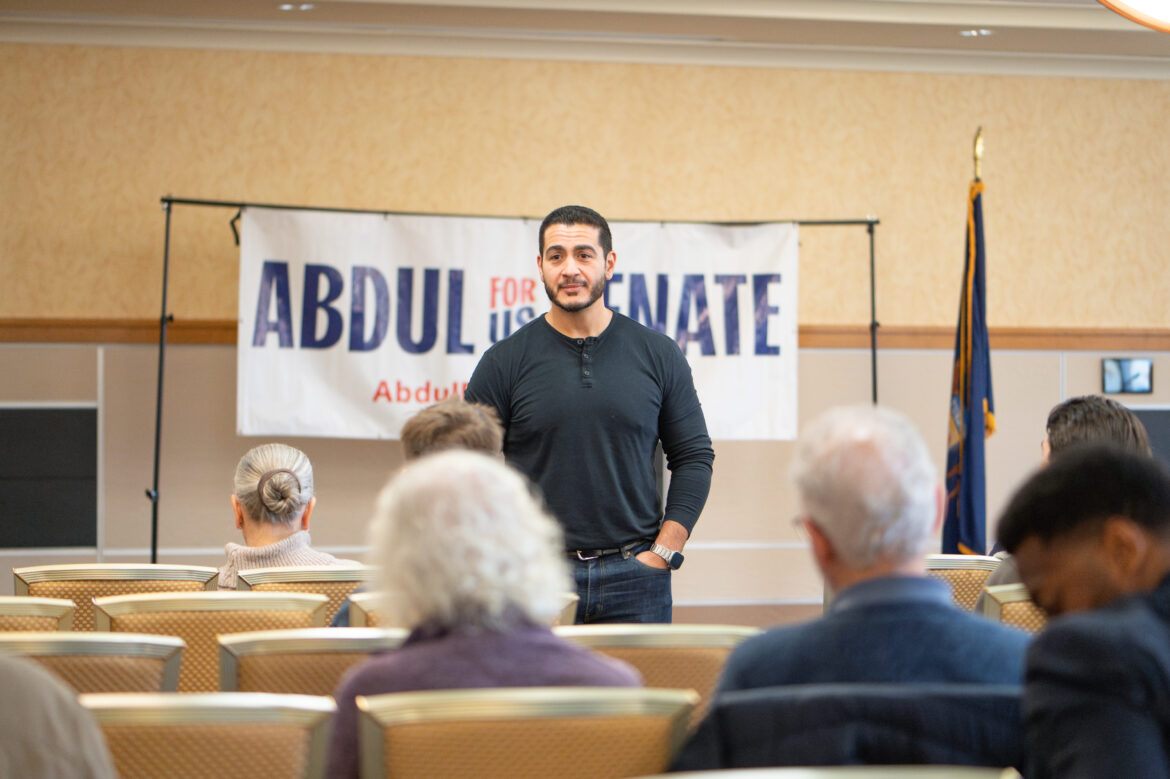
On November 4th, 2026, the day following the US midterm election, Abdulrahman Mohamed El-Sayed was elected as Michigan’s Democratic senator and the first Muslim senator to be elected in US history. Those historic results are even more impressive as Michigan is a swing state, which means that, depending on the year, Democrats or Republicans are both likely to win. When giving his victory speech, El-Sayed thanked the voters for taking a “chance on the unluckiest of candidates”. His victory is particularly significant because he is the son of Egyptian parents and embraces his Muslim identity in a country controlled by an Islamophobic and anti-migration president. Today, we will be asking ourselves if Abdul El-Sayed’s victory represents a rejection of Trump’s politics, and whether it could be part of a broader international Democratic shift.
MIDTERM ELECTION THAT RESHAPED US POLITICS
The midterm election marks the halfway point of Trump’s second term as president. The midterm elections are held to decide who controls Congress, which is divided between the House of Representatives and the Senate. Congress represents the legislative power of the country, meaning that it controls lawmaking. In this case, the results of the election have allowed Congress to flip, meaning that both the Senate and House of Representatives have gone from a Republican majority to a Democratic one. This means that it is now harder for Republican legislation to be passed, which drastically reduces Trump’s power over the country. This year’s midterm election was also marked by various historic results on top of El-Sayed’s historic victory. For example, in Texas, a a Democratic senator was elected for the first time in over 30 years. On top of that, in Georgia, Keisha Lance Bottoms got elected, making her the first Black woman governor of a U.S. state. In New Mexico, Deb Haaland became the first Native American woman governor of a U.S. state. Additionally, Chris Pappas is now the first openly gay man to be elected to the Senate. Those are just a few examples among many others.
A REJECTION OF TRUMP’S POLITICAL AGENDA
Trump urged people to “pretend I’m on the ballot” when voting, and the people clearly did. When looking at polls, it shows that Trump’s approval in the country has gone from 51.6% in January 2025 to 36.5% in November 2026. This increasing disapproval could be interpreted as American citizens being dissatisfied with Trump’s presidency and the impact that he has on their everyday lives. Additionally, since Trump became president, the Republican Party has increasingly shifted to right-wing populism. The recent loss of the Republicans could signify a broader rejection of this radicalization rather than a rejection of Trump alone. In this sense, the Democratic victory in the midterm election marks the failure of the current far-right in the US, which could influence the potential wave of Democratic values for the 2028 presidential election.
ABDUL EL-SAYED: SYMBOL OF POLITICAL HOPE
More than a simple political victory, his success in becoming a senator in Michigan represents a wish for concrete policy change and greater political diversity in the country currently ruled by a Republican president. Just based on his identity, Abdul El-Sayed is everything that Trump has told Americans to hate. He is not white, not Christian, and doesn’t hesitate to make his position known loudly. For example, he clearly stated that he is against the economic support of Israel and said in his victory speech: “We don’t want our money sent to apartheid, or genocide, or war.” Such claims are new to a country that has supported Israel economically since the State was created. His victory may also reflect voters’ desire for healthcare reform in Michigan and in the US as a whole. Indeed, El-Sayed has built his campaign around a proposed universal, publicly funded healthcare, known as “Medicare for All”. This would make healthcare operate under a single-payer system where most medical care would be paid for by the federal government, largely reducing the need for private healthcare insurance. His win suggests a hopeful moment of change, within a country more open to change than what recent politics has implied.
A BROADER INTERNATIONAL DEMOCRATIC WAVE
The midterm election is not the only example of Democratic values taking over politics against the far-right. On October 25, 2026, Lula in Brazil won the presidential election against the son of Brazil’s former far-right president. On top of that, in April 2026, Hungarians voted in a parliamentary election, defeating Viktor Orbán, marking the end of 16 years of the far-right authoritarian regime. The USA, Brazil, and Hungary are all examples of countries that are or were under the presidency of a far-right head of state. Yet we observe a wave against it. In all three cases, electoral outcomes have challenged political movements associated with nationalism, far-right ideology and authoritarian tendencies. This suggests that people can mobilize against political agendas they no longer support. Yet there is still a paradox. In Europe, Italy elected conservative populist Giorgia Meloni; in France, the Rassemblement National keeps growing as we get closer to France’s next presidential election, in April 2027. This suggests that political trends don’t follow a one-size-fits-all model but that politics evolves in different parts of the world. In some places, far-right party influence continues to expand, while in others, progressive movements reject it. It seems that countries are witnessing different waves of political trends in different parts of the world. Abdul El-Sayed is therefore an example of a progressive Democratic movement fighting against the far-right.
IMPLICATONS
More than an individual political success, Abdul El-Sayed might represent a rejection of Trump’s political agenda and an embrace of political diversity. It represents hope for a potential Democratic president to be elected in 2028 in the US. Yet the U.S. midterm election, along with other victories in Brazil or Hungary, cannot simply be interpreted as a wave of Democratic values over the whole world. As we’ve seen, increasingly popular far-right parties are proving that this political shift is not universal or irreversible.
Edited by Lou Didelot
This is an article written by a Staff Writer. Catalyst is a student-led platform that fosters engagement with global issues from a learning perspective. The opinions expressed above do not necessarily reflect the views of the publication.

Amélie is in his second year at McGill University, currently pursuing a B.A. Honors in International Development Studies with a double minor in Political Science and Hispanic Studies. This year is her first year as as a Staff Writer for Catalyst. She is particularly interested in the politics of migration and the rise of far-right politics.