
In recent years, the rise of Hindutva extremism in India has reshaped the country’s democratic foundations, mirroring the ethnonationalist strategies employed by Israel to justify settler-colonialism and systemic oppression. This article examines how India, long mythologized as a secular democracy, is increasingly adopting exclusionary policies that echo Israel’s treatment of Palestinians. From the ideological weaponization of religion to the structural disenfranchisement of minorities, Hindutva’s rise draws troubling inspiration from Zionist policies and the global silence surrounding both.
Hindutva – the political ideology advocating for Hindu supremacy – has been embedded into the political ethos of India, particularly under the leadership of Prime Minister Narendra Modi and the Bharatiya Janata Party (BJP). This ideology is not Hinduism: it is a politicized, exclusionary project that seeks to erase the pluralism that historically defined the Indian subcontinent. Similar to Zionism—a political ideology often conflated with Judaism but fundamentally distinct from it, and presented as a protective project for Jewish people—Hindutva frames itself as a cultural renaissance while actively marginalizing Muslims, Christians, Sikhs, and Dalits.
The trajectory of this extremism has involved state-sanctioned violence, the rewriting and erasure of history, and increasing control over media narratives – tactics disturbingly similar to Israel’s justification of its apartheid and genocidal policies. Just as Israel constructs a narrative of self-defense to excuse the occupation of Palestinian lands and the bombing of civilians, India deploys the rhetoric of national security to justify lynchings, demolitions, and surveillance of its Muslim population.
What both countries share is a political logic that dehumanizes the ‘other’ while appealing to international allies under the guise of democracy and modernization.
The Citizenship Amendment Act (CAA) of 2019 exemplifies this. It marked a shift from India’s secular legal tradition, which historically defined citizenship without regard to religion. By introducing religion as a criterion for citizenship and explicitly excluding Muslims from refugee protections, the CAA upended constitutional commitments to equality. This statute, coupled with the National Register of Citizens (NRC) in Assam, left millions stateless, primarily Muslim citizens. This mirrors Israel’s Law of Return, which automatically grants citizenship to Jews worldwide while denying the right of return to millions of displaced Palestinians. In both cases, citizenship becomes a weapon to consolidate ethnonational and religious dominance.
India’s media landscape has undergone a radical transformation, much like the Zionist influence in Western media narratives. Indian news outlets, increasingly controlled by Hindu nationalist conglomerates, amplify state propaganda while silencing dissent. Muslim victims of violence are often framed as aggressors, and any criticism of the state is branded as ‘anti-national’ – a label dangerously similar to the accusation of ‘antisemitism’ used to silence critics of Israel’s occupation. Dissent is not only delegitimized but criminalized.
The abolition of Article 370, which revoked the autonomy of Jammu and Kashmir, serves as a disturbing parallel to Israel’s annexation of Palestinian land. The military lockdown of Kashmir, communication blackouts, and mass detentions are textbook examples of settler-colonial control. Kashmiris, like Palestinians, are portrayed as inherently violent, justifying their constant surveillance and military occupation. India, like Israel, has turned a disputed territory into a sick experiment for digital authoritarianism, policing, and occupation.
There is also the deliberate destruction of cultural and religious heritage sites. The demolition of the Babri Masjid and the state’s complicity in building a Ram Mandir in its place is akin to the destruction of Palestinian homes and mosques in East Jerusalem to make way for Jewish settlements. In both cases, religious majoritarianism is enacted through physical and symbolic violence, reshaping land and memory to fit the narrative of the dominant group. Future generations in India will associate the site of the Ram Mandir with a Hindu nationalist narrative, rather than its original purpose as a sacred space carrying centuries of Muslim history and community significance – a transformation legally sanctioned by the Indian Supreme Court in its 2019 verdict on the Ayodhya dispute.
However, it is important to point out that these tactics are nothing new. The persecution of minorities in India has historical roots, especially in the case of Sikhs. In 1984, following the assassination of Prime Minister Indira Gandhi, thousands of Sikhs were massacred in a state-sponsored genocide that has still not seen justice. The complicity of political leaders, the failure of police intervention, and the subsequent lack of accountability created an atmosphere where mass violence against a minority group was normalized. Even today, Sikhs continue to face profiling, arbitrary detentions, and silencing—especially those who speak up for human rights or advocate for Sikh sovereignty. Farmers’ protests in 2020 and 2021, which were predominantly led by Sikh farmers, were met with defamation campaigns labeling them as ‘Khalistani terrorists.’ This deliberate framing reflects a continuing project to criminalize Sikh political identity and dissent. The same patterns of impunity and state protection now shape responses to anti-Muslim violence, institutionalizing and normalizing a consistent strategy of sustaining majoritarian aggression while denying justice to targeted communities.
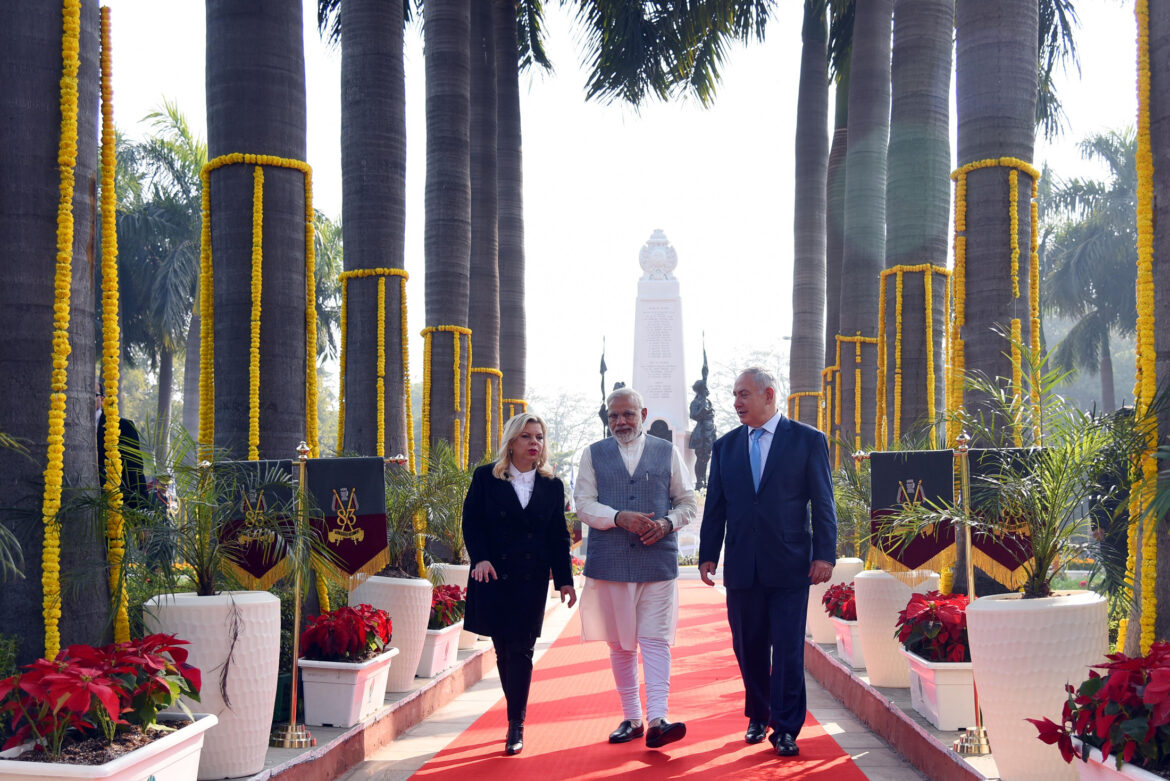
Internationally, India’s growing alliance with Israel is not coincidental. It is strategic. The two states engage in mutual exchange of surveillance technologies, counter-insurgency strategies, and diplomatic support. India is now one of the largest buyers of Israeli arms, many of which are ‘battle-tested’ on Palestinians. These technologies are then deployed in Kashmir and across India to suppress dissent. This arms-for-ideology trade has created a disturbing convergence of ethno-nationalist states that legitimize each other’s violence.
The global response to India’s democratic backslide, much like the response to Israel’s apartheid regime, has been underwhelming to say the least. Western states, particularly the United States, continue to court India as a strategic ally, emphasizing and prioritizing trade and security over human rights –as seen in initiatives like the Quad alliance and recent defense agreements such as the U.S.-India Initiative on Critical and Emerging Technology (iCET). This selective outrage, rooted solely in geopolitical convenience, perpetuates the suffering of India’s minorities. The Muslim, Dalit, Sikh, and Christian communities are sacrificed at the expense of diplomatic alliances and economic interests.
Language, once again, plays a central role. Just as the Western media refers to Palestinian children as ‘human shields’ or ‘collateral damage,’ Indian media often describes Muslim protestors as ‘rioters’ or ‘terrorists.’ Words like ‘radical’ are weaponized to strip entire communities of their humanity, normalizing the mass acceptance of state violence. This linguistic manipulation is a powerful tool in both contexts – not only justifying current atrocities but erasing histories of coexistence, resistance, and diversity.
Until Hindutva extremism is acknowledged for what it is – a violent, fascist project echoing global patterns of ethnonationalism – India will continue its descent from a secular republic into a theocratic autocracy. The world must confront this reality not as a matter of regional politics, but as part of a broader pattern in which far-right governments deploy religion, fear, and violence to maintain power. Silence, especially from so-called liberal democracies, is complicity.
India, like Israel, is not simply failing its minorities, it is actively endangering them. Until the world stops framing these issues as bilateral conflicts or internal matters, the project of justice will remain unfinished.
Edited by Minaal Mirza
Disclaimer: This is an article written by a Staff Writer. Catalyst is a student-led platform that fosters engagement with global issues from a learning perspective. The opinions expressed above do not necessarily reflect the views of the publication.

Kirit Ghumman is a third-year Political Science student at McGill University, pursuing a minor in International Development Studies. As a Staff Writer for Catalyst, she explores the intersections of international politics, migration, and human rights, with particular focus on refugee law, statelessness, and global power asymmetries. Her writing aims to unpack how state policies and international alliances impact marginalized communities—especially those displaced, silenced, or rendered invisible. At Catalyst, Kirit is committed to producing deeply researched, critically engaged work that centers justice, accountability, and the lived realities of those most affected by political violence.