
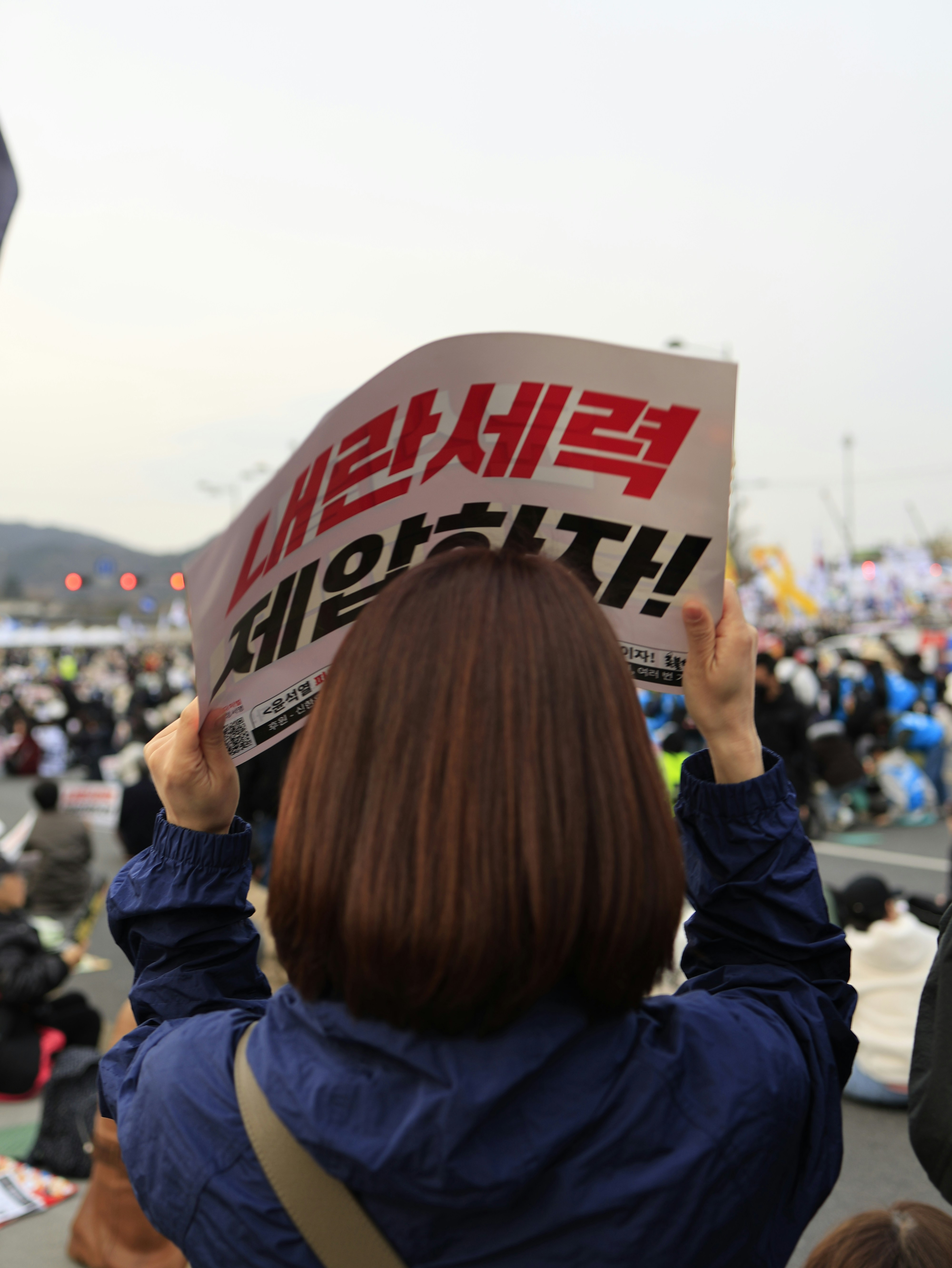
Anti-feminist and incel ideologies have moved from fringe internet spaces into the heart of South Korean politics, fueled by economic frustration and gender resentment. Politicians have now weaponized male discontent, sidelined feminist discourse, and turned institutions like the Ministry of Gender Equality into political targets. Despite this, young women continue to resist through activism and cultural protest, redefining what democratic participation looks like in South Korea today.
When South Koreans headed to the polls in the recent June 3rd election, they were not only choosing a leader. They were also participating in a wider cultural reckoning. What was once considered fringe ideology—online misogyny, incel culture, and anti-feminism—has entered the mainstream, driven by political incentives and social disillusionment. Politicians, eager to court votes from disenchanted young men, amplified divisive narratives that pit genders against each other.
Misogyny, once confined to anonymous internet forums, is now being used as a calculated political strategy.
The Making of a Gender Divide
Over the past decade, South Korea has undergone profound social change. Feminist movements such as the 4B campaign emerged in response to tragedies like the 2016 Gangnam Station femicide, calling for women’s independence from patriarchal norms. To many young men, however, these demands for gender equality have felt like personal attacks on their identity and status.
Some argue that men are now the ones being left behind. They point to the high number of female university graduates as evidence that discrimination has reversed. With a soaring 78.4% university enrollment rate for women, 4% higher than male university enrollment rate, many men believe South Korean society has already achieved equality. In that context, affirmative policies toward women are seen not as necessary corrections but as unfair advantages. However, these numbers fail to account for the societal and qualitative barriers that women still face. With Ewha Women’s University being the first formal higher education in 1925, systematically and culturally under Confucian belief, women have been overlooked and belittled in academic settings. Just using numbers to discuss women’s rights is reductive and is like judging a fire by its smoke.
This belief is growing against the backdrop of economic uncertainty. The traditional salaryman role, once a source of pride and stability, has been undermined by years of slow growth and precarious job prospects. A sense of frustration is also fueled by the country’s mandatory military service, which many young men now view as outdated and burdensome. Korean Women’s Development Institute study of 3,000 adult men found that 72% of men aged in their 20s think male-only draft is a form of gender discrimination, with 65% believing women should also be conscripted and 68% believe it is a waste of time.
These feelings of alienation have found a home in online communities such as Ilbe and Pemco. These platforms promote narratives portraying women as materialistic, selfish, and parasitic. Feminists are dismissed as irrational or mentally ill. The language is harsh, but it resonates with a generation of men seeking someone to blame.

Screenshot from Ilbe, demonstrating misogynistic, anti-feminist rhetorics and conspiracy theories
Ilbe and Pemco echo chambers catalyze weaponization of male victimhood and starts to expand to other spheres– Politics.
Politics Meets the Manosphere
What makes South Korea’s situation especially alarming is the way these fringe ideas have been embraced by mainstream politicians. Former President Yoon Suk Yeol, for example, campaigned on a promise to abolish the Ministry of Gender Equality and Family. He claimed feminism was disrupting “healthy relationships between men and women.” His message struck a chord with young male voters. A 2021 survey found that nearly 80 percent of men in their twenties felt “seriously discriminated against” because of their gender.
Other candidates followed suit. Lee Jun-seok, a former party leader and now the face of a new Reform Party, has gained popularity by appealing directly to this demographic. He frequently cites incel talking points in debates and interviews. His comments often spark outrage, but they also boost his visibility among male voters who feel their frustrations are being ignored.
In contrast, left-wing figures like Lee Jae-myung are walking a fine line. Although he recognizes the activism of young women who rallied for Yoon’s impeachment, Lee avoids feminist rhetoric in order not to provoke male voters. As a result, gender issues are largely absent from public debate, despite being central to many voters’ concerns.
A Deeper Crisis Beneath the Surface
South Korea has the highest gender pay gap among OECD countries, with women earning 31 percent less than men. Traditional gender norms remain strong, with many still believing that a man who stays home to raise children is less masculine. This cultural foundation makes it difficult for feminist policies to gain traction, especially when politicians use gender equality as a scapegoat during campaigns.
The Ministry of Gender Equality and Family has become the main symbolic battleground. Despite managing essential services such as childcare and family support, the ministry is viewed by anti-feminist voters as an embodiment of special treatment for women. Calls to dismantle it are not about policy but about power and visibility.
Critics argue that the ministry was politicized by Yoon and turned into a symbol of gender conflict. Proposals to rebrand or restructure the ministry have been floated, including the creation of a “Ministry of Future Youth and Family.” So far, none of these proposals have gained wide support.
What Lies Ahead?
Women’s rights activists are not giving up. Many young women have turned to grassroots organizing and political protests, often adapting the energy of K-pop fan culture into coordinated activism.
“Into the New World” by Girls’ Generation, originally released in 2007, has since transformed into a powerful symbol of democracy in South Korea. Its political resonance began when students at Ewha Womans University used the song during protests against the university’s administration and its ties to then-President Park Geun-hye despite the administration mobilizing police forces. The immediate spark was the 2016 revelation that Chung Yoo-ra, daughter of Park’s close confidante Choi Soon-sil, had been admitted to the university despite not meeting academic requirements. To fight the fear of arrests, they started singing the song together in a narrow hallway, all linking arms.
Before the full scandal erupted, Ewha students had already been chanting the song in defiance of the administration’s unilateral changes to the degree system. “Into the New World,” once a hopeful anthem of youth, became a rallying cry for justice and transparency.
“In this world where sadness repeats
Goodbye to it from now on
In countless unknown paths
I follow a dim light
We’ll be together forever
The world where we meet again”
As protests intensified, young women in their twenties brought their LED K-pop light sticks to demonstrations in a show of solidarity. Once, candlelight symbolized public resistance; now, light sticks have taken its place as a modern emblem of collective power. During the rallies for 2016 Park’s impeachment, lawmaker Kim Jin-tae remarked dismissively: “Candle lights are just candle lights; the wind can easily blow them out.” Instead, the protests only grew stronger — brighter, louder, and led by a new generation with light sticks in hand.

Left: Protest resembles a K-pop concert Right: NewJeans lightstick with bandana written ‘Impeachment’
At the rallies demanding Yoon’s resignation, women in their twenties were the most visible and vocal participants.
Still, many feel trapped between political options. As Park Jia, director of a gender equality education center, puts it, “We only have poor options in this election. Women are voting to stop regression, not because they believe things will improve.”
South Korea finds itself at a crossroads. If political parties continue to prioritize short-term votes over long-term equity, the nation risks cementing deep divisions. Online anger is spilling into real-world policies, and unless leaders change course, the country may move further away from genuine gender equality.
This moment is not just about politics. It is about the values a society chooses to elevate. Whose voices are heard, whose grievances are legitimized, and whose rights are protected will shape South Korea’s future far beyond the ballot box.
This is an article written by a Staff Writer. Catalyst is a student-led platform that fosters engagement with global issues from a learning perspective. The opinions expressed above do not necessarily reflect the views of the publication.

A double major student studying psychology and international development at McGill. Born and raised as a third-culture kid, I’m interested in the intersection of global politics and culture. Outside of politics, I also enjoy watching old movies and listening to classical music. Currently watching season 3 of “The Summer I Turned Pretty” and is repeatedly listening to Edward Elgar.