
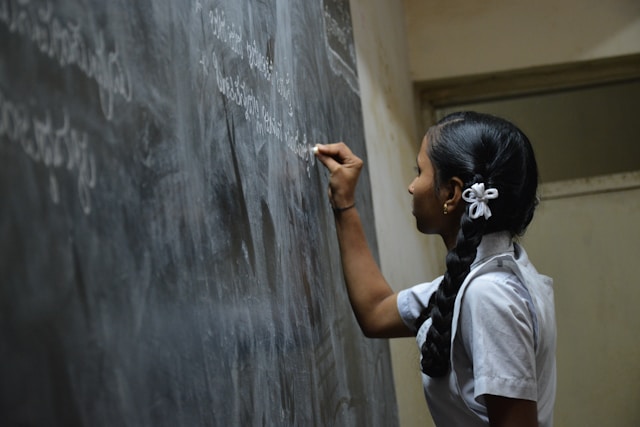
As the Taliban returned to power in 2021, Afghan girls have felt their futures slipping away with every passing moment. Schools have shut their doors while textbooks gather dust, and classrooms, which were once a symbol of hope, now echo with silence. In a country where the simple act of learning has now become revolutionary, Afghan girls are withstanding in the only way possible: by continuing to dream. Their resilience unfolds against the backdrop of what many activists and legal scholars now define as a gender apartheid, which is seen to be a system of governance that systematically excludes women and girls from public life solely based on their gender.
The Weaponisation of Education
The Taliban’s ban on secondary and university education for girls is not just a policy decision but an act of systemic erasure. Most Afghan women view this as a fight for recognition, dignity, and existence, not only for the fundamental right to education.
Prior to the fall of Kabul taking place in August 2021, Afghanistan had made exceptional progress in expanding educational access for girls. According to UNESCO, the enrollment of girls in primary school skyrocketed, from almost none in 2001 to over 2.5 million by 2021. Women in higher education saw similar progress as female university enrollment shot up from 5,000 in 2001 to over 100,000 girls enrolled by 2021. Such significant milestones reflected years of sustained effort by educators, international donors and the Afghan civil society to rebuild a new generation through learning and education.
And just like that, the Taliban returned. Within a matter of weeks, girls had been banned from secondary schools, while universities closed their gates to women. Accompanied by vanishing employment opportunities for women. The Taliban claimed religious justification by a strict interpretation of Sharia Islamic laws; however, prominent Islamic voices promptly countered. The Organisation of Islamic Cooperation (OIC) firmly stated that there is absolutely no basis in Islam for denying education to women and girls.
This was no longer only about religion but about control. Beneath the surface was a political agenda created by the Taliban to confine women to private life by dismantling their access to knowledge and restricting any future potential for growth women had within the country. In doing so, the regime stripped future generations of both knowledge and agency.
In 2022, the United Nations Assistance Mission in Afghanistan (UNAMA) warned that the exclusion of women and girls from education and public life would lead to a generational disaster. Without access to education, young girls face increased risk of child marriage, domestic labour, and violence. Families grow anxious for their daughters’ futures and search for solutions in secrecy.
Invisible Classrooms, Visible Courage
Despite the restrictions implemented, underground schools have begun to emerge across Afghanistan. These schools materialised in cities such as Kabul and Herat, just as they did under the Taliban’s first regime. These are not merely spaces for academic instruction but can be seen as acts of resistance. In a 2023 BBC report, a teacher operating a covert school under the pretence of a tailoring workshop expressed that if they gave up on teaching mathematics, literature and science as they were, who would be left to carry it on? Her question speaks to a quiet but unwavering resistance as over 60 girls attend these sessions, fully aware of the risks and consequences, yet choose to show up every day.
Afghan women and girls have not surrendered. Many such teachers rely on digital material, which is being smuggled in through digital platforms such as WhatsApp. While others receive support from members of the Afghan diaspora, they are resisting through protests, art, literature, and grassroot organisations. Organisations like RAWA and the Malala Fund are amplifying their voices while digital learning platforms and mobile classrooms help to bridge the educational divide, even if only temporarily.
Still, the risks are enormous. The Taliban have cracked down on such efforts with arrests and intimidation. Despite the dimly lit, overcrowded, and under-resourced conditions of the classrooms, students and teachers living in constant fear of raids but still view these spaces as places of radical hope.
Local and Diaspora Efforts
The international community cannot afford to look away. Across borders, Afghan women in the diaspora have mobilised resources in order to support these grassroot education efforts. Groups like Learn Afghanistan, Afghan Women’s Network, and Code to Inspire have continued providing online education, scholarship support, and mental health resources. Though limited in reach due to internet and electricity shortages, they symbolise a refusal to give up.
Every statement of solidarity must be matched by action: targeted humanitarian aid, education initiatives that bypass Taliban control, and diplomatic pressure that keeps women’s rights at the centre of any negotiation. These women-led movements challenge the global narrative of passivity, showing that change doesn’t always come from governments or large NGOs but often comes from those who are working with limited tools but still hold unshakable determination.
Afghan students overseas have also demonstrated a strong commitment as they use social media platforms to raise awareness and advocate for their peers back home. Some have also launched virtual classrooms, while others have collaborated with international universities to sponsor displaced students. For example, the University of New Haven in the United States has partnered with Afghan advocates to provide full scholarships to dozens of displaced Afghan women, offering them a safe academic environment and the opportunity to continue their education despite the crisis.
The Global Response: Too Little, Too Late
While the global community has responded with condemnation, meaningful action remains unsteady. Even though sanctions against the Taliban are ongoing, humanitarian assistance is often delayed due to bureaucratic complexities.
Geopolitical realities have further complicated such issues. Countries like Qatar strive to maintain a diplomatic relationship with the Taliban, while others, such as China and Russia, lean towards pragmatic stances which prioritise regional security over human rights, resulting in a significant reduction in the capacity for unified international advocacy.
As the United States withdrew from Afghanistan, it left with a promise of continued support for civil society, a promise which has now lost all credibility among those affected. This is seen through several women’s organisations, notably a UN Women survey conducted in May 2025 found that half of women’s organisations risk closing within six months due to global aid cuts, with several already reporting sharp funding declines and others forced to shut down due to escalating security risks.
What’s at Stake
Afghanistan’s fate now mirrors a deeper question: can the world uphold its promises to women and education? This fight is not simply about going to school but about reclaiming a future and being able to say “I belong here”, in a country trying to conceal their presence. The world must respond with clarity: “You do belong. And we see you.”
The Taliban’s actions have essentially created a gender apartheid, a term which is now echoed by activists and legal scholars alike. While the world bears silent witness to a generation of women and girls losing their voice, they must see that this loss is not only about the individual.
Beyond Sympathy
There is no single solution. However, there is a clear path which begins by listening, amplifying and acting. Every day, citizens hold power in a democracy. No matter how small, each gesture contributes to a wider movement against oppression.
Supporting grassroots education initiatives, advocating for refugee protections, and demanding accountability from governments are all steps forward. Digital advocacy, fundraising, and academic partnerships can provide platforms for Afghan voices and help sustain learning environments, even in the harshest of conditions.
Despite the silence that now fills their classrooms, the dreams of Afghan girls persist: the dream to learn, choose, and build a future defined by their own terms. The world must decide whether it is willing to stand beside them, not just in words, but in action.
Edited by Natasha Bhimji
Disclaimer: This is an article written by a Staff Writer. Catalyst is a student-led platform that fosters engagement with global issues from a learning perspective. The opinions expressed above do not necessarily reflect the views of the publication.
