
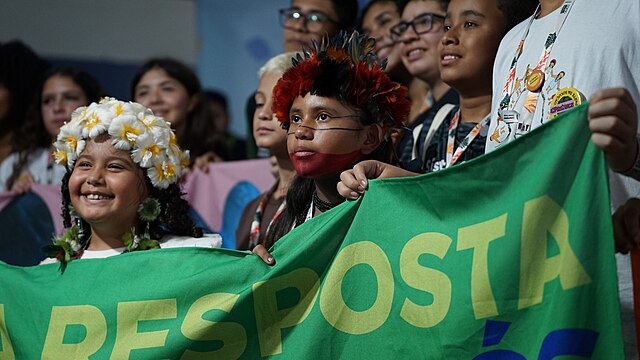
A primary agreement reached during COP30 was the Global Mutirão decision, which aims to unite humanity in the fight against climate change, celebrate the 10th anniversary of the Paris Agreement, and call nations to action and increase ambition. This document has been criticized for failing to mention fossil fuels or a global transition away from them – a commitment parties agreed to at COP28.
Beginning on Monday, November 10, 2025, and ending on November 21, the 30th Conference of the Parties (COP30) marked another effort by the United Nations Framework Convention on Climate Change (UNFCCC) to bring nations together to discuss, debate, and act on climate change. This year, the conference was held in Belém, Brazil, just outside the Amazon rainforest, and hosted representatives from nearly 200 countries. Several issues were on the table as delegates, Indigenous parties, and other civil society groups arrived. Among these were achieving the 1.5-degree Celsius goal, protecting communities from climate change impacts, securing funding for developing countries, ensuring a just transition to renewable energy, and formulating innovative solutions. Outcomes this year were wide-ranging.
Since 1995, the COP has met annually to discuss and debate these matters. These meetings act as a checkpoint and potential milestone for countries on the road to environmental action. The first conference was held in Berlin, Germany, and the COP Presidency, a title given to the nation hosting the conference, also rotates annually. COP conferences are held to fulfill two primary purposes: to evaluate progress towards implementing the UNFCCC, the Kyoto Protocol, and the Paris Agreement, and to adopt new initiatives to further that progress. These are all critical agreements and frameworks surrounding the climate crisis. Ultimately, the COP is the Convention’s main decision-making body.
Last year, COP29 produced several key decisions. Among them was the Baku Climate Unity Pact, which included a major climate finance goal, a goal on climate adaptation, and a climate mitigation work program to encourage intergovernmental collaboration. The finance goal is notable, as it calls on all governments to raise a minimum of US$1.3 trillion annually, and developed countries specifically to raise a minimum of $300 billion per year by 2035. COP29 also produced consensus on Article 6.4, which clarified missing aspects of the Paris Agreement, including the authorization of emission credits and the sharing of adaptation proceeds.
In addition to these agreements, several issues remained unresolved, which set the stage for COP30. Parties did not reach a consensus on the Paris Agreement’s stocktake process, which requires countries to assess collective progress on climate change every five years. Furthermore, parties attempted to follow up on energy-related targets brought up at COP28. Still, certain nations, including China, India, and Saudi Arabia, viewed these efforts as pressure to be more ambitious, leading to stalled debates. Among other issues, COP30 had to address these matters.
In the conference’s early stages, it was revealed for the first time that the global greenhouse gas emissions curve is bending downwards. Compared to 2019 emission levels, global emissions are now projected to decline by 12% in 2035. A decade ago, the predicted global temperature rise was about 4 degrees Celsius; now, the world is closer to a projected increase of 2.7 degrees. This announcement set the initial tone of the discussions to come.
Also notable was the role of Indigenous groups present, both formally and informally, at this year’s conference. COP30 hosted over 3,000 Indigenous representatives from across the globe, all of whom arrived ready to increase pressure on world leaders to recognize land rights, the need for increased climate aid, and environmental justice. Indigenous leadership had a larger role in negotiations than ever before. Furthermore, on November 14th, protesters blocked the entrance to the negotiators’ sectioned-off Blue Zone at the conference.
A primary agreement reached during COP30 was the Global Mutirão decision, which aims to unite humanity in the fight against climate change, celebrate the 10th anniversary of the Paris Agreement, and call nations to action and increase ambition. This document has been criticized for failing to mention fossil fuels or a global transition away from them – a commitment parties agreed to at COP28. It does not include a plan to phase out fossil fuels or reduce deforestation. It does, however, stress the importance of climate finance and the crucial role it plays in adaptation, resilience, and climate progress. Nations did agree at COP30 to triple funding for climate change adaptation, setting a target of US$120 billion per year, but the deadline for this goal was pushed from 2030 to 2035. Within the UN process, the formal COP30 agreement falls short in these areas. Outside the formal agreement, however, Brazil supported two initiatives related to fossil fuels and deforestation, backed by over 90 other countries.
COP30 saw progress, stalls, and setbacks across the board. When it comes to climate policy, there is always more to be done. Significant deals were reached this year, but, as with COP29, much has been left unresolved for next year.
Edited by Alex Ritch
This is an article written by a Staff Writer. Catalyst is a student-led platform that fosters engagement with global issues from a learning perspective. The opinions expressed above do not necessarily reflect the views of the publication.
