
The Board of Peace, a Trump-led initiative focused on Middle East peace, held its initial signing ceremony on January 22, 2026. American elites believe to have found a solution to the Israel-Palestine conflict, which has escalated into a UN recognized genocide. At the center of The Board of Peace’s goals is a master plan to rebuild Gaza through technocratic governance structures. This represents a climax in global discourses surrounding Palestine. It transforms genocide into a matter of reconstruction policy and administrative management, in which rebuilding Gaza becomes merely a developmental project. Behind diplomatic language lies a darker reality that UN experts have warned could legitimise genocidal policies, consequently allowing Israel to pursue its military actions with impunity. Every day, the media releases violent news, and the youth are left to witness the erosion of the international human rights and security framework they were taught to trust. A generation raised on promises of accountability now faces dangerous political discourses that go unanswered, reshaping democratic beliefs — and not for the better.
Is Politics Getting Reduced to Technocracy?
The Board of Peace signals the institutionalisation of a new international norm. The message is clear: genocide and ethnic cleansing become acceptable tools to pursue for states’ own agendas. Such a norm largely depoliticises violence, as the erasure of Palestinians is seen as legitimate or even needed as long as it enables economic growth and promotes security. This reflects neoliberal logics that, when fused with states’ international security logic, treat land as property to be monetized and reduce human lives to obstacles in the pursuit of profit. Applied to Gaza, it turns the fate of an entire people into a private transaction. This is technocracy; the reduction of deeply political questions to administrative tasks, stripped of responsibility and democratic contestation.
In such logic, violence itself fades from the discussion. Israel was barely mentioned during the Board of Peace, rendering the deaths of the Palestinians as almost a natural catastrophe. Consequently, the questions become: What to do with this land? How to maximise the space? What is to be built? This assumes that Gaza is a technical problem, where people are variables, numbers, not political subjects.
Global discourse’s focus on Israel’s ‘right to exist’ reflects this logic: states are treated as moral subjects, while Palestinians disappear as political subjects. Under international law, no state is granted a ‘right to exist’; the only recipients of ‘rights of existence’ are people. Consequently, statehood is an empirical fact sustained insofar as people live freely to self-determine. Yet, younger generations are witnessing a political discourse where systems are defended more vigorously than people, which reshapes democratic expectations. These dynamics reach a climax with the Board of Peace proposing a technocratic committee for Palestinians, without their consent, revealing how technocratic thinking elevates structures over people.
This is the erasure of the Palestinians.
Words Kill Too
There is a void in the international response to the gravity of Gaza. A void of action, of words, of empathy, filled instead with indifference. The genocide in Gaza is not happening in a political vacuum. It’s happening in the normalisation of violent discourses, rendering acceptable the erasure of a population. In fact, behind the ‘casualties’, behind the numbers reduced to abstraction, is the extermination of more than 73,000 people in unspeakable violence. The IDF’s main targets include doctors, mothers, and children. Starvation, torture, refusal of medical and humanitarian aid, bombing of schools and hospitals. People are dying, torn apart, often without even the chance to be wrapped in a white shroud. Ultimately, what remains is denial.
In the face of such violence, we must ask ourselves: How do we speak about Gaza?
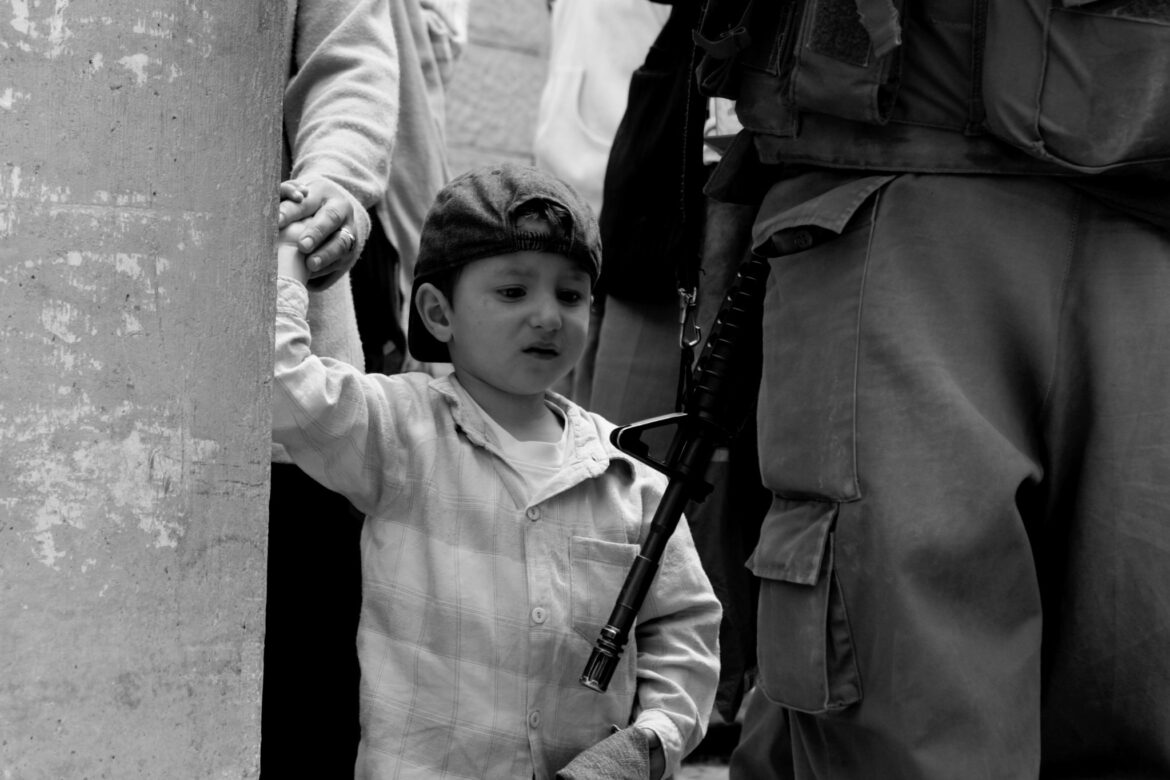
While the return of Israeli hostages is understandably heavily reported, the voices of the Palestinian doctors held in Israeli prisons aren’t given equivalent media coverage. Simultaneously, individuals referred to as hostages on one side are considered prisoners on the other. While an eighteen-year-old IDF soldier is said to be too young to fully understand his acts, a three-year-old Palestinian can conveniently be a future terrorist. The difficulty of escaping propaganda must not be disregarded on either side, especially when growing up in polluted information environments. Through repeated exposure to extreme narratives and authoritative discourses that play on fear and shape who is friend or enemy, young people, even before they can critically assess information, develop the lens through which they understand their own role in the world. However, the way words of ‘innocence’ are attributed contributes, through language, to dehumanisation.
Through words, we too, are complicit in the erasure of the Palestinians. Consequently, a Board that holds no space for Palestinians’ voices can’t imagine a future that involves them.
Complicity ? – Responsibility?
At the center of this permissiveness are Western governments. If you live in a Western country, chances are your government directly funds or provides arms to Israel. The EU is Israel’s biggest trading partner, and the IDF is the largest recipient of US military aid. Canadian direct investment in Israel reached $1.5 billion. Ports of main European cities such as Thessaloniki, Genoa or Marseille are directly linked to Ashdod. States that promote national values of freedom and human rights are directly complicit in a genocide.
If a country can carry out a genocide with no international binding measure taken against it, what such situation says about the future of the international order the younger generation will have to inherit?
The Youth and The Scrambling of Its Democracy
Whether consciously or not, the Western youth are embedded within these political systems. What is often portrayed as distant political turmoil actually hits close to home. The destruction of Gaza is by definition a crime against humanity. Consequently, the erasure of Gazans also has immense consequences for the youth globally. We internalize norms that mark a shift in what we grew up with. European youth, specifically, built strong social ties around collective memories of resistance to the Nazis, to occupation, to genocide. While in history classes, many wondered, how did they let that happen? We found ourselves experiencing the answer to our questions.
In front of such events, many young people are overcome with disbelief and confusion. This leads to desensitization, often characterised by reduced emotional responsiveness, translating into a lack of empathy and refusal to engage in political spheres. Crucially, young Israelis are the main targets of such effects. Mandatory IDF service embeds Israeli youth in heavily militarized discourses, exposing them to desensitization effects and shaping their understanding of democracy. Surveys have shown alarming signs of desensitization: 47 percent of Israeli responders believe that the IDF’s measures should include mass killing of Palestinians, whether targeting specifically children or mothers. In people’s minds, this violence is often neutralized as being the ‘unpleasant reality of modern warfare’.
Western youth see immense violence in the media, and social media algorithms normalize it. As a result, many of us can scroll past videos of a Palestinian child dying without realizing how our brains have internalized this violence as acceptable. Media coverage, often thriving on chaos, spreads confusion and fear among Western youth, thus creating a fog that hinders reflection and leaves them vulnerable to extreme political narratives. Without the political language to interpret and process such violence, repeated exposure does not deepen awareness; it numbs.
For a youth that grew up anchored in ‘Never Again For Anyone’, Gaza reveals the fragility of our international system. It confronts the humiliation of being bound to technocratic institutions where a people’s existence is stripped of human agency. The consequence is inevitable: a growing lack of trust in institutions and political processes.
What happens to a generation that is no longer promised a democratic future? A generation forced to navigate institutions that systematically dehumanize, yet expected to maintain its democratic will?
Edited by Alex Alikakos
This is an article written by a Staff Writer. Catalyst is a student-led platform that fosters engagement with global issues from a learning perspective. The opinions expressed above do not necessarily reflect the views of the publication.

Maria Lecollinet is a first-year student at McGill University, currently pursuing a B.A. in International Development Studies and Political Science. She serves as a writer for Catalyst and has a particular interest in institutional perception, youth participation and civic engagement as well as human rights and the EU’s external relations.