
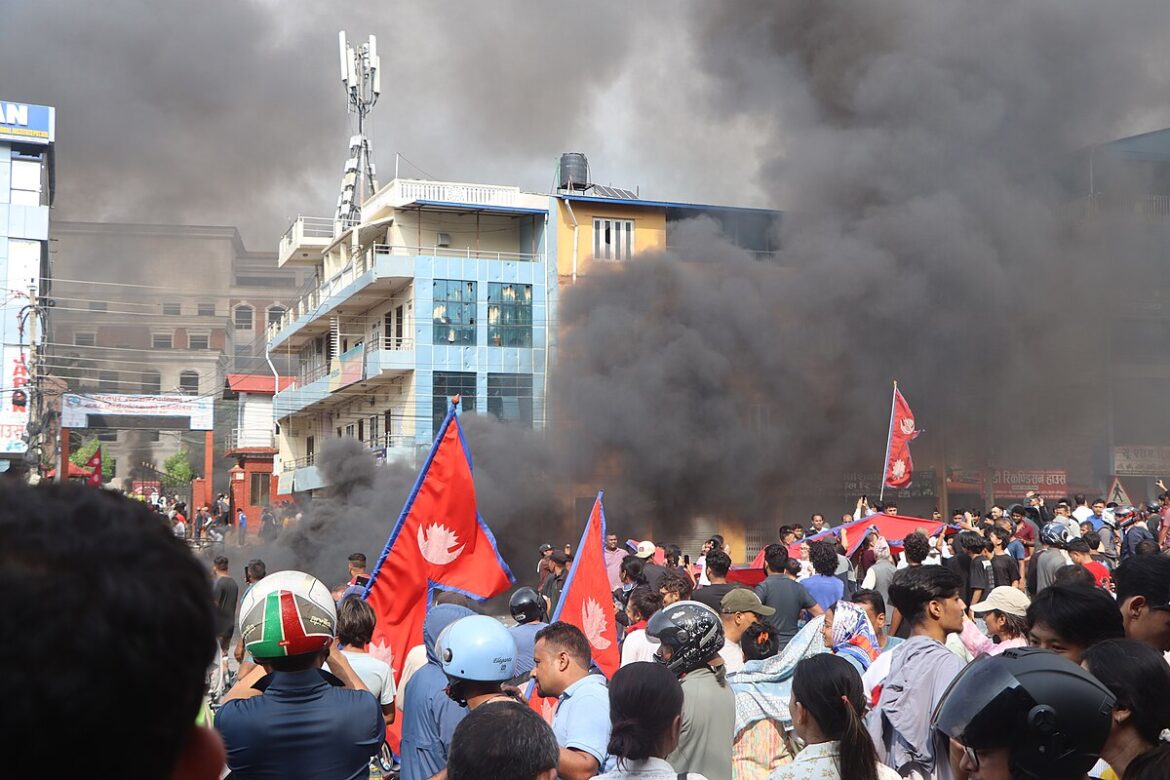
After years of corruption and political stagnation, Nepal’s youth have had enough. Their fight began online, but didn’t stay there long.
In early September, Nepal erupted into some of the deadliest protests in recent history. A government decision to block more than two dozen social media platforms sparked an immediate backlash amongst the population’s youth, many of whom already felt shut out by years of corruption and political stagnation. What began as digital outrage quickly spilled into the streets of Kathmandu and beyond. Chants against graft met clouds of tear gas and, eventually, live gunfire. Forensic reports later confirmed that security forces had used live ammunition, killing at least 72 protesters and injuring thousands more. The violence forced Prime Minister K. P. Sharma Oli to resign, paving the way for an interim government under former chief justice Sushila Karki. With elections promised for 2026, the question remains whether this uprising will mark a true break with Nepal’s entrenched political elite, or if the old order will once again weather the storm.
The Spark: A Social Media Ban That Backfired
On September 8th, the Oli government unexpectedly banned 26 social media platforms, including Facebook, YouTube, and X. Officials claimed it was a crackdown on disinformation and so-called “anti-national” content. But for young Nepalis, who rely on these platforms not only for news and communication but also for work and activism, the ban felt like a direct attack on their freedom. Instead of silencing dissent, the ban ignited it. QR codes, encrypted chat groups, and grassroots networks filled the gap, allowing protesters to organize faster than the state had expected.
From Outrage to Revolt
By September 9th, protests had spread across the country. Crowds stormed Kathmandu’s streets, and clashes turned violent. Government buildings were burned, police outposts were attacked, and in return, security forces retaliated. Hospitals reported waves of injuries, many caused by live ammunition. Within days, the death toll climbed into the dozens. Curfews were imposed, but defiance only deepened. For a generation already struggling with unemployment, inequality, and decades of delayed reform, this was about more than just social media: it was about the future of the republic itself.
Brutality and Accountability
The violence shocked the nation. Forensic reports later confirmed that live ammunition had been fired against demonstrators, contradicting official claims that only rubber bullets and tear gas were used. At least 33 protesters were initially reported dead from gunshot wounds, though the death toll later rose to 72 according to Nepal’s Ministry of Health. Families of the victims demanded justice, accusing the state of treating citizens as enemies. International rights groups called for accountability, and the government quickly lost legitimacy.
The Fall of Oli and Rise of an Interim Government
On September 14th, as the death toll reached 72, Prime Minister Oli resigned. Days later, Sushila Karki, a former chief justice respected for her integrity and judicial independence, was appointed by Parliament to lead an interim government, chosen as a neutral figure to calm political tensions. Her cabinet promised reforms and scheduled elections for March 2026. Travel bans were placed on several senior politicians, including Oli himself, to prevent them from fleeing investigations. For the first time in years, it seemed possible that these elites might face real consequences.
A Generation Finds Its Voice
What differentiates these protests from past uprisings is the central role of Gen Z. Young Nepalis, many of whom have no memory of the monarchy, coordinated protests with speed and resilience. They relied on digital tools, but also on decentralized leadership, making it harder for the state to suppress the movement. Beyond demanding Oli’s resignation, youth groups are now calling for deeper structural reforms: limits on corruption, transparency in governance, and genuine opportunities for political participation.
Regional Echoes and Global Stakes
Nepal’s crisis is part of a wider regional pattern. In Sri Lanka, youth-led protests in 2022 overturned a government amid economic collapse. In Bangladesh, students have clashed with authorities over corruption and inequality. Across South Asia, young people are increasingly at the frontlines of democratic struggles, challenging elites who recycle power among themselves. For Nepal, a small Himalayan nation caught between India and China, instability also carries geopolitical weight. Both neighbors are watching closely, knowing that whoever governs Nepal influences regional balance.
What Comes Next
As mentioned, the interim government has promised free and fair elections in 2026, but skepticism runs deep. Nepal’s political system has a long history of crises without changing its fundamentals. Corruption networks, patronage politics, and weak institutions are not easily dismantled. For Gen Z protesters, the challenge will be sustaining momentum: turning anger into organization, and street power into political power. Whether they succeed or not, September 2025 will be remembered as a turning point: the moment when a generation stood up and forced the country to confront its failures.
Edited by Yasmine Tujar
This is an article written by a Staff Writer. Catalyst is a student-led platform that fosters engagement with global issues from a learning perspective. The opinions expressed above do not necessarily reflect the views of the publication.

Lou is a U2 majoring in Political Science with minors in Anthropology and Sociology. Originally from São Paulo and the south of France, she has lived in seven countries. She joined The Catalyst as a writer in Fall 2024 and has also been involved with SSUNS, JDSP, AIESEC, Think Pink McGill, and McGill Students for UNICEF. Lou is passionate about international law, diplomacy, and youth advocacy, with a strong interest in the politics of development and social justice across the Global South.
Bravo pour ton brillant article. Nous continuons à t’encourager.