
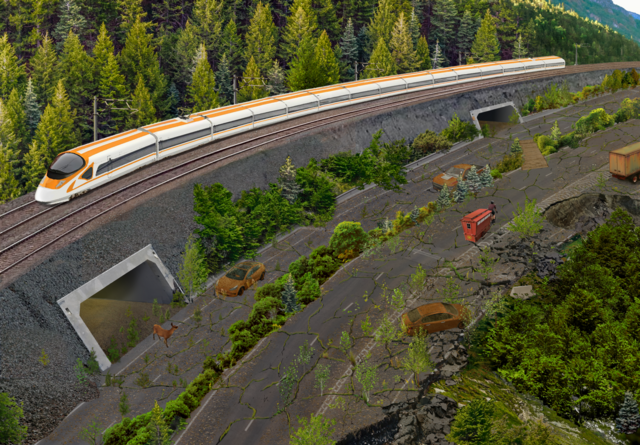
Canada now seems all-in on its “Alto” project to build an electrified high speed rail corridor between Toronto and Québec City. Initially introduced in the final days of former Prime Minister Justin Trudeau, the ambitious initiative seeks to establish a first-of-its-kind system in North America to catch up with global transit standards. This move follows in the footsteps of countries, from China to Turkey to Uzbekistan, that have already invested in similar intercity rail corridors. Nonetheless, this would be a first for Canada. The question now is, how can Canada avoid repeating yesterday’s mistakes in its objective to build a system for tomorrow?
The straightforward answer is to heed the experts. Several transit projects in Canada, namely Lines 5 and 6 in Toronto, have already faced cost overruns and sub-par service, respectively, mainly because recommended expert guidance was not fully implemented. While some improvements such as signal priority and raising speed limits may often augment existing service, more fundamental changes (like converting an entire rail segment into a heavy rail subway, as in the case of Line 5), are simply not feasible after the fact. The point made here is that the infrastructure made for Alto must be built from the outset to be the best possible, with no lingering hurdles or impossible upgrades put off to be made later on. Unfortunately, Canada’s reputation for expanding transit projects, although improving, is not very widely praised, which is why Alto needs to be done right.
Another example, this time outside of Canada and more in regards to rail transit in general, can be found in Mexico’s Tren Maya. The system, constructed rapidly in and around the Yucatan Peninsula, stands as a key example of how rapid transit construction can fail when stations are poorly located. The locations of many of the stations within the cities they are supposed to serve are oftentimes far outside of any meaningful development at all. In other words, most Tren Maya stations are quite far away from where most of their passengers are trying to go. This means that riders have to spend more time and money on their trip, either by taxi or other means of transit, if such options even exist.
It is imperative that Canada does not make this same mistake. Some proposals for Alto stations in places like Toronto and Montréal are ruling out downtown stations entirely, instead opting to put them somewhere else. While merging with existing rail corridors and electrifying them to downtown stations may be an expensive option and therefore less attractive for the sake of price, the bigger picture is missed when opting for doing so. Not only would high speed service directly into Toronto Union Station and Montréal Gare Centrale prompt useful improvements and expansions for those stations (i.e., more electrified trackage, pre-existing connections, etc.), it would also take riders right to where they want to go with a downtown-to-downtown service. If Alto is truly the once-in-a-generation investment that it’s been advertised to be, then it should absolutely follow the lead of the other global high speed rail experts and use stations that are already in useful places, even if it means being more expensive. Thankfully, this is the main plan as of right now, but it must stay that way.
To their credit, Canada is already taking some important measures in planning Alto. The system has committed to having dedicated trackage, which is a must for true world-class high speed rail that aims to consistently run at quicker speeds. It also plans on electrified tracks, although one mention of “mainly electrified” is slightly concerning, but it is hopefully just a slip-up. These are crucial factors to have in mind when the goal is a reliable and efficient system. By comparison, the US’s famous Northeast Corridor was only fully electrified from Washington DC to Boston by 2000, which isn’t all that impressive for the richest country on earth. Furthermore, the Northeast Corridor is plagued with level crossings and tight curves, resulting in its fastest trains still needing to run at slower speeds. Alto thankfully already sees this as having the potential to throw a wrench in the entire plan. Having a dedicated, smooth, and electrified right of way makes service faster and more efficient, as well as being what all other modern and developed systems have.
Lastly, the high speed corridor is a corridor for a reason, not just a right of way. Alto’s implementation and service is an excellent opportunity to grow the entire region that it serves. Investment opportunities around stations could skyrocket if transit-oriented development is done right, such as in and around Montréal’s REM system. Not only that, but more transit could also be in the works. Local transit, whether that be bus systems or a set of light rail lines, could have an incredible opportunity to flourish at key sites. It would give places like Peterborough or Trois-Rivières the ability to connect to the corridor as well as better connect themselves. Alongside high speed service, the corridor also presents the opportunity to spur further regional rail connections on separate nearby tracks, serving smaller communities and also giving rural areas the benefit of being connected to intercity capabilities. A corridor should supercharge a whole region, instead of merely serving the handful of places it stops in.
If done correctly, high speed rail in Canada could be a game changer. At long last, world-class transportation could be brought to North America, built from the ground up, designed well, and thoughtfully. Alto has opened up public participation in their project, open to consultation and feedback, and communities are weighing in. In their quest to do things in the best way possible, they are doing a lot of things right, but they must also keep their original objective in mind and stick to it. Stations far out from downtowns, lingering problems not dealt with, and neglecting potential parallel development could undermine Canadian high speed rail’s reputation, and thus limit its potential as a model for future projects. Alto must play their cards right and not cut any corners, even if some segments become more difficult or expensive to complete.
Edited by Marina Gallo
This is an article written by a Staff Writer. Catalyst is a student-led platform that fosters engagement with global issues from a learning perspective. The opinions expressed above do not necessarily reflect the views of the publication.

Oliver “Ollie” Scott-Hansen is an undergraduate student at McGill University studying history and Russian language, hailing from just outside New York City, yet maintaining similarly strong ties to his familial heritage in north and central Italy. He joined the Catalyst team in Fall 2024 as a staff writer, something he enjoys doing as a hobby as well. With a particularly vested interest in Eastern Europe, the post-USSR world, and the Russo-Ukrainian war, coupled with his various connections throughout the global international relations space, Ollie reports on issues throughout the world that mostly center around key geopolitical developments in contentious places mostly involving war/conflict, and domestic affairs within the United States. He has experience mainly reporting from Telegram, carefully analyzing the Russian Invasion of Ukraine through his updates forum there, but also spends considerable amounts of his free time glued to maps and statistics trying to make sense of the crazy world that surrounds our day-to-day lives.