
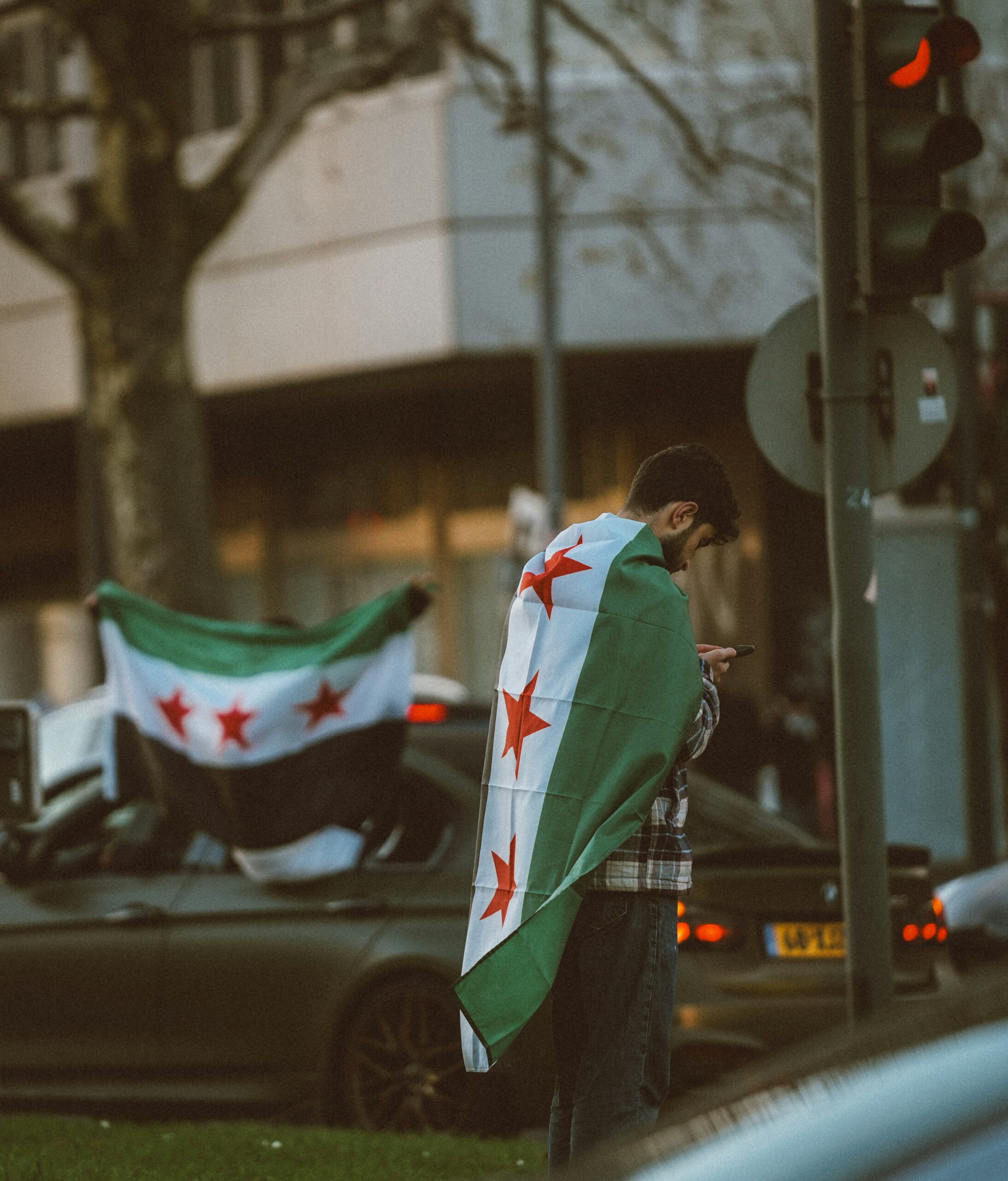
When Bashar al-Assad’s regime crumbled in December 2024, the world blinked—then hesitated. The Syrian war, long viewed as a tragic stalemate, had ended not with negotiated peace but with a military collapse. As dust settled over Damascus, one question thundered louder than victory chants: what comes next?
Enter Ahmad Al-Sharaa, who thrusted into presidency while being a former Al-Qaeda insurgent who fought against U.S forces in Iraq and was detained in the infamous Abu Ghraib prison. Educated in Damascus and Geneva, Al-Sharaa once advised the exiled Syrian National Council and later negotiated on behalf of the HTS-aligned National Salvation Government in Idlib. Though he publicly distanced himself from Hay’at Tahrir al-Sham—an offshoot of al-Qaeda—his political rise was undeniably facilitated by the armed coalition that toppled Assad. This uneasy proximity has drawn skepticism from Western capitals and alarm among secular activists.
“He speaks the language of human rights, but he rose on the shoulders of militias,” one EU diplomat told ABC News. “The burden of proof is now on him.”
Among Syrians, opinion is divided. Some see Al-Sharaa as a rare bridge—able to speak to Islamists and internationalists alike. Others view him as a legal technician fronting for more powerful factions behind the curtain. In a country long ruled by masks and doublespeak, the real question isn’t who he is—it’s whose interests he represents.
And whether, in a land broken by betrayal, anyone still believes in justice at all.
Al-Sharaa inherits not just a shattered state, but a moral abyss: a nation haunted by over a decade of chemical attacks, mass disappearances, sieges, torture chambers, and shattered cities. Now, he faces a near-impossible mandate: deliver justice without destabilization, truth without vengeance, reform without collapse.
A Prosecutor Lands in Damascus: War crimes and Legal Pathways
For over a decade, the International Criminal Court was a distant abstraction in the Syrian conflict—blocked by geopolitical paralysis, sidelined by Assad’s defiance, and rendered toothless by Russia and China’s vetoes at the UN Security Council. That changed in early 2025, when Karim Khan, the ICC’s chief prosecutor, made an unannounced visit to Damascus for closed-door meetings with Al-Sharaa’s transitional government.
The visit was unprecedented—and strategically timed. With Assad ousted and Ahmad Al-Sharaa’s interim government seeking legitimacy, Khan offered a legal olive branch: Syria could submit a declaration under Article 12(3) of the Rome Statute, temporarily accepting ICC jurisdiction for specific crimes without full ratification. Ukraine had done it. So had Côte d’Ivoire. Syria, Khan implied, could be next.
Al-Sharaa didn’t commit—but his openness marked a seismic shift. For a country long defined by absolute impunity, the very act of entertaining ICC jurisdiction was, in itself, a break from the past.
But this wasn’t just a diplomatic feeler. Behind closed doors, Khan reportedly discussed a hybrid tribunal framework—a domestic-international model tailored for atrocity crimes like mass torture, chemical attacks, and enforced disappearances. Syrian courts, gutted by years of political manipulation, would need extensive technical support, witness protection systems, and prosecutorial independence. ICC expertise could provide exactly that. “The message,” Khan told reporters, “is that justice must be visible—not just in The Hague, but in the courtroom down the street.”
Whose Justice? Competing Moral Maps
But what does “justice” look like in a country where nearly every faction—regime forces, opposition militias, foreign proxies—has blood on its hands? Where victimhood and perpetration often blur?
A five-year study by Ohio State University captured Syria’s fragmented moral terrain. Through interviews with civilians, defectors, and exiles, the study found that Syrians’ visions of justice were profoundly shaped by identity, trauma, and political allegiance.
Among regime loyalists, justice was synonymous with national stability and the prevention of revenge cycles. For opposition supporters, justice meant prosecutions and public acknowledgment of state crimes. Among displaced Syrians, justice often began with something more basic: the right to return home without fear of surveillance, arrest, or dispossession.
In short, justice in Syria isn’t a shared horizon—it’s a contested field. Each community imagines its own reckoning and transitional mechanisms that fail to reflect these plural truths risk deepening the very fractures they aim to repair.
Hybrid Courts or Local Ownership?
If there’s one lesson from the past two decades of transitional justice, it’s this: imported solutions don’t transplant well. In post-Assad Syria, that lesson matters more than ever. Legal blueprints must be built on political reality—and on memory.
Hybrid tribunals, which pair Syrian judges with international legal experts, are now the leading proposal on the table. Al-Sharaa’s transitional government has floated a model headquartered in Aleppo, with jurisdiction over war crimes, crimes against humanity, and torture—regardless of whether committed by regime agents, rebel factions, or foreign militias.
On paper, it’s a balanced approach between global legitimacy and local grounding. In practice, the trust deficit is enormous.
Under Assad, the judiciary operated more like an extension of the security state than an arbiter of law. Judges rubber-stamped confessions extracted under torture. Trials took place behind closed doors. Fear, not due process, ruled the courtroom. Any tribunal, however hybrid, must break with that legacy. As the Essex Transitional Justice Network report warns, technical fixes alone won’t restore public faith. Courts must reflect Syria’s plural legal culture and include survivors in their design, not just in their witness boxes.
There are also legal gaps: Syria’s penal code lacks definitions for war crimes and crimes against humanity. Al-Sharaa has pledged reforms, including repealing counterterrorism laws. But rewriting statutes is easier than rebuilding institutions. Who will train new judges? Who will vet prosecutors? And can justice coexist with political compromise?
One Syrian lawyer put it bluntly: “We don’t need a court with international flair but local fear.” For justice to resonate, it must be independent, credible, and human—a break not only from Assad’s system, but from the habits of silence it enforced. Rebuilding legitimacy will require more than clean robes and new logos—it will require a complete cultural overhaul of how Syrians experience law, insulated from political interference and sectarian bias.
Truth Commissions and the Ghosts Beneath
On May 17, 2025, the government launched two national bodies: the Commission on Transitional Justice and the Commission on the Missing. The timing was strategic—just before the Eid holiday, signaling a moral renewal. The symbolism mattered.
Over 100,000 Syrians are still missing, most forcibly disappeared. Families across the country are living in limbo—neither able to grieve, nor to move on. Truth commissions, as shown in South Africa, Argentina, and Morocco, can offer narrative repair. But only if they are independent, inclusive, and empowered to name perpetrators.
So far, critics warn, the Syrian commissions have tiptoed around opposition-linked abuses. This risks turning justice into selective memory—a fast path to renewed conflict.
Reparation Beyond the Ruins
What does it mean to repair a country where an entire generation has grown up in war? Where cities like Homs and Aleppo lie half-abandoned, where property deeds are lost or manipulated, where trauma saturates public life?
In transitional justice, reparations are not just about money. They’re about recognition. Public apologies. Legal restitution. Commemorative sites. Psychosocial support. Al-Sharaa has hinted at property claims reform and symbolic acts of apology. But without meaningful international funding, these efforts risk becoming performative. Still, even symbolic gestures matter. As Syrian lawyer Razan Zeitouneh wrote, “Before the law can heal, it must listen.”
Ahmad Al-Sharaa may have secured regional recognition—with Erdoğan, the Saudi Crown Prince, and the Emir of Qatar endorsing his leadership—but he still faces towering challenges. Chief among them: asserting control over Syria’s fractured territory and containing the armed factions that propelled him to power.
In December 2024, Syrian state media announced that rebel leaders had agreed to dissolve their groups and integrate under the Ministry of Defense. However credible reports of rebel-linked abuses against civilians have cast doubt on Al-Sharaa’s authority. He pledged to investigate and hold perpetrators accountable, though critics question whether he can—or will—follow through.
Domestically, he is working to form a transitional government that can balance rival camps, ex-regime loyalists, and skeptical civil society actors.
“We intend to form an inclusive government,” he said, “reflecting Syria’s diversity in its men, women, and youth.”
He has also vowed to build “new Syrian institutions so that we can reach a stage of free and impartial elections”—a political process, he emphasized, that “requires true participation by all Syrian men and women, inside and outside the country, so that we can build their future with freedom and dignity, without marginalization or sidelining.”
The recent lifting of U.S. sanctions, a major symbolic victory for Al-Sharaa, could prove a turning point. “This decision,” said Mathieu Rouquette of Mercy Corps, “marks a potentially transformative moment for millions of Syrians.” It could enable large-scale recovery, mobilize funds for infrastructure, and shift momentum from humanitarian dependence toward economic resilience.
Yet trust—both at home and abroad—remains fragile. Al-Sharaa’s promise of dignity and inclusion will be judged not by speeches, but by whether power is shared, justice enforced, and the guns eventually silenced.
The Perils of One-Sided Justice
The greatest danger now is victor’s justice. That justice becomes a tool for punishing only the defeated, while the crimes of the powerful—whether regime defectors or opposition elites—go unmentioned.
We have seen it before. In Iraq, U.S.-backed de-Ba’athification purged entire communities and fueled an insurgency. In Bosnia, ethnic courts produced parallel truths and deepened mistrust. Syria cannot afford that path.
Al-Sharaa says he wants to “turn the page without tearing the book.” But doing so requires courage—not just to prosecute the obvious villains, but to face the uncomfortable grey zones of moral complicity.
Then comes the question of sanctions. The Caesar Act—designed to punish Assad’s inner circle—remains in place, freezing billions in reconstruction funds. UN human rights chief Volker Türk has called for a review, warning that blanket sanctions now risk undermining recovery.
But lifting sanctions too fast, without guarantees of reform, could reward war criminals and weaken leverage. The diplomatic challenge ahead is sharp: tie reconstruction aid directly to measurable justice benchmarks—from trial transparency to judicial independence to documentation preservation.
The Verdict is Still Out
Syria today is not just post-Assad. It’s post-truth, post-hope, and post-normal. Yet in this moment of moral vertigo, the choices made by leaders like Al-Sharaa, by institutions like the ICC, and by the Syrian people themselves, will determine whether justice becomes a living process—or just another slogan buried under the rubble.
As Karim Khan noted during his visit: “Justice cannot rewind time. But it can name, it can hear, and it can protect the next chapter from becoming a repetition of the last.”
The road ahead is steep. But it is still open.
Edited by Hannah Byrne
Disclaimer: This is an article written by a Staff Writer. Catalyst is a student-led platform that fosters engagement with global issues from a learning perspective. The opinions expressed above do not necessarily reflect the views of the publication.

Élise Ramo-Mauceri is a third-year student at McGill University, double majoring in International Development and Psychology. As a staff writer for Catalyst, she explores the global intersections of social justice, conflict, gender, and cultural power. She is particularly interested in how development narratives are constructed, performed, and contested across political and aesthetic spaces.