
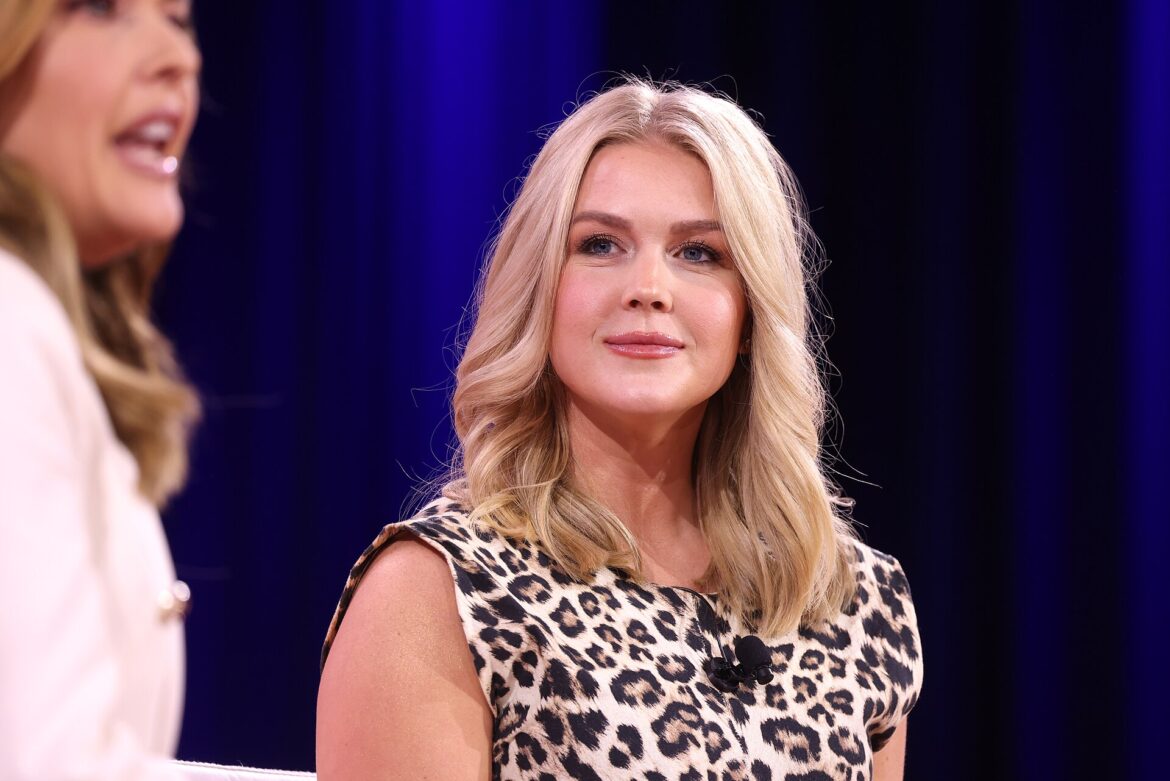
Shortly after graduating from St. Anselm College in her home state of New Hampshire, Press Secretary Karoline Leavitt began her career at the White House. During Trump’s first term, Leavitt worked in his administration’s press office, and as of January 28, 2025, she became the youngest White House Press Secretary in history. Since her debut as Press Secretary, she has become infamous for her sharp responses and counterattacks toward members of the press, especially when their questions conflict with the policy and stances of the Trump administration. Recently, events surrounding two fatal Immigration and Customs Enforcement (ICE) shootings in Minneapolis have exposed serious concerns about Leavitt’s integrity in her role.
Most notably, Leavitt has responded to questioning with politically-charged misinformation and diversions from the truth, exercising a concerning level of control over which journalists are allowed to pose questions. In turn, her responses in White House press conferences unveil her commitment to the Trump administration and its ideology over her responsibility to uphold the truth and press-freedom for the American public.
On January 13, 2026, following a question about the 32 deaths in ICE custody last year, Leavitt redirected the exchange by asking the reporter for his own opinion on the January 7 shooting of Renee Goode by an ICE agent in Minneapolis—a highly unusual tactic that came across as especially insensitive given the gravity of the case. ICE agents shot Goode in her car after she refused to exit her vehicle. Goode began to pull forward, at which point an ICE Agent in front of the car fired at least twice, murdering her on sight. The reporter, Niall Stanage, White House columnist for The Hill, responded that the agent acted “recklessly and killed her unjustifiably,” to which Leavitt sharply asserted that Stanage was merely posing as a journalist, and that this view made him a biased reporter, a “left-wing hack” and “activist.”
Her response was highly inconsistent with the truth, as analyses of multiple public videos, as well as assessments by human rights organizations, indicate that the killing was unjustified. Moreover, the available footage revealed that the agents involved were not under threat at the time shots were fired. Goode’s killing sparked global outrage, with protests erupting in the streets of Minneapolis against ICE’s activity in the city. This response highlights the disparity and tension between the truth and Leavitt’s ideological loyalty towards the Trump administration.
Thirteen days later, Leavitt was tasked with addressing another disturbing ICE shooting in Minneapolis—the killing of Alex Pretti—as national outrage deepened.
Pretti, an ICU nurse and domestically born American citizen, was subdued and brought to the ground in a struggle with ICE while holding a phone during the January ICE protests in Minneapolis. He had a legal, registered, and permitted firearm on him, holstered and un-brandished, which was removed by ICE agents. Once on the ground, face down, pinned and assaulted by agents, he was shot more than five times in a brutal fashion—while outnumbered 6 to 1. Similar to the killing of Renee Goode, Pretti’s death was caught on video. Once again, the footage clearly demonstrated that he posed no threat to the agents, especially not one that constituted lethal force.
These events raised the unavoidable question—where does Leavitt draw the line? At what point does truth and responsibility to the nation trump loyalty to the administration and ideology? Her conduct at the press briefing held on Monday, January 26, offers a response.
At this conference, Leavitt continued to try to favorably reframe the truth for the Trump administration. Specifically, she honed in on Jordan Conradson, White House Correspondent for the Gateway Pundit. Previously, the Gateway Pundit was identified in a 2022 NYU study on far-right news outlets. Leavitt allowed him three consecutive questions. In regard to Pretti’s killing, Conradson asked where the left’s outrage was when Ashli Babbitt—an Air Force veteran who was fatally shot by Capitol Police while participating in the January 6 Capitol riot and insurrection—was killed.
Leavitt began by reiterating that Trump believes the events of the prior weekend were a tragedy, but then added that “all lives are equal” and emphasized that the “biased-left media” exhibits “selective outrage” when choosing victims to highlight. This response completely downplayed the severity of the event and attempted to deflect the conversation towards what Leavitt herself perceived as faults within the left. Throughout the conference, in response to further questions on Pretti, she maintained that the investigation was ongoing and that “facts were taking the lead,” refraining from making any absolute statements regarding Pretti and from condemning or supporting the agents’ actions.
Conradson was also isolated from the rest of the journalists in the room, placed against the wall closest to Leavitt’s right in the “New Media” seat, an administrative move implemented in January 2025. This seat is given to one journalist, podcaster, creator, or other content creating figure chosen by the administration. Conradson was given the first three questions of the press briefing precisely because the new White House convention reserves the opening question for the “New Media” seat. Whilst favoritism is not completely unavoidable in a political setting, the isolated positioning of Conradson and the structure of his questions may be a reason to monitor favoritism in White House press briefings more closely in the future.
It is important to note that the White House recently changed its policy on seating at press briefings, first in January of 2025 and secondly in February. In January, the White House introduced the aforementioned “New Media” seat, located close to the right of where the Press Secretary stands. Moreover, in February, Leavitt announced that the administration would begin choosing the seating of the press pool, ending over a century of seating being organized by the independent White House Correspondents Association. She cited the reason for this change as being to “end the monopoly” the association held and stressed that every voice deserves a seat.
The press conferences conducted this January demonstrate Leavitt’s maintained commitment to supporting Trump’s administration and movement, even when the facts directly and evidently contradict her messaging, ultimately disregarding those who continue to lose their lives in America’s streets. The two 2025 decisions to centralize control over press access to the White House—the addition of the New Media seat and the decision to take over Press Room seating layouts from the White House Correspondents Association—seriously call into question journalistic freedom in the United States. Conflicts of interest could, and will likely, arise from administrative control over the outlets that can question their actions, enabling narrative control and a lack of accountability.
Whilst Leavitt’s tongue remains sharp and loyal, a national storm is brewing. What started as a regional tragedy in Minneapolis is also serving as a means of monitoring Leavitt’s commitments to conservative ideology versus truth, her integrity, and complicity in the cold-blooded killings of two American citizens in the iced-over streets of Minneapolis.
Edited by Marina Gallo
This is an article written by a Staff Writer. Catalyst is a student-led platform that fosters engagement with global issues from a learning perspective. The opinions expressed above do not necessarily reflect the views of the publication.

Owen Roberts is a first-year student at McGill Unviersity pursuing a B.A. in Political Science. Originally from the United States, he has lived most of his life in Australia and Toronto, Canada. As a writer, he is interested in international relations, American and European politics, and political culture.