
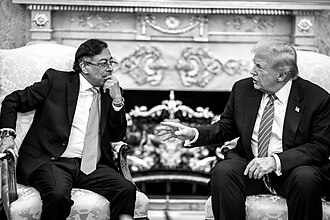
On February 3, Colombia’s first leftist president, Gustavo Petro, visited the White House to meet with President Trump. Throughout the country, Colombians held their breath in anticipation after a year of heightened tensions between the two nations. In October, Trump branded the Colombian President as an “illegal drug dealer”, while Petro compared Trump’s immigration policy to that of “the Nazis”. When the U.S. President threatened that “Colombia is next” following the removal of Maduro from office in Venezuela, Colombians worried these clashes might snowball into real consequences for their country.
Despite concerns, the meeting went well, with pictures surfacing shortly thereafter of Trump holding an “I love Colombia” sign, and of Petro holding a “Make America(s) Great Again” hat, the “S” added on in permanent marker by Petro himself. This small scribbled “S” raises much larger questions for the future of Colombia and Latin America: when even the leaders who were once most ideologically opposed to Trump begin to align themselves to him under a shared slogan, how much resistance truly remains to the spread of similar right-wing populist leaders throughout Latin America? This article will unpack this question to examine the complexity of notions of resistance on uneven playing fields. It will explore the current political landscape the Colombian government is navigating, caught between its ideological differences with the US administration and the latter’s financial and political influence.
Colombia is not unique in this respect — questions of US relations have been critical talking points in recent elections throughout the continent as candidates stake their campaigns on promises of cooperation or resistance to the Trump Administration. Since 2023, a wave of elections across Latin America has been won by far-right populist leaders who share similar ideologies with the US President, and recent polls in Colombia predict a similar result in its upcoming election. This article will examine Trump’s effect on the upcoming election in Colombia and the rise in popularity of far-right candidate Abelardo De La Espriella. By comparing De La Espriella to the libertarian Argentinian President Javier Milei and the leftist Brazilian President Lula de Silva, this article explores how Latin American nations are responding differently to the Trump administration.
The Colombian Case: Stability is Paramount
Following the year of back-and-forth insults, the cordiality between the US and Colombian presidents was, needless to say, a surprising outcome. Gustavo Petro’s sudden change in attitude may have been influenced by looming elections and voter pressure to increase national security; recent polls conducted in Colombia show that 81.1% of the population thinks that it is important to retain good relations with the US government, despite the fact that half of the population has an “unfavorable” opinion of Trump.
What’s more, Petro was eager to reach new agreements with Trump on the issue of narcotrafficking within Colombia, even going so far as to extradite their narcotic criminal leader Pipe Tuluà hours before the Colombian delegation arrived in Washington. Indeed, while narcotrafficking is a flagship right-wing topic used as a political tool in the US, it is also a lived reality of sincere importance among Colombian citizens. Polls show high levels of dissatisfaction with Petro’s government in his efforts to combat this issue, as seven out of ten Colombians believe that the state has lost control in areas where illegal groups operate.
The current government’s initiative against organized crime, Total Peace, which focuses on diplomatic negotiations with cartels rather than increased militarization, is largely considered a failure, with a majority of Colombians stating it makes them feel even more insecure. However, few support Trump’s tactics used in fighting narcotrafficking, as 58% disapprove of the US bombing of alleged “drug boats,” which have killed 145 people since last September. During their bilateral meeting on February 3, Petro urged Trump towards less aggressive tactics to collaborate with Colombian officials to seize drug kingpins living abroad.
While Petro’s increased efforts in combating narcotrafficking appear, at a glance, purely reactionary to the US administration’s agenda, the negotiation is more aptly understood as a response to national concerns surrounding security, which is being doubly-employed as a political tool in international negotiations.
Who’s Next? The Tiger Follows the Lion
In reaction to both international pressure and domestic concerns, prospective candidates in the upcoming Colombian election are mainly focusing on the issues of narcotrafficking, security, and US relations. The lack of faith in the Total Peace initiative is likely to hurt Ivan Cepada, a senator of Petro’s party Pacto Historico, who spearheaded these efforts. The more aggressive approaches of the right side in eliminating narco-trafficking are gaining traction, as evidenced by far-right candidate Abelardo de la Espriella’s surge ahead in the polls.
An ex-criminal lawyer who calls himself “El Tigre,” De La Espriella has officially established himself as the official opposition to Ivan Cepada, promoting a crackdown on crime and strengthened ties with the U.S. De La Espriella speaks highly of Trump, calling him a “great ally of democracy,” and claiming that he “defend[s] the same values as Trump”.
“The distance between Petro and Trump serves no one. It’s not good for Colombia’s economy or its political future” said U.S. Congresswoman Maria Elvira Salazar at a recent rally in support of De La Espriella, with whom she has a close relationship. “I hope Colombia rises to the place it deserves,” she concluded, in endorsement of Abelardo’s vie for presidency.
De La Espriella models his campaign on the libertarian Argentinian president Javier Milei (not-so-coincidentally named “The Lion”), promoting shrinking the government, limiting business regulations, anti-woke values, and close ties with the U.S. and Israel. Milei was voted in in 2023 after a long history of left-leaning presidents. He promised an end to the inflation that has been plaguing Argentina for decades through free-market models and cuts to government spending initiatives that have been in place since the socialist government of Juan Domingo Peron from 1945 to 1955. Milei speaks brashly and communicates with voters on social media through tabloid-esque posts that slam the left with no-holds-barred slogans, insults, and memes, a tactic Abelardo has in turn emulated.
Similarly, Milei strongly advocated for improvements in the country’s relationship with the U.S.: he was the first world leader to meet with Trump after his election, and he applauded him for “accomplishing peace in the Middle East.” De La Espriella surely did not miss that Milei’s “improved relationship” with Trump helped clinch a recent agreement for an unprecedented $40 billion USD lifeline to Argentina, which is currently keeping the country’s economy afloat. While Trump may have been a vanguard that shifted the frame of normality to the right in the Americas, the commonalities in De La Espriella’s and Milei’s campaigns suggest that emerging Latin American leaders may be turning more to the South for inspiration, rather than to the North.
Latin American Populism: The Product of Neocolonialism?
Milei and De la Espriella are not statistical outliers in the shift right—Nayib Bukele’s authoritarian regime has recently taken over El Salvador, and Ecuador’s Daniel Noboa is made of the same strongman mettle. Donald Trump, Milei, Bukele, and Noboa have all been described as authoritarian figures born out of stagnating economies and rising inflation. However, though they may share similar platforms, it would be misleading to equate their issues. The U.S. administration’s ability to impose tariffs on imports from Latin America without significantly harming its own economy is evidence of America’s indomitable financial power, which exacerbates the very market failures that produced this wave of right-wing leaders with whom it now allies itself.
The recent American re-appropriation of Venezuelan oil and the increase in far-right leaders ideologically aligned with the Trump administration would suggest U.S. hegemony is being further entrenched across the Americas. Certain political analysts argue that current U.S. foreign policy falls squarely into the realm of neocolonialism: the imposition of tariffs and corporatization of foreign resources mirror the entrenched American practice of rechanneling profits from local resources in former colonies into their own pockets while cherry-picking leaders who turn a blind eye.
That said, labelling all partnerships with American powers as neocolonial can limit the perceived agency of the smaller power. This framing may portray a government as passively accepting exploitation, rather than as an active political negotiation with salience, agency, and a right to seek investment and allyship between nations. Though U.S opportunism in taking advantage of power inequalities is a crucial aspect to consider, nuance must be made outside the simple narrative of the exploited, patronized Latin American government forced to submit to these dynamics.
The Pendulum Swings Left: Lula’s Return to Office
The narrative of the shift-right cannot be posited as monolithic, however, as this activated agency can be seen elsewhere. A counternarrative to this wave of right-wing elections can be observed in the re-election of left-wing Luiz Inacio Lula da Silva in Brazil in 2022, following right-wing Bolsonaro’s 4-year stint in office. President Lula has had success in his dealings with the U.S., wherein he refuses to compromise on ideological differences, but has been able to economically negotiate all the same: for example, following negotiations, the Trump’s administration removed the 40 percent tariffs that he had imposed on Brazil in November 2025. Granted, Brazil has a higher negotiating ability due its large economy, with a GDP of around 2.19 trillion, compared to Argentina’s 638 billion and Colombia’s 419 billion, but it may still act as a vanguard for other smaller countries on the continent. With an upcoming visit to the United States in the beginning of March, Lula recently said in a press conference: “I want to tell the US President Donald Trump that we don’t want a new Cold War. We don’t want interference in any other country; we want all countries to be treated equally.”
Moreover, Lula’s re-election shows how pendulum shifts in politics work both ways: a shift to the far-right may swing back to the center afterwards, just as a left-leaning government can inspire a shift to the right afterwards. Argentina, for instance, had a long history of left-wing governments, leading to disillusionment with the left and the election of Milei. De La Espriella, for his part, is capitalizing on voter frustrations that emerged from Petro’s left-wing government. This shift to the right may be part of a larger Trump-inspired reaction to discontent with underperforming socialist governments in Latin America, but that does not mean it is the new political stasis.
Conclusion
In sum, Petro’s meeting at the White House on February 3 occurred amongst the changing dynamics of Latin American politics as countries across the continent navigate the uncertainty of the new U.S. administration. The meeting underlined the complexity of negotiating between national economic interests and ideological differences. While the Trump administration has seemed to embolden similar far-right figures to emerge into seats of power in Latin America, it has also seen more nuanced negotiations from ideologically opposed leaders, such as Lula da Silva. As the May 2026 election approaches, eyes turn to Colombia to see whether De La Espriella will be ushered in on the same promises that brought Javier Milei to power, furthering an ideological right-wing alignment throughout the Americas with the U.S., or if the more moderate left-wing campaign of Ivan Cepada will resonate with voters, mirroring Brazil’s Lula de Silva’s return to power.
Edited by Noe Beaudoin
Disclaimer: This is an article written by a Staff Writer. Catalyst is a student-led platform that fosters engagement with global issues from a learning perspective. The opinions expressed above do not necessarily reflect the views of the publication.

Madeleine Landon is a U2 student pursuing an Honours International Development with a minor in Environment. She is interested in writing about Latin American Politics during her semester abroad in Buenos Aires.