
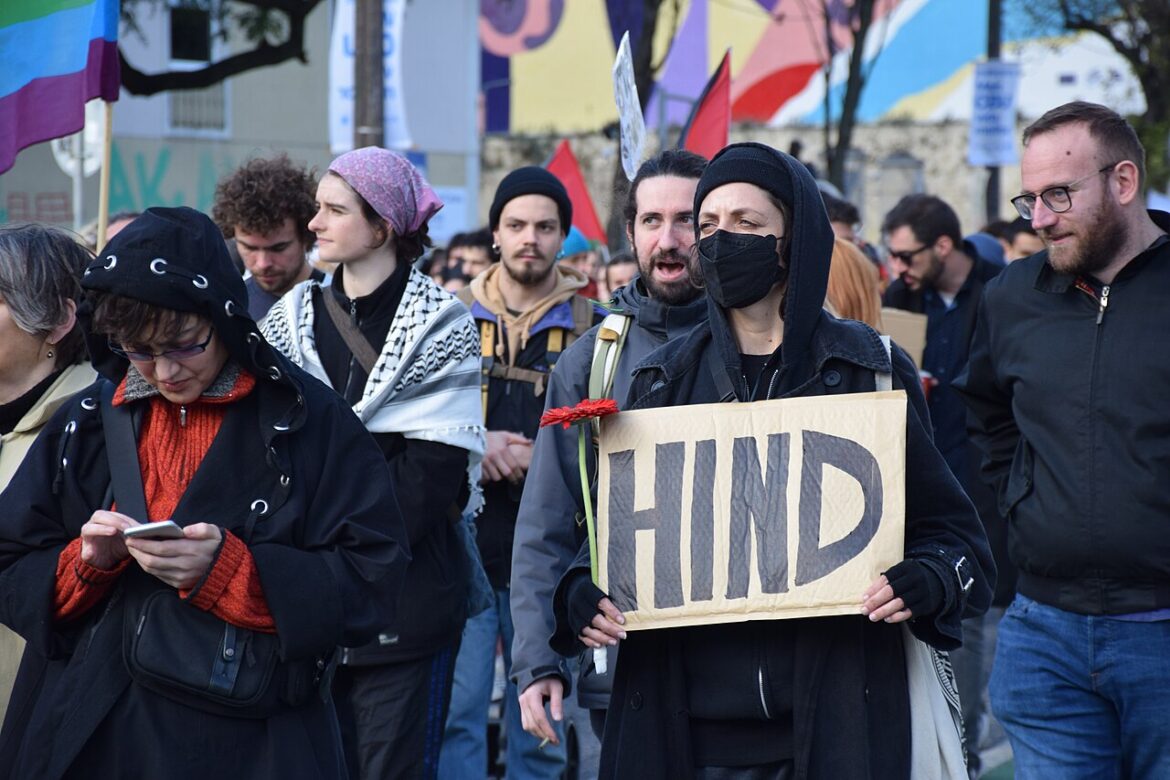
Does the story of Hind Rajab sound familiar? The six-year-old Palestinian girl who was killed by the Israeli army in January 2024 became the symbol of the struggle against the Palestinian genocide, especially across universities in North America. A little girl getting shot by a tank while she was hiding in a car, surrounded by her family members’ bodies… One could wonder: How did no one do anything to stop this from happening? How come the West, despite having the means to help, shows so much reluctance to do anything more than just watch? It is surely a matter of whose voice is heard, whose story is told, and most importantly, of who is said to “deserve” empathy. The movie The Voice of Hind Rajab, directed by Kaouther Ben Hania, tells the story of Hind’s killing, building off of excerpts of the calls between Hind and the Palestinian Red Crescent volunteers, recorded before Hind’s murder. This movie is an attempt to bring the attention of the West to the genocidal situation in Palestine, in a time where heavy media exposure makes such violence look banal, almost. The movie is a ground for reflection over mechanisms of the West’s reaction to crises abroad, but also on the duty of the observer. This article aims to bring to light how the viewer of violence situated in the Global North, which will be referred to as the “Western observer”, gets to decide who is worthy of empathy and help, but also how they need to take into account this systematic role, question it, and understand the importance of considering action beyond simple empathy.
Due to the situation of Western domination in the current state of the World, its population has a privileged position in terms of recognised legitimacy. The Western observer, hence, becomes the one who distributes attention to the different crises across the globe, deciding which one is worth feeling empathy towards. This process of recognition as “deserving” is crucial for people in a crisis to get help. Hence, anyone who finds themselves in need of assistance at a global level will have to engage in a process described by Susan Sontag in “Regarding the Pain of Others” as a turning of their situation into a “spectacle”, meaning a mediated image, something that will convince. It is not about reality anymore, but about the observer’s feelings and reactions. Making a movie about the story of Hind Rajab is an artistic choice that aims to spark empathy in the hearts of Western people, in the hope of bringing attention to the disastrous humanitarian situation of Gaza.
When making itself the observer, the distributor of empathy, the West puts itself and its experience of such at the centre of attention. Suddenly, what matters is the decision Global North countries make, at the global level, or the emotions felt by the Western individual who gets exposed to violent content coming from Palestine. Especially in a situation where the observer feels empathy and feels pain for the other, this shift in focus from the observed to the observer happens. As explained earlier, what is valued is the West’s experience, its feelings, more than anything else. Having the film debut at the Festival de Cannes, a symbol of the Western cultural world, exemplifies the process of putting the Westerner in a position of legitimate observer and perpetuating this position.
This dynamic becomes clearer when examining how empathy is structured through ideas of innocence. The decision of the West as to who is deserving of empathy is heavily influenced by the concept of innocence. Innocence is defined in Ticktin’s “A World without Innocence” as “freedom from sin, guilt or moral wrong in general”. Making innocence a priority in deciding who is worthy of empathy is, hence, guaranteeing that anyone who is perceived as potentially dangerous to the West will be put aside. The figure of the innocent is seen by the observers as lacking agency, as well as means to defend themselves, and in need of a saviour. In the case of the images, videos, and stories the West gets from places like Palestine, innocence organises the empathy reaction hierarchically, responding to age and gender; the children being the most innocent figures, followed by the women, and last, by the men. Race and religion also add to this dynamic, with white and Christian seen as most innocent. Despite her race and religion, Hind Rajab’s age at the time of her death made the reactions to her story even more empathetic than what the rest of the story already told. However, the majority of Palestinians do not fall under these “innocent” categories, which could explain why it took the West so long to react. This raises the question of how long it would have taken if Palestinians were White and Christians for the majority.
The role of observer implies difficult feelings as well as important rewards. Indeed, empathy is valued in Western society, which, despite being built on the exploitation of the rest of the world, gives importance to the idea of “speaking up for the oppressed”. The gold standard here is the empathetic but not responsible observer, following the idea of “engagement of the compassionate but uninvolved observer”. This status is often endorsed at the state level as well, by countries like Canada, which are built on the idea of a humanitarian nation that finds itself “overwhelmed with the brutalities of the New World Order”, as argued by Razack. On the individual level, the empathic observer finds themselves feeling pleasure in being exposed to the suffering of the other because it is an opportunity to contemplate their own humanity. Similarly, when seeing racialised bodies being exposed to violence, the White observer is reassured about their position in the hierarchy, as Razack explains, citing Anthony Farley’s notion of “race pleasure”. Empathy, hence, becomes – most of the time, unconsciously – the perpetuator of the oppressive hierarchical system in which the Western observer, but also the non-Western observer, was socialised into. If being a Western observer carries so many negative aspects, how should one act in relation to images and stories from Palestine and other places in crisis? How to be a better observer? What is the observer’s “duty”, in reality?
The uninterrupted exposure to visual content from Palestine since October 7th has surely been overwhelming for any observer. What is dangerous about this extreme abundance is that any story, like the one of Hind, ends up becoming one of many others, diminishing its weight in terms of empathy. The choice of making her story into a movie also has its limitations in that it becomes one of the hundreds of thousands that exist. Does the astonishing number of images and videos of the Palestinian crisis interfere with the observers’ capacity to feel empathy? While one could think that repeated exposure disrupts the strength of the reaction, Sontag argues that it is more complex. The problem also resides in our society’s consumption-led foundational aspect. Most news consumption is done through television or social media. Both heavily depend on the user’s stimulus for them to keep consuming the content. Sontag warns against war images becoming banal and argues that shocking images can be seen as necessary to provoke a reaction in Western eyes.
The observer’s duty, therefore, according to Sontag, is to remember that art has the value of making people uncomfortable, and that in that sense neither feeling good nor bad is the point of a photograph or a movie. It is about maintaining the connection with the situation. Keep thinking about it, keep talking about it. Secondly, it is essential to act, to go beyond feeling empathy, which ends up disappearing if no action is undertaken.
Hind Rajab’s story reveals crucial mechanisms behind the role of the Western observer. Indeed, Western empathy depends on the notion of innocence, informed by age, gender, race, among others, and systematically puts the observer’s emotions at the foreground. The role of “distributor of empathy” is a double-edged sword in that it is socially valuable in terms of morals, but also can be overwhelming. A constant reflection on this role is necessary. Empathy alone is therefore insufficient without sustained reflection and action.
Edited by Lou Didelot
This is an article written by a Staff Writer. Catalyst is a student-led platform that fosters engagement with global issues from a learning perspective. The opinions expressed above do not necessarily reflect the views of the publication.

I’m in my third and final year at McGill University, pursuing a B.A. in Political Science and International Development Studies. I’m particularly interested in social justice, political ecology, feminist theories, and the study of fascism.