
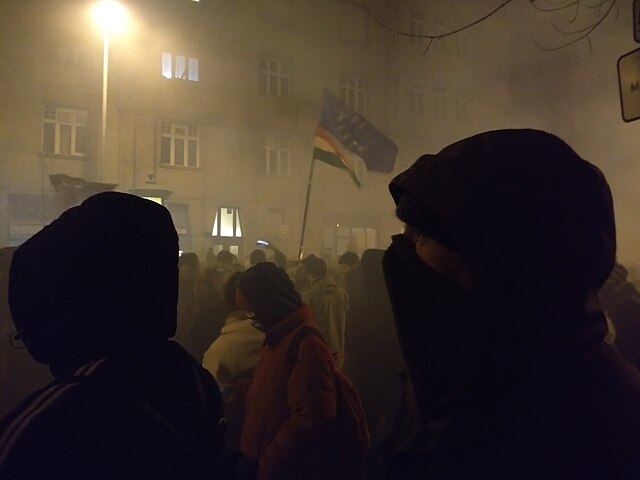
Anti-state rhetoric has become a popular refrain among far-right anti-establishment politicians promising to “drain the swamp.” Yet once in power, anti-statist parties and politicians often fail to minimize the state as pledged. Instead, as in the case of Hungary’s far-right Fidesz party led by Viktor Orbán, they selectively restructure the state to erode democratic norms and entrench their rule. This article examines the practice of anti-statism in Hungary, against the promises of a shrunken state.
“Drain the swamp.” Worldwide, this anti-establishment refrain has become a rallying cry for far-right populists promising to dismantle bloated bureaucracies, slash debt, and return power to ‘the people.’ In practice, however, this rhetoric often masks a different project: the expansion of authoritarian control. In reality, the programs being slashed undergird the checks and balances that preserve democracy and support citizens: the media, judiciary, and the welfare state. Anti-statist rhetoric is the Trojan horse of authoritarian populism. It conceals a selective reconstruction of state power which weakens welfare protections and democratic accountability, while expanding authoritarian control over media, the judiciary, and civil society. One example is the Fidesz party in Hungary, helmed by Prime Minister Viktor Orbán, in power since 2010.
In a 2013 speech at Chatham House –“the Role of Traditional Values in Europe’s Future”– Orbán claimed that the welfare state “is over.” He went on to say that Europe should return to a “merit-based society” by fighting bureaucracy and cutting taxes, to ultimately decrease state debt and encourage competiveness. A flat-tax was instituted in 2011 that disproportionately benefits high-earning Hungarians, who pay less tax despite earning far more than the majority of the country. These changes marked a strategic reallocation of resources away from social protection and toward ideological control. Orbán’s government reduced the timespan that people can receive unemployment benefits from 270 to 90 days. This reduction in benefits has pushed people to not register as unemployed causing the employment rate to seem artificially higher. For example, the number of people searching for work with the National Employment Service is far higher than the number registered as unemployed. In January 2016, there were 269,000 unemployed, while there were 359,000 jobseekers according to the NES. The Fidesz party has sought to build what it calls a “work-based society,” where labour protections and welfare programs are cut in the hopes that this will pressure employers, and job-seekers, to boost the labour market. This retrenchment of the redistributive arm served a dual purpose: disciplining the workforce while freeing state capacity to expand its ideological functions.
In a 2022 speech at the Conservative Political Action Conference, to a largely American audience, Orbán made a recommendation to conservative politicians: “have your own media.” He is speaking from experience. Following the Fidesz 2010 election win, he used his supermajority to overhaul the country’s media regulator, the Media Authority and Media Council by stacking it with Fidesz loyalists. He promptly fired over 1,600 journalists and media workers at the national public media company (MTVA), replacing them with loyalists who parrot the government’s narrative: turning MTVA into a government-controlled broadcaster. He further consolidated power with the establishment of the Central European Press and Media Foundation (KESMA) in 2018, which controls over 470 media outlets in the country, on the basis of protecting national sovereignty. Many of the media outlets he targeted supported aspects of the liberal welfare state, including personal protections and political rights. Now, the majority of media repeats the Fidesz party’s nationalist and religious rhetoric, including criticism of welfare programs. This media consolidation shows that welfare retrenchment enabled, not limited, the expansion of ideological state functions.
While presenting themselves as anti-state revolutionaries on the campaign trail, once in power, far-right populists like Orbán expand the state’s coercive and ideological apparatuses, while dismantling welfare and democratic institutions.
Orbán made good on his anti-statist promises: after his 2010 win, taxes were slashed and welfare programs were cut. The state apparatus, however, only expanded. Since gaining office, Orbán has taken control of 80% of Hungary’s media market resources, according to the international press watchdog Reporters Without Borders. The expansion of Hungary’s coercive arm is most visible in the 2023 creation of the Sovereignty Protection Office (SPO), a body which labels civil society organisations who challenge government aligned values as “threats,” and punishes them with steep fines or closure. This is reminiscent of Russia, which cut welfare programs in the face of sanctions for its annexation of Crimea in 2014, while expanding programs targeting critical democratic and human rights organizations .These moves expose the authoritarian undercurrents of his anti-statist promises, and provide a warning for countries grappling with far-right, anti-state politicians and parties.
Anti-statist rhetoric promises a lean, efficient government, and frames the liberal state as corrupt and overreaching. In various speeches, Orbán has railed against the EU’s liberalism, decrying factions which support LGBT and migrant rights as decadent and out-of-touch. In March of 2024, he blasted the EU as “locusts” and urged supporters to choose between “Brussels and Hungarian freedom” in the EU elections.
Orbán frequently frames Hungarian national sovereignty as under threat, not only from the EU or external actors but also from internal “enemies” like NGOs, independent media, and civil society. According to this line of thinking, in order to defend against the internationalist liberal elite, a democracy with a centralized executive power that cannot be infiltrated is the only way to protect Hungary’s soverignty. In Hungary’s case, it is paired with the erosion of rule of law, and expansion of the ideological and coercive apparatuses.
Under the auspices of securing “sovereignty,” Orbán has systematically captured key autonomous institutions: the judiciary and media. Upon gaining office in 2010, he sought control of the judiciary, which he was able to do legally due to his Fidesz party holding a two-thirds majority in Parliament. He raised the number of judges from 11 to 15, so he could appoint four. Additionally, he created a National Judiciary Office that oversees which judges hear a given case, and has veto power over new judicial appointments. This control of the judiciary enabled a new constitution to be adopted in 2012, which cemented nationalist and Christian ideals in the legislation. This judicial takeover did not shrink the state; it eliminated horizontal accountability, subordinating the law to executive power.
Anti-statist rhetoric has become characteristic of far-right reactionary politics, yet once in power, genuine state reduction is largely illusory. Rather, the redistributive and democratic functions are slashed, while the ideological and coercive arms are expanded. Liberal assumptions that far-right populism is inherently “anti-government” are fallible. The case of Hungary under Orbán provides a warning and example of what “drain the swamp” can really mean and shows how anti-statism can be a veneer for the selective reconstruction of the state.
Edited by Gita Kerwin
This is an article written by a Staff Writer. Catalyst is a student-led platform that fosters engagement with global issues from a learning perspective. The opinions expressed above do not necessarily reflect the views of the publication.

I’m a writer for Catalyst and the McGill Journal of Political Science. I am passionate about topics such as politics, sustainability and geography!