
Covering the Russo-Ukrainian War, or even fully understanding it, is not an easy task. Even for me, someone who has been sifting through niche Telegram channels and combing every piece of media coverage there is to offer, I still find myself often scratching my head, trying to think of an answer as to why something exactly happened the way that it did, only to maybe truly realize its significance days or weeks later. What’s fascinating to me about this war in particular, and part of the reason as to why I’m so interested in it, is because it is the first chance we have to witness modern 21st-Century warfare as it’s playing out where one side does not have an insane advantage over the other. Granted, maybe if Russia was actually good at fighting a war then this would be a different story, but thankfully their incompetence and corruption has hindered their ability to do so. At the same time, though, this still does not make it easy to predict anything from either side, especially when one of Ukraine’s (at least supposed) allies has now notoriously become the world’s bastion of unpredictability. I am of course referring to Donald Trump’s United States.
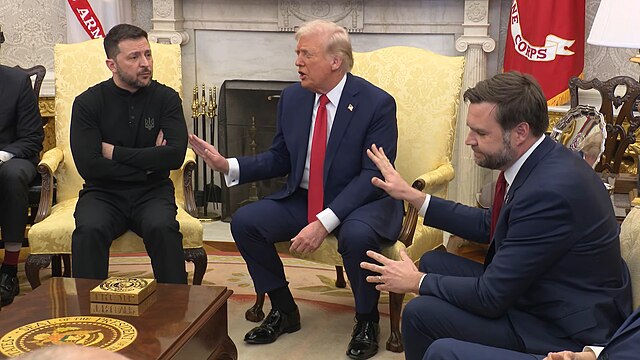
“If I’m President, I will have that war settled in one day,” Trump famously declared on the campaign trail. It doesn’t take a genius to know that this did not in fact happen; actually, quite the opposite. Despite his role in helping to solve other conflicts around the world, the Ukraine war has become the one tough nut he has been unable to crack. He’s tried a lot of differing approaches, too. His first meeting with Ukrainian President Volodymyr Zelenskyy was atrociously disastrous in so many ways, while his first meeting with Russian President Vladimir Putin consisted of rolling out the red carpet, literally. Then, all of a sudden, Trump came out with a brazen announcement: he thinks Ukraine can win back all of its territory. It seems like he changes his mind every day, swaying back and forth between real talking points and literal Russian propaganda. Why exactly does he do this, though? What is the point of not making up your mind on something when you’ve been dealing with it for months? Sure, it’s a headache for me, but perhaps not for the man making the decisions. It is entirely possible that Trump’s whole strategy for Ukraine, his master plan for what to do, is to not have a set plan at all.
It sounds crazy, but in a way it makes sense. Trump’s “art of the deal,” or rather more accurately simply doing whatever you don’t expect, has worked for him before, usually in the form of impromptu tariffs. He forced Colombia to accept US deportees by threatening tariffs after they did not at first accept them, and similarly did an international “band for band” with China as the two sides clashed with rival tariff levies earlier this year. Through this, it can be seen that Trump’s main leverage comes from American economic power, and it remains his favorite tool to both use and threaten to use. In dealing with Russia, Trump has just as clearly tried to use the economic leverage that the US possesses in an attempt to get Putin to the negotiating table, both directly and indirectly. He threatened to impose a 50% tariff on India, who he usually sees as a close ally. This strange action was done as a result of their importing of Russian oil which in turn keeps Russia’s heavily sanctioned economy afloat. On top of this, he has also threatened Russia themselves with tariffs, although these are unlikely to make much of an impact. Nevertheless, the point is that Trump’s demonstrated ability to randomly bear down American economic might on anyone who defies his wishes has been instrumental in his execution of foreign policy.
What the tariff threats show us is that Trump, as a non-traditional politician, has been able to use his unpredictability to his advantage in getting what he wants. The reason why he flip-flops so much is because, in the long run, he gets something out of it. Everybody observing him is so concerned about waiting for his next move that they drive themselves crazy trying to predict it, when you simply cannot. In other words, Trump’s biggest strength is that he can project fear and anxiety by merely deciding things on a whim. By staying eternally unpredictable, Trump has indeed gotten some things done, but the Ukraine issue remains a thorn in his side. As a result, the US has no Ukraine policy. What is Trump’s endgame with Ukraine? Does he even have an endgame? What if there is intentionally no endgame at all in order to keep all possibilities open?
Keeping himself unpredictable gives Trump the ability to play both sides, to maintain an equal image in the eyes of both Russia and Ukraine in order to get them to come to a negotiated settlement. This way, he doesn’t need to come up with a set strategy at all, and instead just does what he does best in hopes of achieving peace. The thing is, though, while purposeful ambiguity may work in securing favorable trade deals following tariff threats, a trade war and a real war could not be more different. On top of this, the differences in sentiment of ending the war between Russian and Ukrainian leadership are incredibly stark. Ukraine has repeatedly made clear that it wishes for a ceasefire that leads to talks and a “just and lasting peace,” while Russia has publicly denied any sort of cessation to the conflict without first being given numerous ridiculous concessions. This has angered Trump, but has still not resulted in him siding with the Ukrainians, as he knows that in order to end the war, Russia must be comfortable with sitting down to talk. Furthermore, he also knows that the Ukrainians would never dare go too far in their criticism of him because they need American support to hold firm. This puts him in the position of being the one that everybody keeps their eye on; he is the center of attention, the key decision maker. When both look to the decision-maker for answers and they stay ambiguous, the assumption in Trump’s mind might be that this gives much better chances in getting the two sides to accept whatever comes naturally.
Yet President Trump is still gambling with lives here. Despite time and time again yelling at Russia and Ukraine to “stop the killing,” and to “make a deal,” his strategy of maintaining uncertainty has only dragged the war on. I, as a pro-Ukrainian analyst, have a clear bias towards one side, and so of course I would want for Trump to make up his mind in Ukraine’s favor, but I recognize this is unlikely something the President wants to do. He wants to keep people on edge, he wants to keep ramping up the pressure, he wants to get into people’s heads. Who knows, maybe he even gets a kick out of it. Regardless of whether you agree or not with what Trump is doing, the facts on the ground remain the same and thus remain immune to opinion. Unfortunately, the only thing I can do as an analyst is observe and ponder. Like the countries Trump is dealing with, he too is keeping me guessing. That, though, has ultimately led me to believe that instead of trying to deduce his strategy, the whole point may be that the strategy is to just not make one at all.
Edited by Gita Kerwin
This is an article written by a Staff Writer. Catalyst is a student-led platform that fosters engagement with global issues from a learning perspective. The opinions expressed above do not necessarily reflect the views of the publication.

Oliver “Ollie” Scott-Hansen is an undergraduate student at McGill University studying history and Russian language, hailing from just outside New York City, yet maintaining similarly strong ties to his familial heritage in north and central Italy. He joined the Catalyst team in Fall 2024 as a staff writer, something he enjoys doing as a hobby as well. With a particularly vested interest in Eastern Europe, the post-USSR world, and the Russo-Ukrainian war, coupled with his various connections throughout the global international relations space, Ollie reports on issues throughout the world that mostly center around key geopolitical developments in contentious places mostly involving war/conflict, and domestic affairs within the United States. He has experience mainly reporting from Telegram, carefully analyzing the Russian Invasion of Ukraine through his updates forum there, but also spends considerable amounts of his free time glued to maps and statistics trying to make sense of the crazy world that surrounds our day-to-day lives.