
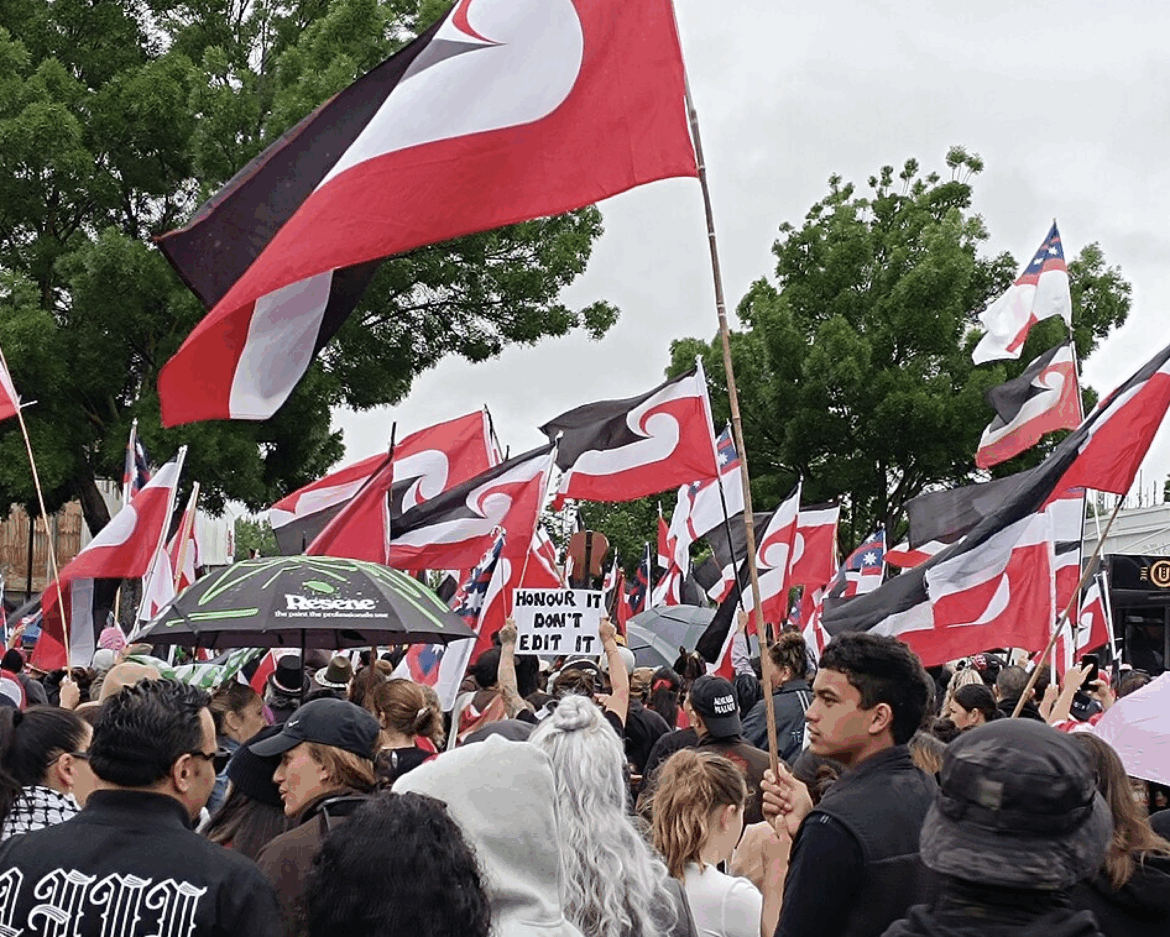
They walked for nine days, from the northern tip of Aotearoa, New Zealand to its political heart in Wellington. In November 2024, Hīkoi mō te Tiriti (“March for the Treaty”) became the largest mobilization in support of Māori rights in New Zealand’s recent history, drawing more than 42,000 people in peaceful protest against the highly controversial Treaty Principles Bill. Introduced by right-wing libertarian ACT Party, the bill sought to redefine Te Tiriti o Waitangi (The Treaty of Waitangi), New Zealand’s founding agreement, initially promising a partnership between the British Crown and Māori chiefs. A promise many argue remains largely unfulfilled.
Organized by Toitū te Tiriti and led by Māori activist Eru Kapa‑Kingi, this hīkoi was both a protest and a proclamation, drawing people across generations and ethnicities. It culminated in a powerful assertion of tino rangatiratanga: Māori sovereignty reaffirmed in motion. As the bill gathered momentum in Parliament, so too did the resistance it ignited.
Rewriting the Treaty?
Signed in 1840 by the British Crown and over 500 Māori rangatira (chiefs), Te Tiriti o Waitangi is Aotearoa New Zealand’s founding document, written in both English and te reo Māori, the Māori language. Yet, its interpretation has always been contested. While the English version claims the Māori ceded full sovereignty to the Crown, the Māori text uses kawanatanga, a more nuanced loanword for ‘governance’ and ‘self-determination’ that implies administrative authority rather than absolute surrender of power. In turn, the Māori version guarantees tino rangatiratanga (absolute authority) over lands, resources, and affairs, which the English text narrows to ‘possession.’ These linguistic discrepancies have fuelled over a century of legal disputes, tribunal hearings, and political negotiation.
Over the past 50 years, lawmakers, courts and the Waitangi Tribunal, which investigates breaches of the Treaty, have interpreted its principles in light of its broader spirit. Principles of partnership, participation, and protection have underpinned efforts to revitalize the Māori language by making it an official language, and were used to establish a Māori Health Authority to reverse disproportionately poor health outcomes for the Māori, which the coalition government dismantled in 2024.
Championed by the ACT Party, the centre-right National Party and coalition partner NZ First, the proposed Treaty Principles Bill emerged amid rising settler anxieties over co-governance models, and sought to reinterpret Te Tiriti principles through a ‘single standard of citizenship’. It declared that misinterpretation had created a dual system for New Zealanders, granting Māori political and legal privileges over non-Māori. Exploiting these tensions, ACT leader David Seymour has framed co-governance in health, water, and education as “racial separatism”, and opposes measures such as Māori wards or “ethnic quotas in public institutions”, calling them contrary to democratic equality before the law.
It is quite common for settler governments to frame Indigenous and minority rights as “special treatment” and calling for an end to “division by race”, as claimed by the ACT Party, and to get rid of well-established principles in favour of its own. Dr Claire Charters from the University of Auckland argues that this approach will not necessarily lead to a just society:
“Some people start at different starting points. So when you’re talking about people who have been through colonisation, loss of land and dispossession, you treat everyone the same, and they’re automatically going to fall off because of their starting point.”
Far from an isolated impulse, ACT Party’s rhetoric mirrors a global conservative backlash. From Ron DeSantis’ ‘anti-woke’ agenda in Florida to anti-immigration discourse in France, Italy, and Hungary, it weaponizes fears of division and separatism to justify dismantling equity frameworks. That this is playing out in New Zealand, a nation often lauded internationally for its Treaty settlement and co-governance models, underscores how even progressive-seeming colonial states are not immune to social setbacks when Indigenous rights and advocacy are perceived as a threat to entrenched power.
Critics and scholars have condemned the bill as a regressive, racially coded tool of legal erasure, and blunt instrument of settler backlash against hard-won Māori rights and partnership status. Gideon Porter, a veteran journalist covering Māori issues from New Zealand, told Al Jazeera that most Māori, historians, and legal experts, perceive the bill as an “attempt to redefine decades of exhaustive research and negotiated understandings of what constitute ‘principles’ of the treaty”. Other critics argue that “the ACT Party within this coalition government is taking upon itself to try and engineer things so that Parliament gets to act as judge, jury and executioner”. In the eyes of most Māori, Porter said, the ACT Party is “simply hiding its racism behind a facade of ‘we are all New Zealanders with equal rights’ mantra.”
Days later, a Waitangi Tribunal report concluded that the bill “breached the Treaty principles of partnership and reciprocity, active protection, good government, equity, redress, and the guarantee of rangatiratanga.” It warned that redefining them would ultimately “limit Māori rights and Crown obligations, hinder Māori access to justice, undermine social cohesion, and reduce the constitutional status of the treaty”, adding that the process was unfair, discriminatory, poorly designed, and undertaken “without any engagement or discussion with Māori”.
A Threat to Māori Rights and Partnership
Stripping Treaty principles from law is not simply a symbolic affront. In education, health, and environmental governance, Treaty Principles provide a legal foundation for consultation and partnership. Their dilution could erode Māori input in policy-making, in a way that would deepen already existing stark structural inequalities.
The New Zealand Human Rights Commission notes that Māori already experience poorer health outcomes, lower educational attainment, and disproportionate incarceration rates, despite comprising only 20 percent of the total population. They also tend to earn less on average than non-Māori and are less likely to own homes—disparities often linked to remnants of colonial structural violence and policy failures that ignored or bypassed Treaty obligations. “It is clearly a priority for this government to ensure that Māori remain at the bottom of the social order,” said Debbie Ngarewa-Packer, co-leader of The Māori Party.
International bodies have also echoed this concern. In 2023, the UN Special Rapporteur on the Rights of Indigenous Peoples had already urged New Zealand to strengthen—not weaken—Treaty protections. Amnesty International Aotearoa warned the Treaty Principles Bill would cause long-term harm to Māori wellbeing and democratic participation, and was contrary to the United Nations Declaration on the Rights of Indigenous Peoples (UNDRIP). Critics also fault Prime Minister Christopher Luxon for “standing by” as Treaty protections were stripped from state care, the Māori Health Authority dismantled, and Māori wards rolled back. Without these principles, Māori lose crucial legal tools to defend their rights—and the country risks serious social upheaval.
Haka in the House and Parliamentary Sanctions
Just a few days before the hīkoi, during the first reading of the bill, MP Hana‑Rāwhiti Maipi‑Clarke stood to cast The Māori Party’s vote, then tore up a copy of the legislation and performed the traditional Ka Mate haka on the chamber floor. Joined by colleagues Rawiri Waititi and Debbie Ngarewa‑Packer, and supported by Green and Labour MPs, the protest halted proceedings and emptied the public gallery as Parliament was suspended.
Critics called it disorderly; supporters saw a culturally grounded challenge to legislative erasure. Māori leaders stressed the haka was not merely theatrics, but a spiritual protest rooted in tikanga (custom), essential to expressive justice.
In June 2025, Parliament’s Privileges Committee imposed the harshest disciplinary suspensions in its modern history: 21 days for Waititi and Ngarewa‑Packer, and 7 for Maipi‑Clarke. While the committee chair framed the action as necessary to uphold parliamentary integrity, legal commentators and civil society groups denounced the sanctions as disproportionate, and targeted at Māori expression. “Are our voices too loud for this house?” Maipi-Clarke asked, as rallies formed in support of the MPs. The Māori Party declared that they would not be silenced, and critics called the bans antidemocratic and culturally intolerant.
Intergenerational Resistance: The Power of the Hīkoi
The November 2024 hīkoi drew on the legacy of previous Indigenous marches, most famously the 1975 Land March led by Dame Whina Cooper, which helped spark national recognition of Māori land grievances. However, this time, the struggle was not about whenua (land), but epistemology: whose knowledge systems define the law.
The hīkoi was more than a protest—it was a rupture in national identity. Māori leaders confronting state power revived historical tensions that echo across the Pacific, part of a broader wave of Indigenous struggle against pervasive colonial power. Yet, rather than being silenced, Māori political and civic engagement surged. In November 2024 alone, 3,096 people of Māori descent switched to the Māori electoral roll, compared to just 59 the previous month; 2,262 people moved from the general roll and 862 were new registrants. Analysts linked such a shift to protest momentum, framing strategic voting by an energized and mobilized electorate as sovereignty by ballot.
Haka-led actions within Parliament chambers were echoed across marae (traditional Māori meeting grounds), in schools, and on social media. Youth also played a central role. Groups like Te Ara Whatu, a Māori and Pacific climate justice collective, and young activists from kura kaupapa (Māori immersion schools), helped organize logistics, social media campaigns, and speeches. Their involvement signaled a new generation stepping into resistance: digitally savvy but rooted in whakapapa (genealogy). Oppositon to the bill spread well beyond Māori communities, drawing in unions, churches, environmental groups, and many Pākehā (non-Māori New Zealands of European descent).
The movement refused to play into tropes of passive victimhood. Instead, it projected ancestral strength and political clarity. Protesters invoked the doctrine of tino rangatiratanga (self-determination), asserting that Māori have the right to define the terms of their own governance. Cultural protest forms like haka, waiata (songs), and whaikōrero (ceremonial speeches) became political tools, reclaiming space in both Parliament and public consciousness. For many, it represents a shift from reactive protests to proactive reassertion of mana motuhake (authority over one’s own affairs).
“For generations our story has been told and mistold by others … when we’re controlling the narrative and owning it through social media, our people are part of the story instead of observing it,” Māori activist Eru Kapa-Kingi told The Guardian. “It’s beyond any person, it’s beyond any group … we’re not going away, and we’re going to keep growing the movement in all ways possible.”
A Bill Rejected, but a Lingering Structural Crisis
The backlash against the bill was swift and broad: 300,000 public submissions, 90 percent opposed; media coverage calling it “grubby”; and solidarity protests from diverse communities, including Pasifika, Asian, and Muslim groups. The message: protecting the Treaty is not a Māori concern alone, it’s about national cohesion.
On April 10 2025, Parliament rejected the bill decisively: 112 votes against, 11 in favour, all from ACT Party MPs. Despite defeat, analysts caution that the bill revealed deeper tensions in Crown‑Māori relations that survive legislative loss.
From Wellington to British Columbia, Settler Colonial Echoes in Canada
For Canadian readers, the fight over Te Tiriti may feel strikingly familiar. While Aotearoa New Zealand and Canada differ in legal systems and treaty histories, both are shaped by similar settler colonial patterns: broken agreements, land dispossession, and the use of state law to dilute Indigenous sovereignty. In both countries, governments invoke the language of equality or national interest to justify dismantling Indigenous rights.
The Wet’suwet’en land defenders’ resistance to pipeline construction —despite lacking free, prior, and informed consent—parallels how Māori voices are being sidelined in decisions that directly cut to the core of their self-determination.
In June 2025, on the other side of the Pacific, the Heiltsuk Nation in British Columbia ratified its own written constitution, rooted in hereditary, elected, and women’s councils. Though not formally recognized under Canadian law, the Heiltsuk see the document as a foundation for internal sovereignty and legal clarity, asserting governance outside the federal framework. As one Heiltsuk leader stated: “We’re now the architects of certainty for ourselves.”
The Fight to Be Heard, Again
What began as a march against a controversial bill has become a richer story of political awakening, cultural assertion, and pressing questions about sovereignty. The Treaty Principles Bill has been rejected—but the political landscape has definitely shifted: Māori voices demand not just rights within institutions, but institutions shaped by Māori principles, history, and collective authority. That insistence will continue to define the arc of rule, rights, and resistance, not only in Aotearoa, but wherever settler-colonial states are being challenged from within.
Edited by Lindsay Hayes
Disclaimer: This is an article written by a Staff Writer. Catalyst is a student-led platform that fosters engagement with global issues from a learning perspective. The opinions expressed above do not necessarily reflect the views of the publication.

Élise Ramo-Mauceri is a third-year student at McGill University, double majoring in International Development and Psychology. As a staff writer for Catalyst, she explores the global intersections of social justice, conflict, gender, and cultural power. She is particularly interested in how development narratives are constructed, performed, and contested across political and aesthetic spaces.