
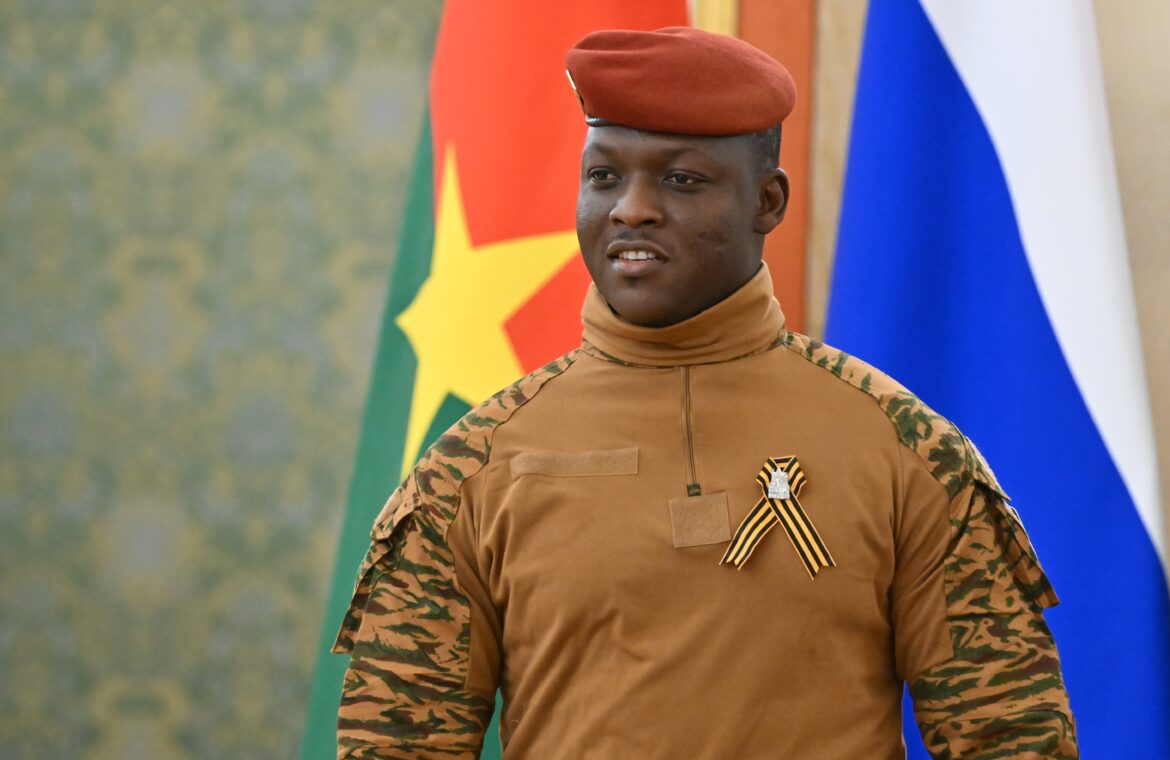
Since Captain Ibrahim Traoré’s ascension to power in Burkina Faso in 2022, he has garnered a controversial reputation as a symbol of anti-imperialism for some and a continuation of military authoritarianism for others. Through rhetoric and policy, he represents a revival of the pan-Africanist progressivism — an ideology that promotes solidarity and sovereignty for African states — that defined politics on the continent in the post-independence era, but his gradual slide towards authoritarianism contradicts his narrative of benevolent rulership. As his rule progresses, to what extent does Traoré’s leadership represent a legitimate commitment to public interests and Burkinabé sovereignty?
From Captainship to Celebrity Politics
Traoré joined the army after graduating with honors from the University of Ouagadougou in 2009 with a bachelor’s degree in science and geology. At twenty-four, he served as peacekeeper in the United Nations Multidimensional Integrated Stabilization Mission in Mali before working in domestic counterterrorism, where he earned his title of captain.
In September 2022, Traoré led the military junta to oust the provisional government at the time, led by Interim President Paul-Henri Damiba, and seized leadership of Burkina Faso, becoming the world’s youngest head of state at age thirty-four. Damiba himself seized power via military coup only eight months before, citing the previous authority’s incapacity to control the ongoing jihadist conflict in northern Burkina Faso, which had been a source of political violence and displacement since 2015. Traoré used this same justification in a statement following the coup, as Damiba was similarly incapable of rectifying the deteriorating security situation.
Although Traoré claimed that the coup was a legitimate act to defend true Burkinabé interests, political scientists have suggested that this chronic oscillation between various military leaders is part of a greater trend of weak governance and neopatrimonial military structures. The kernel of the problem may thus instead lie in weak legal-rational institutions, limited governmental capacity, and colonial legacies in Burkina Faso. By this logic, the 2022 coup is not a legitimate sign of change but rather a continuation of the status quo, though Traoré distinguishes himself from his military counterparts by his youth, charisma, and bold economic populism.
It is notable, therefore, that Traoré’s authoritative ascension to power did not result in popular dissent. To the contrary, in spite of his perpetuation of anti-democratic norms, in the three years of his rule, Traoré has become, according to Enoch Randy Aikins, a researcher at South Africa’s Institute for Security Studies, “arguably Africa’s most popular, if not favourite, president.” Traoré’s message is clear: he aims to free Burkina Faso from the clutches of Western imperialism and neo-colonialism by exemplifying military strength and youthful vigor and by implementing nationalist economic policies. His mission has resonated with dissatisfied citizens across Africa, who hail him as a contemporary version of beloved pan-Africanist Thomas Sankara, who led Burkina Faso until 1987.
Explaining Traoré’s Celebrity Status
His meteoric popularity, though it comes with some significant caveats, can be partially attributed to a shrewd marketing strategy. Traoré’s youth, military uniform, and confident oratory skills cuts a charismatic figure that contrasts aging counterparts and rent-seeking bureaucrats. He has taken advantage of social media to promote his image through misleading posts, and fans have created A.I. generated music videos replacing the lyrics of popular songs with pro-Traoré rhetoric. Traoré’s use of modern technology markets to a younger demographic in a way that his older counterparts have failed, especially considering that the median age in Burkina Faso is 17.7 years. According to Rinaldo Depagne, the deputy director for Africa at the International Crisis Group, Traoré “knows the art of politics — how to make a nation completely traumatised by war feel there is a better future. He is really good at that game.”
Further, it is true that his government has delivered tangible, material deliverables through radical economic policies that signal a departure from the status quo. Traoré severed all relations with former colonial power France in favor of a strong alliance with Russia and established a state-owned mining company alongside a gold refinery and gold reserves. His regime levied a 15% stake from all foreign firms with local skill transfer stipulations, revoked foreign exploration licenses, and nationalized a number of foreign-owned mines. These acts came with the goal of increasing Burkinabé economic sovereignty and redirecting resource profits domestically, which can be considered a keystone aspect of pan-Africanist ideology as it aims to protect African interests from colonial powers’ economic influence. It remains to be seen whether Russia is in actuality a more benevolent partner than the original colonial power.
Traoré’s policies initially appear to have had some success. The International Monetary Fund (IMF) released a statement in April making favorable predictions for Burkina Faso’s economic growth, commenting that the government made “commendable progress” in raising revenue and providing key services in education and health. The World Bank announced that although inflation increased during Traoré’s rule, the extreme poverty rate decreased by almost two percentage points due to development in the agriculture and services sectors. This favors the perception that a ‘strongman’ can be a more effective leader for fragile states as they have the executive power to effect change efficiently, while democracies are limited by bureaucratic red tape.
Traoré’s leadership has an influence beyond Burkina Faso as well. Ghanaian security analyst Prof Kwesi Aning said that “the popularity of the military leader reflected a political shift taking place on the continent, especially in West Africa”. Traoré aligned with Mali and Niger to jointly withdraw from the ECOWAS regional bloc and the G5 Sahel security alliance and instead form the Alliance of Sahel States (AES). Their joint statement explained their departure by criticizing the sanctions ECOWAS levied on seized governments, which they characterized as a result of foreign influence, as well as its failure to intervene in security crises; without ECOWAS, citizens’ ability to seek accountability for human rights violations may become more limited.
Reconciling Popularity with Dictatorship
Though the successes of his governance are relevant, the authoritarian tendencies of Traoré’s regime cannot be understated. Upon seizing power, Traoré suspended all political and civil society activities and dissolved the transitional legislative agency that was previously responsible for the democratic transition. Since, he has routinely suppressed citizen freedoms, the media, and opposition through methods that have often included violence and unlawful arrestation. Deliberate misinformation to favor his public image runs rampant. He has refused to shepherd Burkina Faso towards democratization (at least not in any imminent capacity before the economic and security situation has been consolidated), claiming that ‘Western-style’ democracy is not conducive to growth and welfare in an African context.
Though it is true that the majority of Burkinabé people favor democracy, Traoré’s popularity reflects a fluctuating popular attitude towards the style of shaky democratic governance that reflects a colonial legacy and often fails to deliver efficient and representative results for the public. Therefore, Traoré’s candid strongman authoritarianism has a complicated reputation because he presents an energetic alternative to corrupt bureaucratic lethargy that has plagued other democratic states. The dangers of neopatrimonial authoritarianism are nevertheless undeniable, and many of Traoré’s actions fail to protect the future of Burkinabé citizens.
Part of his appeal is that he routinely invokes Thomas Sankara as a source of political legitimacy and hope for African independence. Sankara was key in a particular strand of modernist, unified resistance and espoused economic independence, national pride, women’s rights, health services, popular education, and environmental restoration. But Traoré may not be more than a loose facsimile of his predecessor, employing the most effective aspects of his image but repurposing them to strengthen a military regime. Although Traoré advocated for some of the principle tenants of pan-Africanism and has been energetic in resisting international encroachment, in many ways he is the continuation of the contemporary status quo: a military leader seeking his moment of power, using charisma and coercion to cement his role in power.
It is possible that this is a false dichotomy, and the debate surrounding Traoré is complicated by various challenges: should the democratic model be investigated as a colonial legacy, and are alternatives worth exploring? What is the balance between effective change for struggling populations and long-term stability based on a foundation of rule of law?
Perhaps the informative aspect of Ibrahim Traoré is that it reveals a need in Burkinabé’s population for a radical departure from a status quo of abuse and stagnation. His magnetism and fervent revolutionary ardor can simultaneously be a distraction from the real prevalence of ‘coup culture’ — and the colonial legacies that, through the erosion of a moral governance body and healthy civil society, have damaged African statehood — and an example of a leader who exhibits a legitimate commitment to his country’s well-being, even if he employs the avenues and strategies of power established by his authoritarian predecessors.
Edited by Elizabeth Kiff
Disclaimer: This is an article written by a Staff Writer. Catalyst is a student-led platform that fosters engagement with global issues from a learning perspective. The opinions expressed above do not necessarily reflect the views of the publication.

Noé Beaudoin is a second year student at McGill majoring in International Development Studies and Economics and minoring in English. As a writer for Catalyst, she seeks to explore the interaction between current events abroad and cultural discourse and is particularly interested in the Middle East and climate action.