
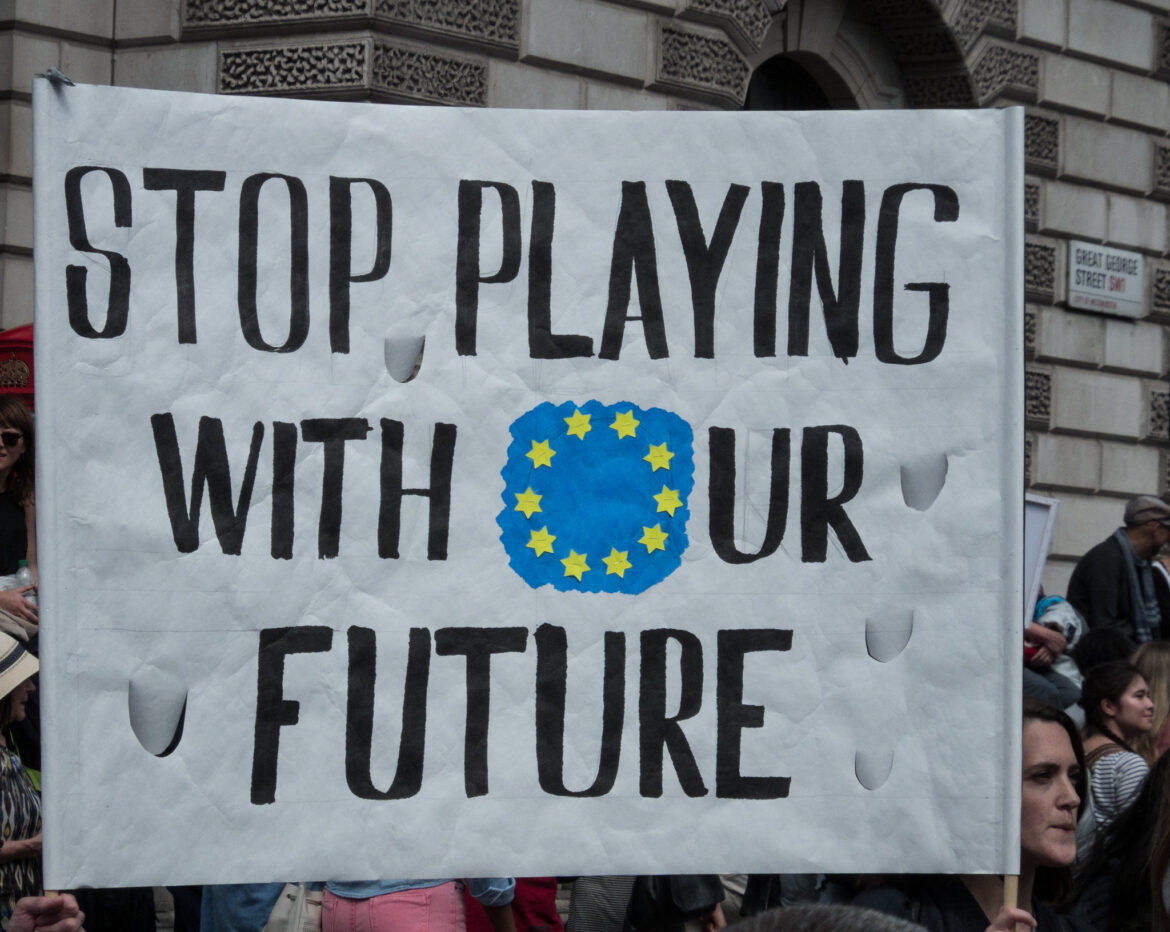
‘Europe can no longer be a custodian of the old world order’, says Von der Leyen, President of the European Commission. In her speech in Brussels on March 9, 2026, she states that our past world order has ended and will not return. Built after 1945 on ideals of unity and hope, this order rested on clear standards Europe set for itself: democracy, the institutional protection of fundamental human rights, and the responsibility to protect its societies from the drift towards racism and fascism.
Yet the EU isn’t left untouched in the storm. It faces an erosion of the social and political mechanisms that once enabled it to resist extremism. As pointed out by the commission’s president recently, we can’t rely on a rules-based international system anymore. In the face of this, the capacity of European societies to sustain social cohesion and political continuity is under strain. Since 2022, with a war unfolding directly on its continent, and 2025, marked by complications in international relations under a Trump-led US hegemony and its attendant discontents, the union finds itself at a critical crossroads. Under this pressure, pillars of stability begin to weaken.
When bigotry and hate are louder than the ideals that made the European project possible, its capacity to withstand an unstable world order is no longer just a risk, but a political reality that societies will have to face – or choose to prevent.
Nationalism in times of external turmoil
The EU’s recent inefficiency in the face of the international crisis has left some frustrated. Many parties have become skeptical. In France, the National Rally (RN) advances messages of disengagement from the EU, emphasizing nationalist objectives that have been reaffirmed within French society. In Italy, Meloni’s speech shifted from a purely eurosceptic one at the beginning of her mandate to a more pragmatic approach based on potential external cooperation. Namely, she is seen as ‘moderating the far right’, an oxymoron that experts have shown is a technique allowing states to pursue illiberal nationalist projects at home while maintaining the facade needed to gain the EU’s privileges. Orban’s Hungary can be seen as merely one of the first symptoms of a decaying system. Since 2010, Hungary has been plunged into an ‘illiberal democracy’. Despite infringement procedures, Hungary’s veto is still effective in complicating major European decisions, especially regarding funds. This highlights the challenge of integrating increasingly illiberal member states within the Union, where participation in EU affairs is driven more by narrow national interests than by a shared commitment to the rule of law, common benefits, and unity. The tolerance of such agendas signals a shifting system increasingly willing to accommodate extremist policies.
Consequently, Europe finds itself at a fragile point, with its political unity sustained less by a shared vision than by the unpredictability of the world beyond its borders.
Greatness by Division
Everyone wishes to be great, but on their own. In regional discourses, fantasies about the past greatness of European countries are increasingly present. A hashtag became viral on the internet: MAKE EUROPE GREAT AGAIN. However, this reveals a contradiction. The ‘grandeur’ sought is often a national one. As nations sense the world order unravel, countries turn inward, prioritizing their own security and interests over collective commitments, as rules, laws, and treaties seem no longer reliable. The slogan calls for making European countries great again, not Europe as a union. The resemblance of this message to the American project MAKE AMERICA GREAT AGAIN is felt. Former French prime minister Bayrou spoke of ‘feelings of submergence ‘ and of ‘flooding’ when referring to migrants. Such rhetoric, also used by Trump, builds division by dehumanizing individuals and creating a rigid opposition between ‘us’ and ‘them’.
All democratic politics could be described as a fight over the future. Yet this desire to go back to a ‘again’, to an imagined past, remains an unclear political project inscribed in politics that rely on sentiments, most often nationalistic ones. These sentiments, paired with fear, tie individuals to their nation through narratives of loss and promised greatness, but in doing so, they foster division. By definition, the greatness of one group implies the relative decline of another. Consequently, compromise is no longer perceived as cooperation, but as loss, and solidarity becomes irrational within a zero-sum framework that legitimizes exclusion in the name of ‘greatness’. This logic gradually redefines the EU not as a community of shared values but as a transactional framework where the nation is increasingly reaffirmed through emotionally driven politics based on hierarchy, deepening the tension with supranational unity.
We may ask: Do people still feel European? Or simply French, German, or Spanish?
When extremism becomes mainstream
If the rules-based order is gone, it is replaced by the politics of fear.
The question is not only to understand why such politics emerge but also how effectively they embed themselves in societies. Europe, the ideal of liberal democracy, collective security, and ‘self-regulating order ’, has often been described by political scientists as distanced from pure power politics. Yet in recent years, we’ve seen a resurgence of REALPOLITIK.
What is striking is the asymmetry of what societies perceive as intolerable. The prospect of perceived loss of national greatness and ‘purity’ creates deep emotional reactions, while violent measures that undermine fundamental rights are neutralized as a form of practical realism. Politics appeals to dogmatism while calling for a need for pragmatism when it comes to the world’s different crises: migration, war, or even genocide. It’s in this combination that lies the success of these policies. Insecurity is best responded to by strong narratives, appealing to a strengthening of sovereignty, sometimes at the expense of our fundamental values.
The generations currently living in Europe are, and have been, the most protected ones to ever exist. Democracy, human rights, and liberalism feel inherent, natural, something that could never be taken away from us, and of which we can enjoy in irresponsible manners. This ideal held by European citizens represents the success of Europe but also its fragility. The European project managed to keep the continent in peace and prosperity throughout its unified policies, economic, and institutional partnerships. Europe managed to make security and prosperity a given right, not a political achievement to be protected. In this environment, discourses that challenge Europe’s foundations gain traction, as the dangers they pose are underestimated, amplified by historical amnesia and the banalization of genuine threats to democracy and peace.
Yet these rights are neither fixed nor guaranteed.
Tolerating the intolerable
French parliamentarian Rima Hassan warned the European parliament in one of her speeches: ‘There are no determinisms to the rise of fascism, it is the result of political choices’. Political choices that, when growing to be tolerated, shift the boundaries of what is normalized in public spheres. A striking example is the EU’s recent announcement that it is ready to approve a bill designed to approve deportation techniques paired with far-right policies that call for stricter measures, notably through detention in deportation centers outside the EU for up to two years. The adoption of such measures represents a major backslide, observed in most of the Western world when it comes to the respect of civil liberties. Extremism risks becoming institutionalized.
Populations grounded in values and historical memory, informed by critical thinking and democratic awareness, are better equipped to recognize threats to democracy and resist them. This capacity depends on the understanding that fundamental rights are inseparable from the duties to uphold them. In this sense, citizens are politically responsible actors who, in the social sphere, have a duty not to sustain policies that harm and endanger others’ liberties. Consequently, European unity will be dependent on the political choices and desires sustained within its societies. For generations, the European project was built on the hope of a political model that could resist division. The attachment to its founding ideals persists. A hope that must be translated into political choices that refuse the banalization of fear and exclusion. Domestically or internationally, Europe can’t afford to lose its role as a diplomatic broker; without reform now, its defining unity risks collapsing.
– The gamble over civic liberties in the name of security is a dangerous one, and ultimately defining of European identity.
Edited by Lou Didelot
This is an article written by a Staff Writer. Catalyst is a student-led platform that fosters engagement with global issues from a learning perspective. The opinions expressed above do not necessarily reflect the views of the publication.

Maria Lecollinet is a first-year student at McGill University, currently pursuing a B.A. in International Development Studies and Political Science. She serves as a writer for Catalyst and has a particular interest in institutional perception, youth participation and civic engagement as well as human rights and the EU’s external relations.