
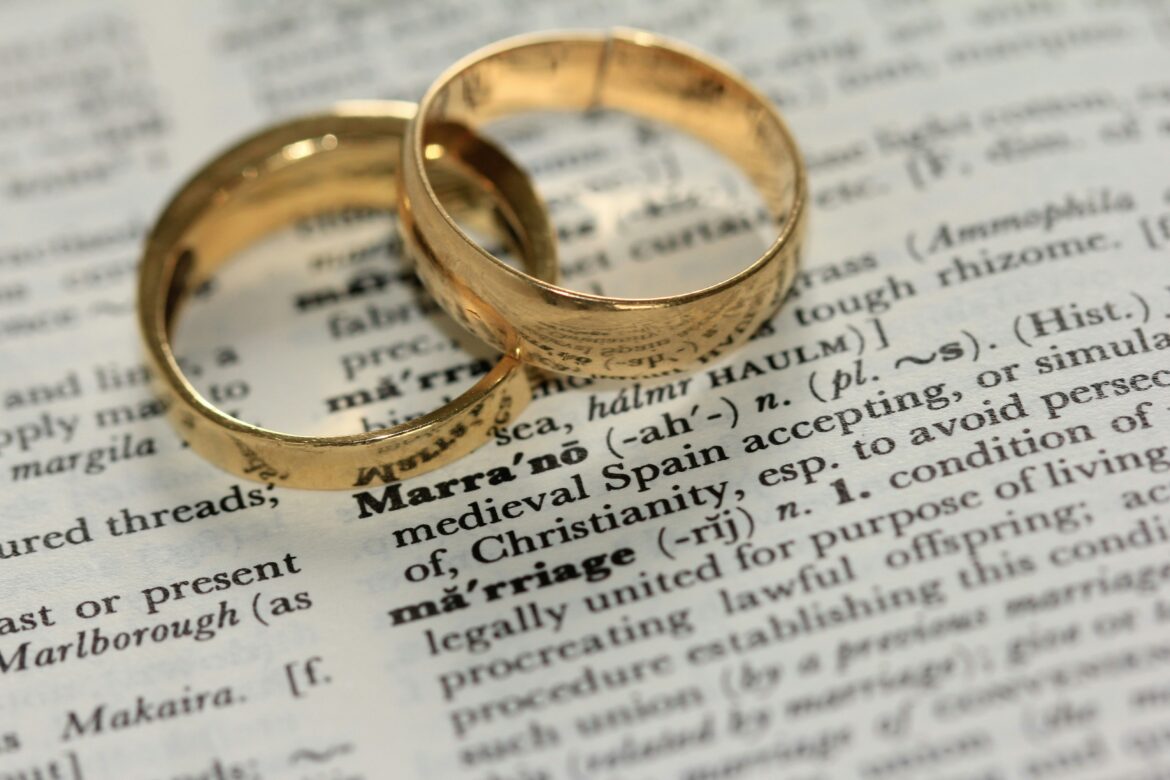
In a heterosexual marriage, it has been historically common for the wives to assume their husband’s surname. This practice takes its roots in the Anglo-American common law called coverture, which first emerged in the 13th century, in which women’s legal identities were suspended and became subsumed into their husbands. Married women were effectively treated as a single legal entity with their spouses, barring them from exercising rights, including property ownership, entering into contracts, or participating in legal actions. Not only unique to England, but coverture became widely practiced in British colonies such as the United States, Canada (with the exception of Quebec) and Australia. Especially in the United States, it was legally required for women to change their surnames to their husbands’ through common law and state-level requirements until the 1970s.
Today, there is no legal requirement in society that requires women to change their last names after marriage. But the social practice continues—according to the Pew Research Center, 8 in 10 women in the United States took their husband’s last name after marriage.
Recent developments surrounding voting rights in the United States suggest there may be political and social consequences of women adopting their spouse’s surname, as contemporary governmental institutions continue to regulate access to rights through mechanisms of legal identity.
What is the SAVE Act, and Does It Impact Married Women?
The Safeguard American Voter Eligibility (SAVE America) Act is a proposed federal law that requires individuals to provide proof of U.S. citizenship to be eligible to vote, mandating proof such as a passport or birth certificate to verify identity. As of March 2026, the proposed bill is being reviewed by the Senate.
The core debate of this bill lies in the fact that many eligible citizens do not have sufficient documentary proof of citizenship; while Republicans claim this would strengthen security against voter fraud, Democrats argue that it risks disenfranchisement of eligible voters, particularly married women who have changed their last name to their husbands’.
If the SAVE Act gets enacted, married women would have to show citizenship documents that match their current legal names. This poses an extra layer of barrier for married women with changed surnames, as their passports and birth certificates still reflect their previous names. In fact, nearly 69 million women in America have birth certificates that do not match their current names, according to Rep. Lauren Underwood.
While Karoline Leavitt, the press secretary of the White House, reassures the married women who have already registered to vote will be “entirely unaffected” by the SAVE Act, the case in New Hampshire proves otherwise.
Cases of Rejected Female Voter Applicants
New Hampshire had a head start in piloting a similar voting restriction law in 2024, requiring first-time voters to show proof of U.S. citizenship when registering. As a result, several voters were not able to vote, solely because they were missing name change documentation.
New Hampshire election officials claim that a voter’s qualification could possibly be restored by searching state records, but even this presents a major obstacle.
In Bethlehem, NH, it was confirmed that 25% of voter applicants were rejected because they were female applicants who only had their birth certificates with their maiden names and did not provide additional name-change proof. Furthermore, a similar case was reported in Concord, NH, where a recently-divorced woman who changed back to their maiden name was denied to vote, all the while her ex-husband was still allowed to vote.
How Hard Is It To Obtain Proof of Name Change?
The instances in New Hampshire are indicative of the potential challenges women may face if the SAVE Act is ratified. However, it is also emphasized that women with changed surnames could regain access to voting by submitting proof of name change. So, how hard is it to get one?
Though it is not particularly difficult to obtain proof of name change, it proves to be time-consuming, one that involves many bureaucratic hurdles. Though it varies by state, the general flow begins with filing a marriage certificate, followed by sending multiple requests to change names on Social Security Card, driver’s license, the US passport and other travel documents. All of this process takes 2 weeks at the shortest, 6+ months at the longest.
Both historically and currently, women are registered to vote in the US at higher rates than men (74.9% of women registered to vote in 2024, in contrast to 72.2% of their male counterparts). However, these additional layers of complexity could affect women’s participation in voting and potentially impact the balance of this gender gap.
Just How Widespread is Election Fraud?
More fundamentally, the core issue that the SAVE Act claims to tackle is preventing election fraud. But is it truly as prominent as the republicans claim it to be?
According to the Brennan Center’s seminal report (The Truth About Voter Fraud), it found voter incident rates to be very minuscule—0.0003% and 0.0025% within the “hot spots” that are known for alleged voter fraud. Americans are more likely to be “struck by lightning” than to impersonate another voter at the poll, it concluded.
In fact, most of these incidents were found to be based on errors, such as clerical errors, mismatched data, and voter mistakes, rather than actual fraud. Such data poses further questions about whether the SAVE Act is truly worth implementing; should it prioritize preventing voter impersonations that rarely seem to happen, and risk posing more bureaucratic hurdles for female voters?
All of these points point to the social and political implications women may face, solely because of the name-changing customs; not only does this reveal the historical remnants of coverture doctrines on today’s women’s voting rights, but it also demands a closer examination and cautious approach when modifying policies that could potentially ostracize particular stakeholders.
The SAVE Act is being promoted to uphold electoral integrity, but in practice could turn into a structural mechanism of exclusion that may conflict with the very democratic principles the Act seeks to protect. Congress now faces a defining choice, as a democracy that limits who can participate in the name of protecting itself risks becoming something else entirely.
Edited by Olivia Moore
Disclaimer: This is an article written by a Staff Writer. Catalyst is a student-led platform that fosters engagement with global issues from a learning perspective. The opinions expressed above do not necessarily reflect the views of the publication.

Leina Pham-The is in her first year at McGill University, currently pursuing a double major in Political Science and International Development. She serves as a writer for Catalyst and has an interest in topics where culture, history, and human rights intersect.