
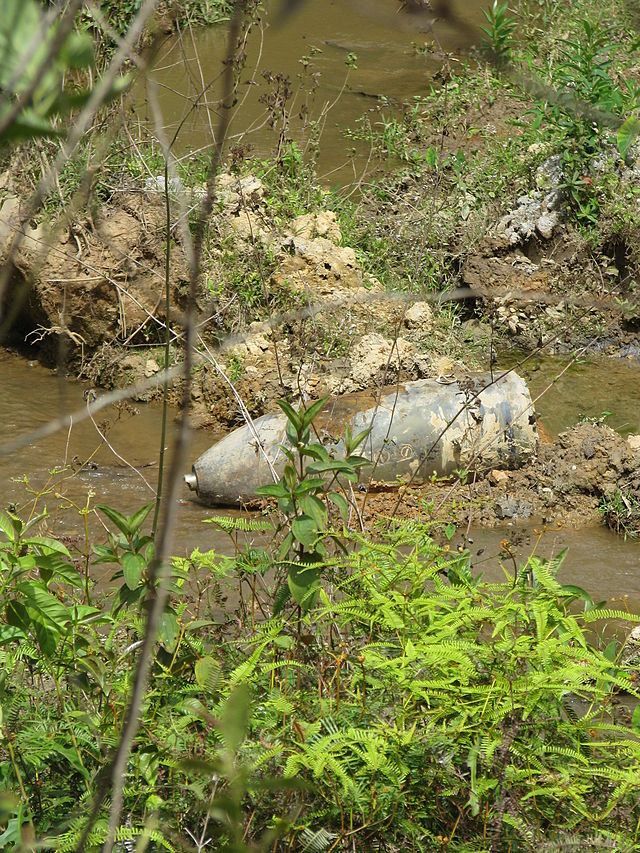
During Cold War counterinsurgency operations and the Laotian Civil War, the United States conducted a “Secret War” in Laos that spanned from 1964-1973. The US organized 580,344 bombing missions over Laos in an effort to isolate Communist North Vietnamese forces during the Vietnam War. Around 2 million tonnes of explosive ordnance were dropped on Laos, making it one of the most heavily bombed nations in history. 270 million of which were cluster bombs, and 30% never detonated. Cluster bombs scatter submunitions that often fail to detonate on impact, but remain active. Thus, communities continue to live in danger of accidentally setting off these unexploded explosive ordinances (UXOs) as they go about daily life.
Four-year-old Namneung is among many who have become victims of these explosives. While playing in the forest in Nambak District, Laos, she picked up an object that resembled a baseball. When it detonated, she was rushed to the nearest hospital, almost two hours away, and treated, but sadly, lost vision in her left eye.
These occurrences are far from rare in Laos. Since the war ended in 1975, 20,000 people have been killed by unexploded explosive ordinances (UXOs), approximately half of whom were children. Farmers are unable to tend potentially rich soil due to the risk of coming across an UXO. Construction of schools, roads, hospitals, and industrial parks can only be done once land is cleared, hindering economic and social development. Development opportunities are routinely stalled, as the continued presence of UXOs restricts land use, delays essential infrastructure projects, and limits the country’s ability to fully leverage its natural and human resources.
Balasubramaniam Murali serves on the Board of Directors at Legacies of War, an advocacy organization working to raise awareness and address the ongoing impacts of American wars in Laos, Cambodia, and Vietnam. He also served as the Deputy Head of Office for the United Nations Development Programme (UNDP), while residing in Laos. The primary focus of the UNDP in Laos is UXO clearance. While living in Laos, he experienced firsthand the impacts of these UXOs on development. Murali explained that these UXOs are unlike mines since they lack fuses. There is no way to deactivate them, so when touched, they almost inevitably blow up. A team must be called to remove them from the site. Priority for removing these UXOs is given to farmland and areas where community-based activities are held, such as schools or community centers. However, even as these bombs are cleared, the area can soon be deemed contaminated again.
Murali explains that heavy rains and flooding, which are common in Laos, can bring these baseball shaped UXOs in their wake, leaving areas previously cleared to become re-contaminated. When such events occur, the government deems these areas unsafe, and any activities conducted risk people’s lives. This land volatility significantly constrains agricultural expansion and disrupts the safe use of land for industry, tourism, and infrastructure construction, increasing the costs of development projects. All of this is particularly damaging in a country where subsistence agriculture remains the foundation of rural livelihoods.
The consequences of this “Secret War” waged by the U.S. have persisted past its original intentions. They are considered “the fundamental drivers of Laos’ chronic underdevelopment” according to a paper by Riaño and Caicedo. They discuss the specific correlation between the bombings and long-term impact on economic development. Finding that areas contaminated with UXOs show “decreased human capital accumulation, hindered structural transformation and dampened rural-urban migration.” Identified as one of the poorest countries in the world, Laos thus faces one of the most significant challenges to development as a consequence of physical remnants of a conflict in which they bore no agency.
International efforts to remediate the effects of these UXOs have been ongoing for several decades, though progress has been slow relative to the scale of contamination. Organisations like The HALO Trust, Mines Advisory Group (MAG), and Norwegian People’s Aid have provided funding and operated alongside the Laos government’s national clearance body, UXO Lao, in conducting survey and clearance operations across affected provinces. Acting as a government regulatory body, the National Regulatory Authority/Mine Action Sector in Lao PDR (NRA) has advocated for Convention on Cluster Munitions (CCM): a legally binding international treaty ratified by over 100 states that prohibits use of cluster munitions. The NRA has also pushed for the inauguration of SDG 18, “Lives Safe from Unexploded Ordnance (UXO)”, making Laos the only country with an 18th Sustainable Development Goal. While these measures bring awareness and acknowledge the barrier posed by UXOs, funding for UXO removal remains somewhat inadequate.
The United States, historically the principal bilateral donor to these efforts, has contributed more than $350 million since 1995, funding clearance teams, explosive ordnance risk education, and survivor assistance programs. With funding from these various sources, UXO Lao has identified 254,235 hectares of hazardous areas and cleared unexploded munitions from 101,569 hectares. This effort over three decades has been substantial, yet leaves much to be done. Insufficient momentum has been further destabilised by recent policy shifts in Europe and the U.S.
The funding freeze imposed by the Trump administration on January 20th, 2025, suspended all U.S. foreign aid for 90 days pending a review by the Department of Government Efficiency. Even this supposedly short period of suspension meant devastation for this aid community. The work of many specialized humanitarian workers was lost, and people continue to face the consequences of the bombs. More than 100 calls were made to the clearance hotline, but workers were not permitted to respond due to the executive order. Still, it is unclear whether funding has resumed, leaving these communities vulnerable to the explosives. Though greatly reduced, the bomb removal operations are continuing thanks to funding from countries like Japan, Norway, and New Zealand. “The comprehensive scope and sustained funding that [the USA] brought to the table may be hard to fully replace”, says Sera Koulabdara, the CEO of Legacies of War.
Further policy shifts from European countries have further destabilised the bomb clearing effort. Early in 2025, Estonia, Latvia, Lithuania, Poland and Finland announced plans to withdraw from the Ottawa Convention, or Anti-Personnel Mine Ban Treaty, in response to Russia’s full-scale invasion of Ukraine. The treaty bans all use and production of anti-personnel mines and commits members to clear contaminated land. This move weakened the political consensus around mine action and ignored the devastating consequences that such mines have posed on various Southeast Asian countries.
The diminishing global dedication to the removal of explosive remnants of war carries real and immediate consequences for the communities of Laos and its neighbours. More than half a century after the conclusion of hostilities, UXO contamination continues to constrain agricultural productivity, impede infrastructure development, and claim lives. The suspension of U.S. funding, the withdrawal of several European states from key international treaties, and the broader reorientation of donor priorities collectively undermine decades of incremental progress. While organizations such as UXO Lao, MAG, and The HALO Trust continue to operate under increasingly strained conditions, the scale of contamination far exceeds what non-governmental actors can address without robust state support. Addressing this crisis in a meaningful and timely manner requires sustained financial commitment and political will from the states most responsible for the conditions that produced it.
Edited by Alexandria Alikakos
This is an article written by a Staff Writer. Catalyst is a student-led platform that fosters engagement with global issues from a learning perspective. The opinions expressed above do not necessarily reflect the views of the publication.

Suhani is in her fourth and final year at McGill University as an International Development student, with minors in Environmental Studies and Psychology. She is originally from New York City and is especially passionate about environmental issues and policy making that can have critical impacts on global communities.