
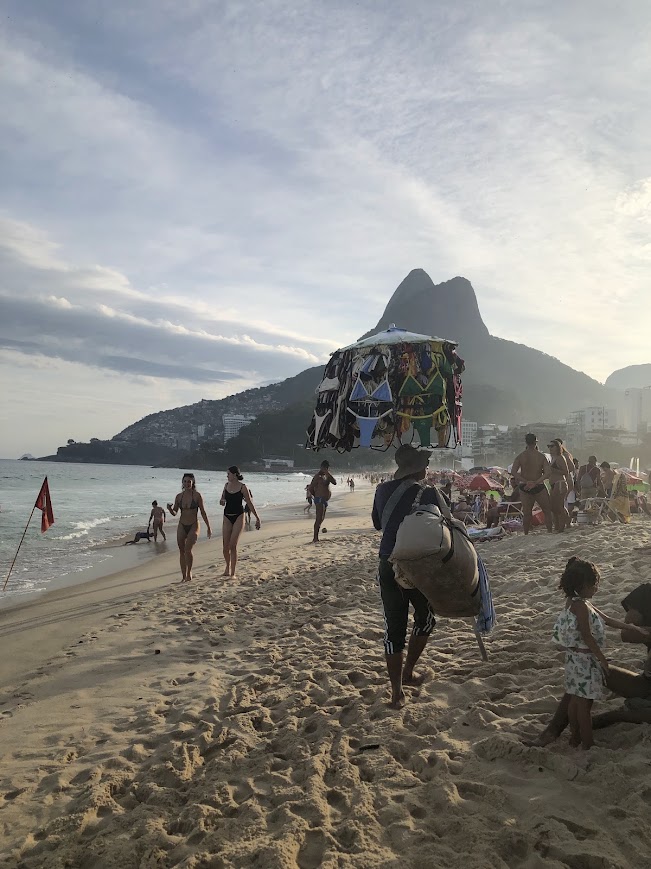
This article was prompted by a personal experience during my trip to Rio de Janeiro in early May. When a series of vendors on the beach asked me to help their families living in the favelas by buying their products, I felt a mounting sense of stress and guilt, both when I did buy from them and when I refused. I could not determine what the “right” thing to do was, knowing on one hand that I was on a student budget and might be getting scammed, and on the other hand that I was immensely privileged to even be there and that they could use the money more than I could.
That experience led me to consider a question: Is it better to remain within mainstream tourist spaces, as I did—where my only interaction with favela residents was a stressful transaction on the beach—or to take a tour that, while potentially romanticizing the area, might allow for more meaningful interaction?
This question felt like a microcosm of my broader uncertainty of the ethics of international development as a whole, where the questions “what is the best way to help?” or “is it saviouristic to think you even need to help?” often echo in my mind. Understanding this experience felt like a helpful way to clarify some of my broader thinking about my area of study and eventual career.
The Spectacularization of the Slum
With the arrival of the consumerist Western Middle Class in the late 1930’s, old Protestant morals surrounding poverty began to change. Once perceived as dangerous and undeserving of sympathy, the poor began to be seen as victims of society’s failure to support them. This change of sensibilities created the “spectacularization of the slum,” which provided a way for the middle and upper class to explore, yet remain at a safe distance from, the exotic world of poverty and deprivation. Celebrities and intellectuals, such as Albert Camus and Orson Welles, visited Rio de Janeiro and praised these spaces for their vibrancy compared to the dull company of the bourgeoisie. Today, higher-income travelers are driven to participate in favela tours by this same desire for ‘authenticity’: short, three-hour excursions that take you by foot or by car from your hotel lobby up to the favelas that perch on Rio’s hills.
However, the favela tours that emerged in response to this demand for authenticity are scrutinized by academics, who argue that the tours exoticize favela residents’ lives. Some academics believe that these tours act like safaris, portraying people living in poverty as animals. Locals have little say in decision-making, while professional tourism companies often reap all the financial benefits.
Others argue that some of these tours can challenge stereotypes if done correctly and improve the lives of favela residents. Elite academics may also overestimate the degree of exoticization felt by favela residents. Indeed, academics rarely consult the favela residents whose dignity they claim to be advocating for. In Rocinha, the city’s most popular favela to visit, 84% of interviewees actually do sympathize with the presence of tourists. Many residents simply appreciate that people want to visit their hometowns.
That said, favela residents are far from a heterogeneous group, and some are wary of tourists’ interests; Heitor, a motorcycle delivery boy, exclaimed: “Favelado ain’t no sucker! We know what you are up to. We know that people come here to have fun, but they also want to see all our little shacks, to see the big-shot criminal.” In the same way that the favela residents are observed by tourists, the tourists are, in turn, observed by the favela residents, who often make joking remarks about them. Common conceptions of favela residents as either passively benevolent towards tourists or completely opposed to them oversimplify their perspectives. It is essential to acknowledge residents’ agency and individuality while recognizing the unequal power dynamics between them and the tourists.
The debate around the ethics of favela tourism also often generalizes tourists as a voyeuristic mass. In reality, tourists also grapple with the morality of their participation in a favela tour. Tourists’ motivations for participating in favela tours include seeking authenticity, non-traditional experiences, community spirit, adventure, and curiosity about poverty. All 6830 TripAdvisor reviews of these favela tours expressed satisfaction with the authenticity of their experiences and the strong sense of community they encountered. Granted, these experiences are influenced by the “tourist gaze,” as tourists arrive with preconceived ideas about the favela and seek out what they consider “authentic” experiences on their tours. Nevertheless, direct interaction with the place and its people can actually challenge these imaginaries, especially the representations of the city’s violence. Indeed, compared to the blatant spectacle and staged repetition of massively popular tourist sites throughout Rio, favela tourism holds the potential for greater authenticity.
One-Way Street: Unequal Access to the City
While the slums increasingly attract wealthy visitors for short trips, the reverse—poor Brazilians entering affluent spaces—is often met with resistance. A recent example of this contradiction is the rolezhinos, or “little strolls,” that took place throughout malls in Brazil’s major cities in June 2013. Groups of youth, mainly from lower-class neighbourhoods, ran through malls chanting, provoking middle- and upper-middle-class shoppers and mall security. Brazilian conservative media deemed it vandalism, recalling a similar practice of social disruption, spray-painting and tagging, often carried out by lower classes in public urban areas. However, the Rolezhinos and spray-painting push back against the normalization of the “Divided City,” a term coined by Zuenir Ventura which conceptualizes Rio as divided into two: the Asfalto (the asphalt), the formal, urbanized, and wealthy areas of the flat paved city—such as the South Zone of Ipanema and Copacabana—and the Morro (the hill), the informal favelas on the hillsides.
However, this division is not as strict as it is made out to be, as between distinct divisions, there are “contact zones” where the two worlds can meet and navigate their relationships. Ipanema Beach is an example of this contact zone, where lower-income Rio residents interact with wealthier tourists and other Brazilians while selling goods or asking for money. These interactions are still influenced by class power dynamics, as lower-class folk often cater to the needs of higher-class Rio residents. But how productive are these reactions — do they actually serve to challenge the status quo?
Copium for the Shame of Wealth
I attempted to understand my emotional reaction to the contact zone on the beach through Rachel Sherman’s Uneasy Street: The Anxieties of Affluence. She interviewed 50 upper-middle-class families in New York to understand how liberal progressives justified their wealth in a world that no longer offers a convincing excuse for it. Through her interviews, she determined that there are three dimensions of what makes a person feel legitimately entitled to their wealth: working hard, consuming prudently, and giving back. It is hard to justify the first two dimensions while lounging on Ipanema beach in Rio, but the third, the public display of giving back, is where the conflict emerges. Each interaction with someone less fortunate, each “nao obrigada,” begins to feel like a refusal to give back, fuelling a growing sense of shame. Sherman explains that some interviewees felt aware of their privilege, and their “not doing enough” was enough to entitle them to their wealth, saying, “thinking about being fortunate is like the compromise point between a lack of awareness and concretely giving up enough to cause discomfort.” This line struck a chord with me, as I found that feeling upset about the incident was somewhat productive and a good expression of my guilt and, thus, my morality. Sherman contends that today’s awareness of class differences is primarily private, leading to a feigned ignorance of these divisions. The chapter concludes with an ominous warning about this pattern:
“Thus, the transmutation from private awareness to public egalitarianism silences difference rather than acknowledging it. Although the social norm of equal, reciprocal treatment serves to avoid shaming those who have less by not drawing attention to their status, its function of obscuring difference also serves to mitigate discomfort in those with more.”
This reluctance to put myself in situations where class divisions must be confronted explains my knee-jerk reaction to the favela tours. If I am being honest, I was not so much provoked by concerns about unequal financial recompense to the residents or the other ethical concerns mentioned above—I was mortified by the notion that I would have been judged for participating. Judged by my progressive peers, but mainly, judged by the residents themselves. I worried that my participation in such a tour would place me in the path of the critical gaze of those from lower socioeconomic backgrounds, who would determine (as I had) that I had no legitimate entitlement to my wealth and resent me for it. I did not want to disrupt the bliss of ignorance of class division that has been framed as “awareness.” The fear of the favela tour then encouraged me to dismiss it with progressive arguments, enabling a cognitively dissonant line of reasoning: “If the favela tours are wrong, then I am therefore not wrong for being scared to do them.” In this manner, my experience in the public urban contact zones of Rio, with its infinite array of people, revealed a private truth lying unexamined in my subconscious.
Edited by Noah Bornstein
This is an article written by a Staff Writer. Catalyst is a student-led platform that fosters engagement with global issues from a learning perspective. The opinions expressed above do not necessarily reflect the views of the publication.

Madeleine Landon is a U2 student pursuing an Honours International Development with a minor in Environment. She is interested in writing about Latin American Politics during her semester abroad in Buenos Aires.