
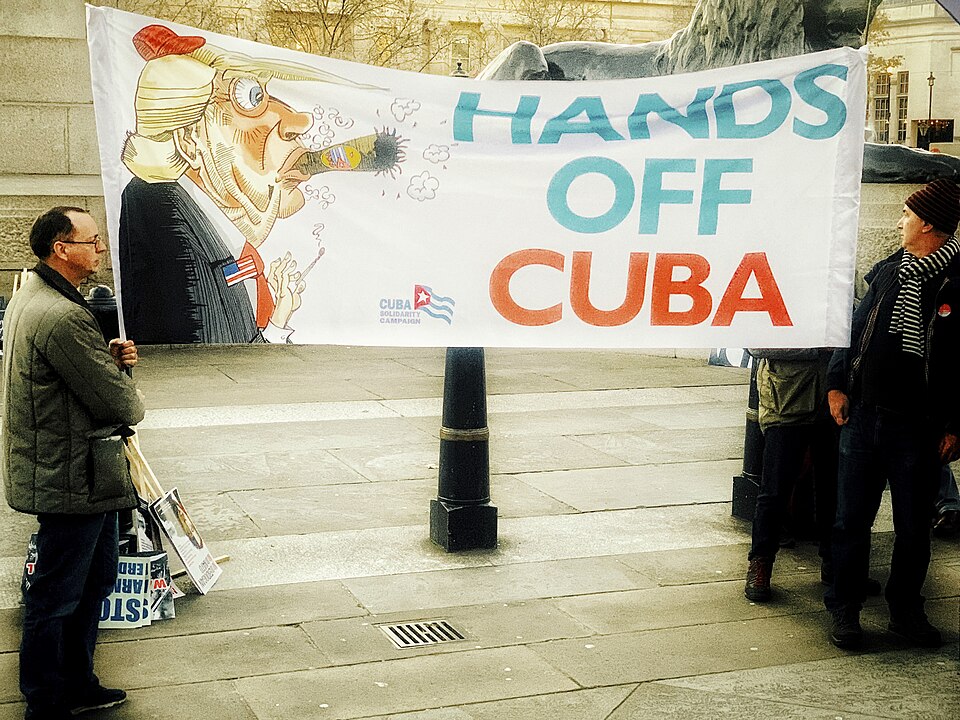
In May 2026, U.S. President Donald Trump expanded pre-existing sanctions on Cuba with the intention of cutting off more foreign investors into the Cuban economy. The new order built on previous sanctions implemented in January, which sanctioned only parties directly responsible for supplying Cuban fuel and thereby created an energy blockade of Cuba. The May sanctions are significant as they are secondary sanctions, meaning that “any foreign financial institution handling transactions for a sanctioned entity risks being sanctioned themselves.” In other words, all parties playing a part in facilitating a Cuban transaction — not just those directly supplying goods to the country — are at risk of a U.S. sanction. This poses greater risk to a wider net of agents, including those responsible for energy, financial services, and “any other sector of the Cuban economy”. The new sanctions will thereby have an extraterritorial deterring effect on traders, insurers, tourism, shipping companies, and financial institutions, further impairing Cuba’s security, energy, and economy.
Companies already sanctioned under Trump’s new order include the Grupo De Administracion Empresarian S.A. (GAESA), Moa Nickel S.A. (MNSA), Almacenes Universales S.A. (AUSA), and Internacional S.A, managing the financial services, mining and metals, exports and imports, and commercial banking sectors of the Cuban economy, respectively. Stephanie Connor, a former senior official in the Office of Foreign Assets Control, warns that the secondary sanctions could deter foreign banks from operating in Cuba entirely, even if transactions don’t result in US sanctions, because “the new authority applies to entire sectors of Cuba’s economy.” Secondary sanctions may additionally be applied to companies already sanctioned under Trump’s previous orders. However, under previous sanctions, such companies were permitted to make transactions with the U.S. as long as such transactions were separate from their Cuban trade. Under secondary sanctions, they are entirely cut off from the US market even if Cuban transactions are separate. Losing access to the U.S. dollar and associated financial institutions would isolate companies from one of the most important financial markets, significantly increasing the risk of involvement in the Cuban economy. Trump’s new sanctions will effectively undermine Cuba’s economy by turning away not only its direct foreign investors, but also any secondary agents necessary to facilitate sale into Cuba.
Why Cuban Sanctions Work
The small island of Cuba has always been greatly reliant on foreign investors for economic efficiency. Following the 1959 Cuban Revolution, former Cuban President Fidel Castro reorganized the country’s economy around trade with the Soviet Union. When the Soviet Union fell, Cuba’s economy crashed, and the U.S. immediately acted to block private investment into Cuba for political leverage. While Cuba did acquire other important trade partners, particularly Venezuela, which became one of its greatest oil suppliers, it remains vulnerable as its ability to survive relies on external circumstances. For instance, when Trump invaded Venezuela and captured its president Nicolas Maduro in January 2026, Cuba’s economy and energy supply took a strong blow. Sanctions impacting entire sectors of the Cuban economy, therefore, will reliably create multifaceted consequences across the country.
Trump’s Cuba Policy
Throughout his presidencies, Trump has significantly intensified the American economic embargo against Cuba. In his first term, Trump immediately reversed President Barack Obama’s Cuba policy, reinstating lifted travel and business restrictions and formally designated the Cuban government as a “State Sponsor of Terror”. Such actions faced majority disapproval across the American public and were criticized by Congress, which warned that they would only worsen Cuba’s political climate and economic isolation. Trump has only continued to politically demonize Cuba in his second term and aggressively put pressure on its economy in the form of multiple waves of sanctions.
In January 2026, Trump issued an executive order declaring the actions of Cuba’s government a national emergency, stating that its ties with US adversaries like Russia, China, Iran, and Hamas make it a great national security threat. Additionally, the order outlined that the country’s communist regime itself is dangerous to the U.S. as its policies promote violence and terrorism and jeopardize Cuban human rights. The order invoked the International Emergency Economic Powers Act (IEEPA), under which Trump attempted to impose tariffs on any U.S. imports sourced from countries trading with Cuba. However, the Supreme Court ruled such tariffs under the IEEPA unconstitutional, forcing Trump to resort to the secondary sanctions issued in May. In threatening the fundamental operation of Cuba’s economy, Trump hopes to generate enough pressure to create regime change in Cuba, which he views as an American threat both in principle and in practice.
U.S. Secretary of State Marco Rubio defended Trump’s new sanctions, claiming that GAESA is used by Cuba’s regime elites to “steal the island’s few resources, diverting them for repression, anti-American subversion and spying instead of schools, power plants, and basic necessities for the Cuban people.” The Trump administration claims that a primary reason behind implementing Cuban sanctions is to end the unjust treatment of the Cuban people by their communist government.
However, to impose such sanctions with the alleged intention of improving the human rights of the people of Cuba is contradictory.
Humanitarian Consequences
Trump’s sanctions have greatly undermined human rights in Cuba, depriving its people of access to food, water, and essential healthcare. Volker Türk, UN High Commissioner for Human Rights, expressed concern over the new sanctions, warning that they are effectively causing widespread humanitarian harm to the people of Cuba. The sanctions have halted fuel imports, creating blackouts across Cuba lasting over 20 hours consecutively. Families in Havana are concerned for their survival with the dwindling oil supply, as they have been forced to use wood and coal to cook, which many cannot afford. Nearly 80% of food consumed in Cuba is imported, making the sanctions detrimental to the availability of food necessary for survival.
Healthcare has also taken an extreme hit. Türk notes that children in particular are dying due to the newfound lack of medical resources caused by suspended shipments into Cuba following the sanctions. The infant mortality rate has doubled to 9.9 deaths per 1000 live births since the January fuel sanctions, and childhood cancer survival rates have declined from 85 to 65 percent. Ambulances lack the fuel to respond to emergencies, and energy blackouts are severely disrupting the operation of hospitals. Individuals living in Cuba with chronic illness are among those most harmed, with an estimated five million having their treatments and medications affected. Türk urges the sanctions to be lifted immediately, as “’such severe sanctions packages that target entire sectors of an economy and produce broad, indiscriminate, and harsh effects on populations are incompatible with basic principles of international human rights law.’”
Beyond the concern and disapproval of the UN, Trump’s sanctions have fueled tensions among many countries, notably Cuba’s largest trade partners, many of which are U.S. allies. In April, Spain joined forces with Mexico and Brazil to express “deep concern regarding the serious humanitarian crisis the Cuban people face”, and urge the U.S. to adhere to the principles of territorial integrity enshrined in the United Nations Charter. Mexican President Claudia Sheinbaum has also openly opposed Trump’s sanctions, stating that Mexico has never supported the Cuban blockade. China has also repeatedly expressed condemnation for the U.S. embargo against Cuba, with Foreign Ministry spokesman Lin Jian accusing Trump of “‘inhumane actions that deprive the Cuban people of their right to subsistence and development’”.
The people of Cuba, whom the Trump administration claims it is attempting to protect, are the very group taking the strongest hit from its new sanctions. Despite domestic and international condemnation and evidence of widespread Cuban suffering as a consequence of his behavior, Trump continues to aggressively reverse the normalization of U.S.–Cuba relations and discourage foreign participation in the Cuban economy.
Edited by Nina Serengulian
This is an article written by a Staff Writer. Catalyst is a student-led platform that fosters engagement with global issues from a learning perspective. The opinions expressed above do not necessarily reflect the views of the publication.

Sofia Kaplan is pursuing a double major in Psychology and International Development studies at McGill University. She is particularly interested in politics of human rights.