
On a Monday morning in front of a Parisian school, a sign is raised: ‘Arthur nous l’a montré: etre jeune c’est se révolter’ translating to ‘Arthur showed us that being young is being revolted’. Arthur Rimbaud, whose poetry is part of the national secondary-school curriculum, is now invoked by the very students who have taken his words to the streets to protest against the educational system. The irony is striking: students draw on ideals encountered through state education to challenge the very institution that teaches them.
By early October, more than 90% of schools across France had mobilized against the state’s failure to allocate sufficient resources to education. Slogans such as ‘money for schools, not for their wars’ are being used to denounce chronic underfunding. In only a few weeks, students have swiftly positioned themselves as the backbone of their country’s socio-political life, refusing to relinquish their civil rights to question authority and shape France’s future.
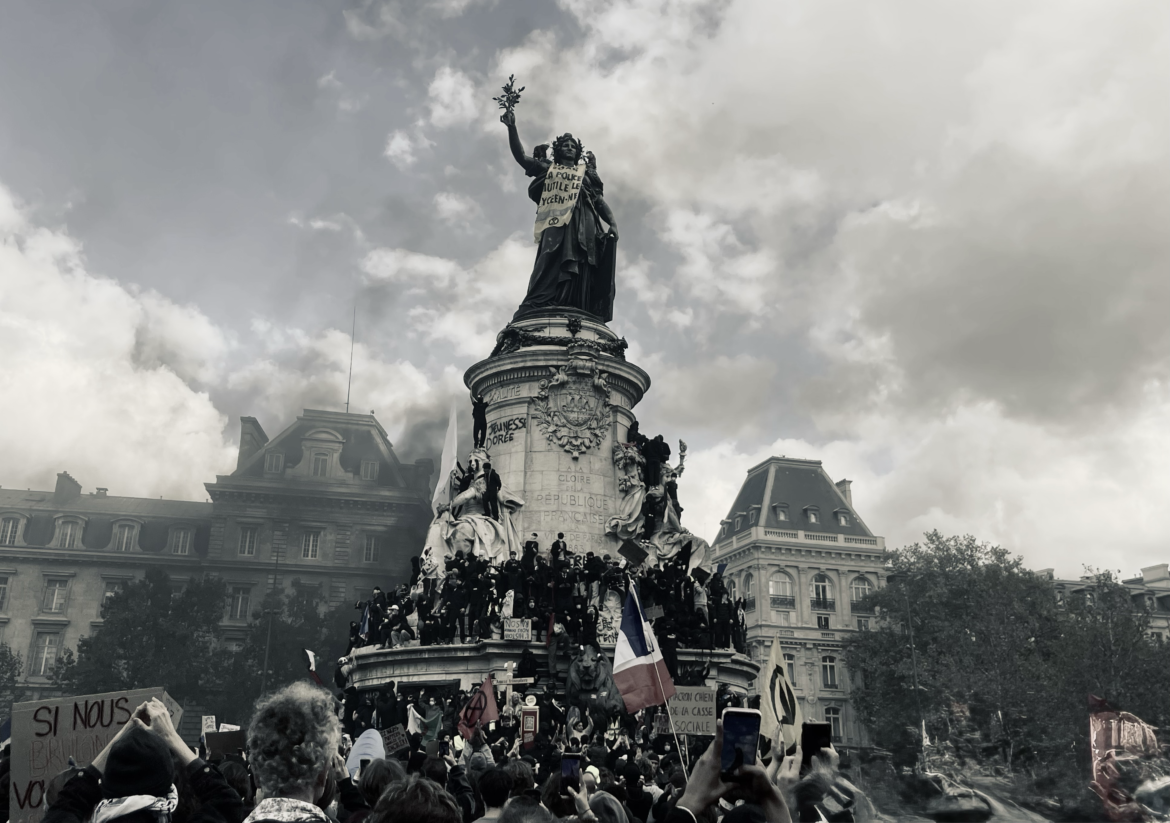
But the movement wasn’t met by the state with equal enthusiasm. On October 17, in light of the mass mobilisation of converging social movements, the statue of Marianne, emblem of the French Republic, was adorned with a massive yellow-vest (a symbol of grassroot French protest movements) written ‘2026: The police mutilates highschoolers’.
Police Misconduct: Asking for Teachers, Receiving Grenades
After three weeks of protesting, the number of young people arrested or harmed by the police is unprecedented; 8,000 people have been placed in police detention, the overwhelming majority being minors. Human rights organizations are criticizing the drastic levels of violence being used against peaceful protestors: minors strangled, beaten, tear-gassed, and, in some extreme cases, have lost limbs due to grenades. While the government claims that the police’s response was ‘proportional’, the reality on the ground proves otherwise. Amnesty International, as well as deputies in the European Parliament, denounce the authoritarian drive that the repression took, unexpected in a democratic country.
Nina, a French student, gives her testimony. While she was making her way towards Place de la République in Paris, the authorized gathering point where the protest was supposed to begin and follow a pre-established route, the police struck civilians with tear-gas grenades. This forced the crowd to disperse, triggering dangerous crowd movements and creating chaos. She recounts that the police intervened before the protest even started, disrupting a joyous and peaceful demonstration, filled with music, dancing, and orchestras. This experience was not unique; the day before, while protesting at the Place de la Bastille, the police enclosed protestors in the square. When approaching police officers asking where to find a way out, she was constantly redirected and eventually prevented from exiting freely. After an hour and a half, she managed to leave the square, but the people still blocked inside were being teargassed. Such experiences became the norm for youth rightfully defending their rights: ‘There is a very palpable climate of violence, especially when I pass near the police, it feels scary’.
The French police suffer today from a huge democratic deficit. It is perceived as being too distant from the people, failing to serve the interests of protestors and instead acting as an armed response of the state. Its behaviour towards minorities exhibits racial profiling, disproportionately targeting people of color perceived as more ‘suspicious’ or ‘inherently dangerous’.
Rather than embracing de-escalation strategies, police force against protesters fosters vicious circles of violence. Namely, police custody of minors is overwhelmingly instrumentalized as a means of intimidating and deter demonstrators, rather than solely addressing misconduct.
Such violence raises questions about the gap between the democratic ideals embraced in France and the reality of the repression faced by youth on the ground, a stark contrast to communal aspirations for the educational system.
Education : An ‘Égalité des Chances’ ?
The French educational system claims to be based on one ideal: ‘l’egalité des chances’ (‘equality of opportunities’), implying equal opportunities for civilians to access quality education. This is founded upon the core tenet that humans are born free and equal in rights (Declaration des Droits de l’Homme et du Citoyen de 1789 ). Consequently, if all individuals are equal they also hold the same opportunities in accessing schools and jobs. This ideal cannot be detached from the concept of meritocracy: a social and political system in which individuals are rewarded based on their personal merit. This works on the premise that all citizens are equally autonomous and that, therefore, you become what you are depending on your personal work and dedication. This makes people the only ones fully responsible for themselves and their success in society.
Social realities are far different. While students are subjected to the same standards and expectations (with nation-wide exams like the Baccalaureate ) they do not necessarily possess the same resources, support systems, or social and cultural capital with which to meet them. Their opportunities or ‘chances’ are constantly shaped by socioeconomic circumstances that precede their participation in the educational system. Applying identical standards does not erase differences. On the contrary, it risks exacerbating inequalities by expecting the same level of academic excellence from everyone, regardless of their personal desires and paths.
This educational structure is, in part, what encouraged the protests. French students in secondary schools undergo immense pressure from these standardized expectations often presenting excellence and competition as values. Their failures within the educational system taste all the more bitter because they are perceived as a reflection of their own lack of merit. They find themselves in a constant struggle to rise above one’s social circumstances. Protestors call for more resources to be allocated to schools, especially in marginalised parts of the country, where the shortage of teachers and infrastructure does not provide the same conditions for studying as in the capital.
‘Etre jeune c’est se révolter’–
A juxtaposing discourse is occurring; ‘They teach us revolt, ideals of liberty, equality and fraternity, but when we claim such rights for our country, we are met with repression’. Protest is deeply embedded in France’s culture. Whether through history, monuments, music, or slogans, revolt is an inherent part of French identity. The collective memory of the 1789 revolution shapes the perception of the Republic, and today’s political discourses remain filled with references to crucial moments such as the storming of the Bastille. Namely, the student revolts of May 1968 have been invoked on placards and in chants in protests. It’s not just seen as an option but a duty, in case the government doesn’t meet the citizens’ grievances. It’s an integral part of civic and political life, as much as voting.
The student movement grew into a national movement, anchored in its very youth. Protestors mix TikTok references, memes, and even ‘aura battles’ with their demands, switching from popular songs to the national anthem as they protest. They break the illusion that engaging meaningfully in the political life of the country is reserved for a certain type of language, movement or age.
We can hear protesters scream, ‘The republic isn’t old people in offices; the Republic is the youth; the republic is us’. A student testimonies: “The French flag is raised everywhere; we sing the national anthem all together in front of the police, and in squares”. Student protests became sites of joy, using music, art, and dancing to counter an increasingly monotone and inactive power. However, the state’s response changed the gears of the demonstrations, and it is using the media “to portray us as violent troublemakers who want to destabilize France, but I see exactly the contrary.” Students’ protests stem from a deep attachment to their country and its future, rather than from hatred of it. What they demand is for the government to live up to its promises, to their hopes for their country and their futures in France.
The influence of the movement in Italy and Belgium is creating an important wave of social justice, characterised by the growing political awareness of the youth. Confronted with a state apparatus that teaches them ‘sois jeune et tais toi’ (be young and stay silent), the youth refuse not to be heard.
Edited by Julia Bolan-Campbell
This is an article written by a Staff Writer. Catalyst is a student-led platform that fosters engagement with global issues from a learning perspective. The opinions expressed above do not necessarily reflect the views of the publication.

Maria Lecollinet is a second year student at McGill University, currently pursuing a B.A. in International Development, Middle East Studies and Political Science. She serves as a writer for Catalyst and has a particular interest in institutional perception, youth participation and civic engagement as well as human rights and the EU’s external relations.