
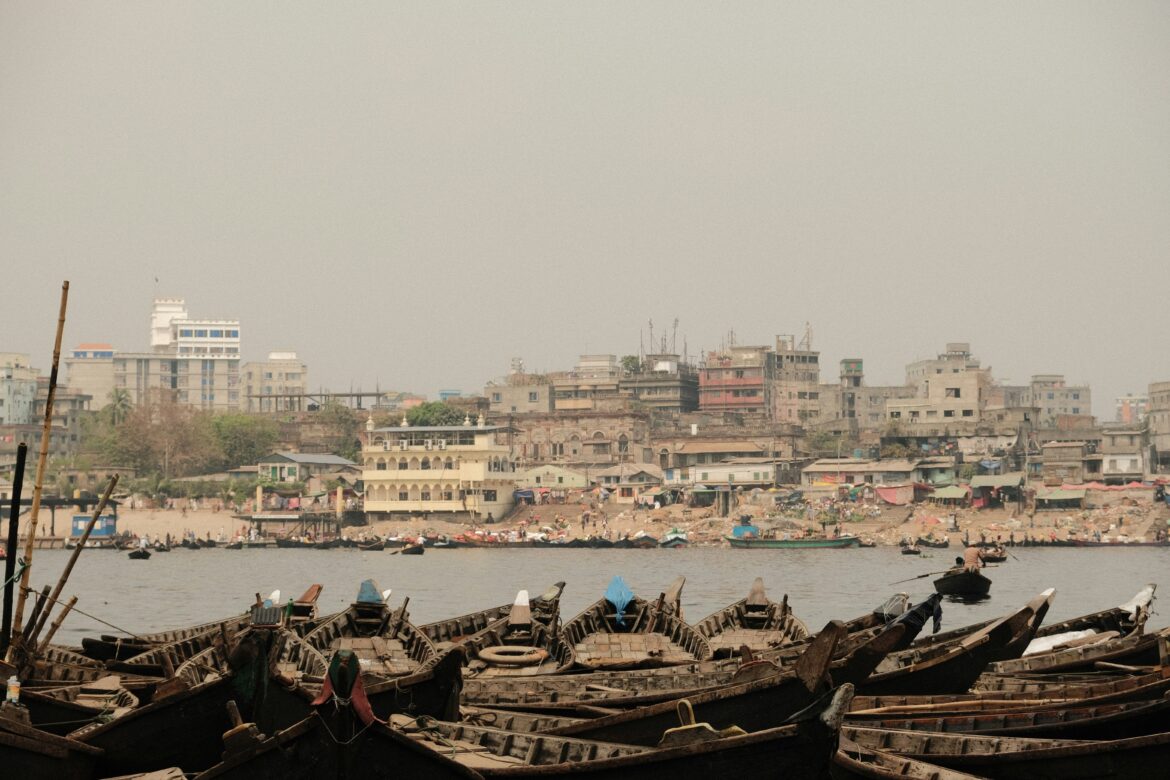
Bangladesh has become a nation forced to the frontline of climate-related impacts. The low-lying country is cut across by major rivers and is characterized by exposure to the Bay of Bengal, creating a unique combination of hazards that so few regions also deal with. Each year, these pressures on the environment damage farmland and critical infrastructure, disrupt local livelihoods, and push people out of their homes. With estimates suggesting that millions of Bangladeshis could be displaced by climate change in the next few decades, the precarious human costs of living with increasingly more extreme weather is becoming clear.
Research on Bangladesh’s climate risks has repeatedly shown that millions of people live in areas actively exposed to cyclones, floods, droughts, and erosion. A World Bank report from 2022 found that 90 million Bangladeshis live in “high climate exposure areas,” with 53 million subject to “very high” exposure. Another finding from the same source projected that sea-level rise and related consequences could contribute to 13.3 million internal migrants by 2050.
Riverbank erosion sits at the centre of the country’s crisis. Bangladesh is a riverine country, meaning it is located along and shaped by banks or basins of major rivers, so shifting channels regularly destroy civilian settlements. Studies, such as that from the Asian Disaster Reduction Center (ADRC), describe it as one of the country’s most destructive climate-related hazards, displacing tens of thousands of people annually. Recently, one researcher noted that half a million people are temporarily or permanently relocated each year in the Padma, Jamuna, and Meghna river basins. The exact figures vary by method and location, but the patterns still show how communities are continually uprooted from their own land.
In addition, these displacements are not solely physical; they have economic and social impacts as well. Riverbank erosion — among other extreme weather events — destroys cultivable land, livestock, housing, and transportation means. In many cases, families have stable income and secure tenure. As a result of this, millions of Bangladeshis are forced into overcrowded slums in urban areas like Dhaka, facing extreme poverty and high exploitation risks.
Bangladesh has made significant progress in its ability to respond to potential climate threats, but not enough to stop displacement on a large scale. Since the 1970 cyclone disaster, the country has invested in warning systems, evacuation planning, and disaster shelters, showing that lives can be saved through funding adaptation efforts focused on getting populations and environments prepared for a changing climate. Unfortunately, they do not always solve the root issue, which in this case equates to intensifying climate stress. The scale of vulnerability continues to outrun the capacity of many communities to recover; coastal areas such as the Meghna estuary and islands remain exposed to storm surges, tidal flooding, and saltwater intrusion. Inland regions, especially in northern districts of Bangladesh, face massive flooding.
Cases such as Bangladesh exemplify why adaptation is important. Flood embankments, climate-smart agriculture, and cyclone-resilient housing are all examples of pressure-reducing strategies allowing households to stay put — and simultaneously making migration less abrupt. However, adaptation requires money, and that remains a major constraint. The UNEP estimates that developing countries could need US$310 billion to US$365 billion annually by 2035 to adapt to climate change, while international public adaptation finance only reached US$26 billion in 2023.
Bangladesh therefore demonstrates that climate displacement is also a question of global responsibility and inequality. As a state, it has contributed very little to greenhouse gas emissions that drive global warming, yet it bears a heavy share of the damage. Many other countries have the same issue, but this further exemplifies the injustice. The UNHCR notes that three out of four forcibly displaced people live in countries facing high-to-extreme exposure to climate-related hazards, showing how climate stress emphasizes pre-existing vulnerabilities across the Global South. Bangladesh sits in the middle of this pattern; it is exposed to climate risks without the financial cushion needed to absorb them.
The legal dimension associated with displacement adds another layer of difficulty. The term “climate refugee” has become increasingly common to describe the displacement of people due to climate-related impacts. However, it does not have a formal definition under international refugee law. Unlike refugees fleeing persecution, climate refugees do not receive automatic legal protection under the 1951 Refugee Convention, leaving many in a legal grey zone. If climate change forces people from Bangladesh to cross borders in search of safety, they may find that existing law does not recognize their situation. As such, the severity of such a legal gap will only get worse as displacement increases.
Reducing emissions remains essential for counteracting the consequences, but mitigation alone will not protect people already living with climate risks. Bangladesh needs much greater adaptation finance, access to stronger infrastructure, and support for communities facing chronic erosion and flooding. There is also a need for international recognition that climate displacement is a predictable outcome of environmental changes. If global policy continues to lag behind reality, Bangladesh will remain one of the clearest examples of how climate change turns environmental vulnerability into forced emigration.
Thus, Bangladesh serves as a warning regarding how the ability to stay in place depends on investment, planning, and geography. The same pattern is already emerging across deltas, drylands, and small islands in the Global South. Addressing climate emergencies will require the international community to invest in adaptation finance and ensure those displaced by climate change are not left without support or recognition. Ultimately, it is left up to world powers and decision-makers to respond before more communities are left with nowhere to go.
Edited by Nina Serengulian.
This is an article written by a Staff Writer. Catalyst is a student-led platform that fosters engagement with global issues from a learning perspective. The opinions expressed above do not necessarily reflect the views of the publication.

Annika Paul is entering her second year at McGill University, currently pursuing a B.A. in Political Science and a minor in Economics. She is thoroughly fascinated with many aspects of the current political landscape, with a special focus on global health, international economic policy, and humanitarian aid.