
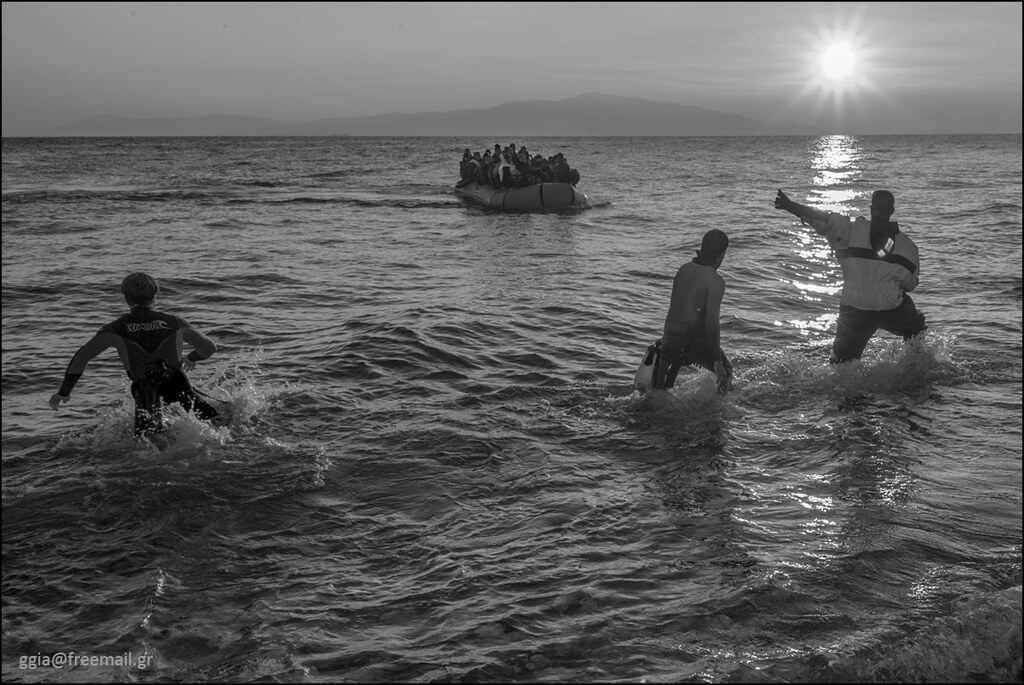
Migration has increasingly become a pillar of presidential campaigns in many European countries, while being one of the most polarising. In France, for example, the issue of migration can account for up to 38% of all news stories broadcast each month, filling the media space especially during election campaigns. Migrants and refugees are labels heard overwhelmingly in debates about domestic policy. They are largely not being discussed with concern for their human rights and experiences of displacement in the context of the conflicts they are fleeing. Rather, they are often discussed in relation to the self, to home. The fear of ‘illegal aliens’ and of ‘submersion’ has embedded itself in the social sphere.
Examples are not hard to find. A Reform UK candidate has spoken of putting asylum seekers in ‘concentration camps’. In Germany, the AfD has been openly explicit about its wish to deport immigrants, while the EU has approved ‘return hubs’ in third countries, commonly understood as deportation centres. Deportation is especially troubling when it is carried out by countries whose history is closely tied to the dispossession and genocide of Europe’s Jews, which happened in large part through deportation techniques. While contemporary deportation practices are inherently different in their nature, context, and outcomes, this history makes their use particularly worthy of scrutiny. In fact, only a few decades ago, the word was far less common in public life. Today, governments feel confident enough to use it openly, without fearing much public backlash. Securitization discourses have filled the social sphere, successfully putting sovereignty and the security of the nation as the primary concern of citizens.
Liberal Illiberalism
Refouling asylum seekers by expelling them to places where they would face serious persecution is prohibited under international law, in light of the 1951 Convention Relating to the Status of Refugees. Chain-refoulement, the returning of migrants to a third country where they could face human rights violations, is also illegal. Yet, border control techniques implemented and promoted by EU countries seem to combine both. In fact, the EU and the UK, since their 2015 so-called migration crisis, have been heavily relying on extraterritorial processing of asylum seekers and deportation to return hubs in third countries, where they are to be resettled. The process of externalisation is a strategy under which wealthier countries outsource migration to other countries, thereby shifting their responsibilities under international law. It encompasses all the techniques that seek to prevent migrants from entering the territory and accessing the rights associated with that status. It can look like physical prevention ( through walls or Frontex boats) or, legally, having them on the territory but discarding their claims as legally inadmissible.
This new way of ‘dealing’ with refugee populations, despite infringing on human rights, is often warmly received by the public. It appeals to people’s sense of security and to nationalist rhetoric, and it is concealed behind terms like ‘remigration’ or ‘return hub’. It keeps people displaced, but somewhere else, where the state is not responsible and can maintain its liberal facade. At the same time, states speak the language of human rights in service of domopolitics, a politics conducted in the name of a particular conception of home, while stripping refugees’ rights of their political weight. Human security comes to be understood as state security. It shifts the focus from protecting the well-being of an individual to protecting the interest of a political entity, sometimes at the expense of others falling outside that realm. The rights of the nation, its sovereignty and its borders, take centre stage, while the rights of migrants are depoliticised: they stop being a question we collectively owe an answer to.
Importantly, rights and security are framed in economic terms, as if they were scarce resources. There is talk of a ‘rights scarcity’ or a ‘security scarcity’ as though rights shared with non-citizens would endanger the whole national community. Scarcity generates competition, often resulting in the creation of hierarchies where the welfare resources of the state (such as medical care) are to be preserved for a limited group of people. Consequently, helping one group is presented as coming at the expense of the other. Harsh border controls are now used for domestic consumption, boosting politicians’ popularity by soothing the fears of increasingly xenophobic publics. Often the easiest answer to ‘who are we?’ becomes ‘not them.’ These exclusionary dynamics give politicians a simple lever for strengthening domestic support. Meanwhile, the long histories and identities attached to migration and refugeehood are flattened into a single label: a ‘politically inconvenient population.’
A Protective Punishment?
With what confidence can a party like Germany’s AfD pronounce the word ‘deportation’ during an electoral campaign, or a British politician speak of ‘concentration camps’?
The process of deportation has been rebranded to make it acceptable, yet it holds deep contradictions. States claim to honour their international duty to assist and protect refugees, while building a system that turns the act of claiming asylum into a crime. People are held in high-security detention facilities for up to 24 months, where they undergo repeated assessments of their cooperation and potential dangerousness. Migrants are treated like prisoners: they must prove their innocence and their good conduct, and they are handled as cases rather than as people.
What happened to ‘innocent until proven guilty’?
A prisoner is not a detainee. A prisoner has been convicted of a crime; a detainee has not been convicted. Detention usually casts the detaining state as ‘the bad guy’ and the detainee as the victim of arbitrary detention and curtailed liberty. But when every migrant is portrayed as a potential threat, people are stripped of their innocence, and deportation comes to seem a normal, even necessary, safety measure. This dehumanises the search for asylum and sets citizens and non-citizens in a hierarchy: one holds rights by birth while the other, simply because of their search for protection and a semblance of equality, becomes a threat.
‘Fear does deeply political work’
Deportation risks creating a vicious cycle. By constantly framing the search for asylum as a security threat, states build a self-fulfilling prophecy. Migrants’ lives are conditioned so heavily, whether by cuts to social services, dangerous sea crossings, or detention, that some are forced into informal activities simply to survive. Often faced with the impossibility of generating revenue legally, migrants find themselves developing informal economic activities to provide for themselves or their family. The system produces the effects it names, fuelling self-reinforcing loops of violence that create non-cooperation. Yet the resulting ‘illegality’ is then explained by cultural and ethnic factors, which absolve state actors and the private companies given a monopoly on detention of any responsibility.
This de-responsibilisation, which helps make deportation so acceptable, is sustained by a distance from violations abroad and a denial of complicity. Refugee movements are often driven by conflicts that European countries, especially given their colonial past and the current globalised world, cannot claim to have had no part in. Algerian migration to France cannot be understood independently of the legacy of French colonial rule, including the enduring influence of the French language established during the colonial period.
In public discourse, people reject the so-called ‘importation of the third world’ or the idea of welcoming ‘all the misery of the world’. This unwelcoming of ‘misery’ is disconnected from the reality that, by creating policies that end up detaining people or refusing them access to land, it creates new causal links of responsibility, adding to the suffering they claim to keep out.
‘You create a nest out of your own fears’
The prominence of ‘civilisational’ debates tinted by racism in the immigration debate is undeniable. In France, for example, the far right promotes the idea of the ‘great replacement ’, the theory that an Arab population is coming to replace the supposedly ‘native’ white French. Yet why be so afraid of being replaced by an outside population? This fear is manufactured for political purposes and in specific historical contexts, often in societies with a colonial past.
Perhaps the fear of replacement may be seen as a fear of history repeating itself: having been the settlers, these societies know what settlement can do, and project it onto those who arrive today. Through deportation, migrants are kept displaced… but somewhere else. They end up falling under no one’s responsibility yet remain subject to everyone’s discretion, which ends up leaving states perpetually innocent and people perpetually foreign.
Edited by Lou Didelot
This is an article written by a Staff Writer. Catalyst is a student-led platform that fosters engagement with global issues from a learning perspective. The opinions expressed above do not necessarily reflect the views of the publication.

Maria Lecollinet is a second year student at McGill University, currently pursuing a B.A. in International Development, Middle East Studies and Political Science. She serves as a writer for Catalyst and has a particular interest in institutional perception, youth participation and civic engagement as well as human rights and the EU’s external relations.