
On May 14 2026, the Taliban formally enacted Decree No. 18, a new law which formally eliminated the previous minimum age for marriage and made it more difficult for women and girls to seek divorce. The decree directly affirmed that “the silence of a virgin girl who has reached puberty” is consent to marriage, a provision that enables child marriage, expands ambiguity surrounding age restrictions, and nullifies any notion of consent among girls. Additionally, the law further widened the disparity between men and women’s ability to divorce by requiring women to provide multiple witnesses to validate their request for divorce, while men do not need to do so and therefore retain the right to divorce freely. The Decree also fails to define puberty, which creates a dangerous gray area that will not only facilitate child marriage, but also effectively limit girls’ ability to seek divorce by giving men more power to decide whether it is allowed.
Roqia Saee, a founder of the Afghan Women’s History Transformation Movement, calls Decree No. 18 “one of the most worrying legal developments in Afghanistan under the Taliban”. She further emphasizes how, in passing laws like Decree No. 18, the Taliban is actively working in the opposite direction as the rest of the world, which has sought to abolish child marriage and increase freedoms for women. By permitting child marriage, the new decree threatens to normalize the rape and forced marriage of underage girls, and by not defining age specifications, it gives the Taliban authority greater control over women’s rights regarding marriage and divorce.
Historical Context
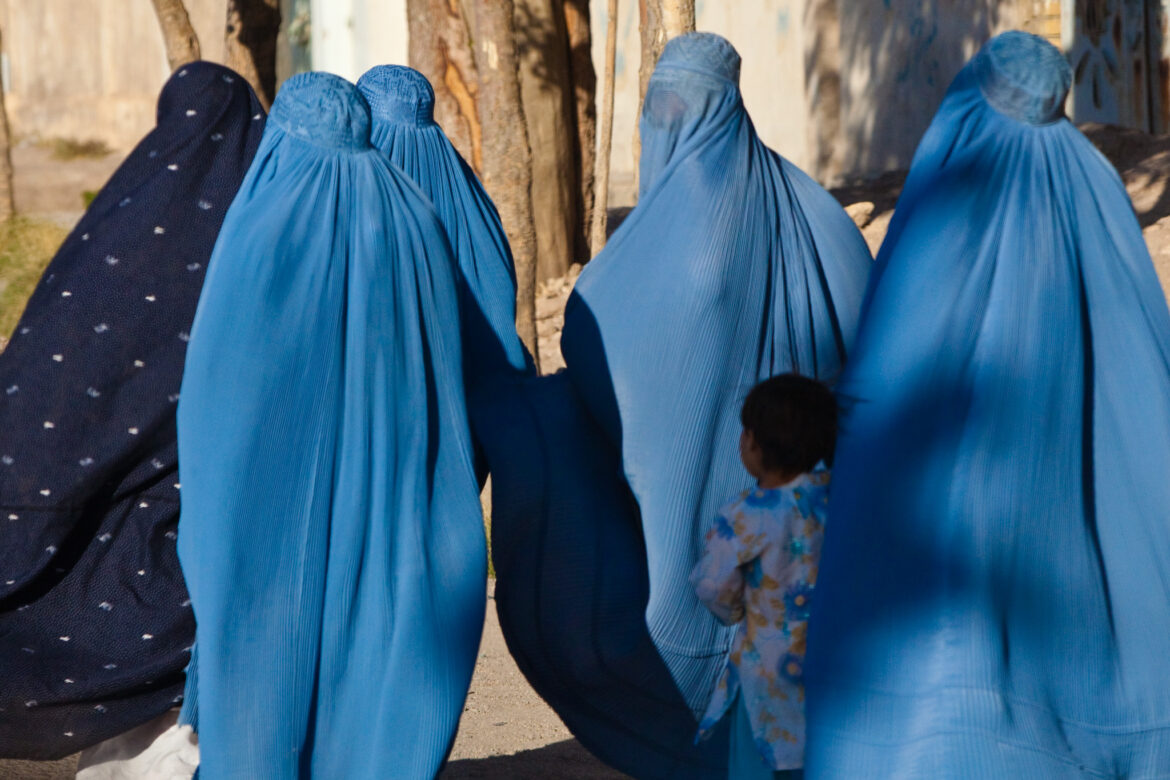
Decree no. 18 follows a long history of institutionalized gender-based oppression and inequality in Afghanistan. The Taliban embrace a fundamentalist interpretation of Islam and use their authoritarian power, in control of the de facto Ministry of Justice, to enforce adherence to their laws. Before the U.S. occupation of Afghanistan in 2001, the Taliban held power from 1996 to 2001. During this time, they imposed a great number of restrictions on women, taking the shape of four main categories: restrictions on movement, restrictions on work, restrictions on education, and restrictions on attire. Women were banned from traveling without a mahram (a family member with whom marriage is permanently unlawful), working, and attending school beyond age eight. When in public, women were required to wear the burqa — a garment that completely covers the body — and be accompanied by a mahram. Violations of these laws were punishable by “severe corporal or capital punishment”, including public violence and persecution.
After the Taliban regained control of Afghanistan in 2021, they initially demonstrated more moderation in their policies as compared to their 1996-2001 rule, such as permitting women to pursue limited secondary education. However, they quickly resumed their tight restrictions on women, once again banning women entirely from education, work, and free movement, sparking outrage and criticism domestically and globally. In 2022, they completely banned women from pursuing secondary education, and in 2023, they banned women from working for all UN agencies and NGOs. In October 2024, the Taliban passed morality laws banning women from speaking loudly in public, including praying and reciting the Quran, the religious text of Islam. The morality laws also banned women from going to public parks and gyms. Furthermore, the Taliban banned all books with female authors, and prohibited any teaching of human rights and gender studies.
The Bigger Picture
Behind such tight control of women has not only been the Taliban’s dedication to sharia law — a strict legal system derived from Islam — but also their fear of women being influenced by Western or secular ideology through education and employment, and subsequently passing these traditions onto their children. Western ideas like democracy, human rights, and gender equality contradict traditional Islamic values, making them a potential threat, when considered critically by educated women, to the Taliban’s totalitarian authority. On the contrary, the Taliban’s control remains secure when the people of Afghanistan — particularly women, who have historically played crucial roles in generating change — lack the critical thinking skills necessary to contest their policy and ideology. Accordingly, bans on women’s education, work, and even movement and public presence fit into the Taliban’s agenda to control women to protect their own power.
Fereshta Abbasi, an Afghan human rights lawyer, expresses concern about the recent pace at which the Taliban have been passing oppressive laws, many of which target women and girls. She refers to Decree No. 12, passed by the Taliban in January 2026, which legalized most forms of domestic violence against women. The law established that a husband would only be legally liable — facing a 15-day imprisonment — if he caused severe injury to his wife, like visible bruising or broken bones. Wives must also prove their abuse in court, though they must remain completely covered by a burqa and accompanied by a mahram. The law largely deprived women of their ability to seek justice from domestic violence, as they may be legally abused and face great obstacles in reporting any abuse that is illegal. In addition to stricter laws on women’s rights, there has also been great concern — even prior to the passing of Decree No. 18 — of the rise of child marriage in Afghanistan. In 2021, the United Nations Children’s Fund estimated that “28 per cent of Afghan women aged 15-49 years were married before the age of 18”. This striking number demonstrates that the issue of child marriage is not new in Afghanistan, nor has it been unusual. It now faces not only social, but legal normalization under Decree No. 18.
International Response – A Fundamental Limitation?
The Taliban has received widespread, nearly unanimous condemnation for their recent behavior, which many argue has strayed far from the Islamic faith and is discriminatory. However, the Taliban’s commitment to strictly Western-opposing Islamic ideology makes international intervention on their human rights violations fundamentally difficult. In January 2025, the International Criminal Court (ICC) issued arrest warrants for two notable Taliban leaders Haibatullah Akhundzada and Abdul Hakim Haqqani for the group’s persecution of women and girls in Afghanistan since 2021. The ICC labeled the leaders’ behavior as crimes against humanity, punishable by arrest if found within Afghan territory. However, the warrants were futile as the Taliban rejected the ICC’s jurisdiction, calling the decision “unlawful” and stating that “‘the Islamic Emirate of Afghanistan does not recognize any obligation to the Rome Statute or the institution referred to as the ‘International Criminal Court.’’” The Taliban claims that their rejection of Western systems stems from their contradiction to Afghan Islamic ideology and Afghanistan’s history of colonial subjugation. This makes it extremely difficult for international courts and organizations grounded in Western values to directly intervene in the Taliban’s oppressive behavior and protect the women of Afghanistan. These organizations, like the United Nations (UN), the North Atlantic Treaty Organization (NATO), and the ICC, play a pivotal role in defining international norms which shape international law, and since their interests are rooted in spreading Western ideals, their authority and jurisdictions are rejected by the Taliban. The UN can do little more than express concern and condemnation of the Taliban’s behavior and urge them to adhere to international law.
With such limitations in mind, the UN has not remained silent on the oppression of Afghan women. It has adopted resolutions aimed at facilitating peace in the region and pressuring the Taliban to end repressive policies. The United Nations Assistance Mission in Afghanistan (UNAMA) was formed in 2002 to provide humanitarian assistance to the people of Afghanistan and remains active in doing so. UNAMA has expressed “grave concern” over Decree No. 18, which it stresses fits into the broader context of the erosion of the rights of women and girls since 2021, though the new decree is particularly concerning for girls. However, UNAMA concludes that Afghanistan is “bound by its international human rights obligations”, when in reality, the Taliban refuses to abide by such obligations and rejects any prosecution by the ICC or criticism from Eurocentric organizations. There remains a clear gap between the theoretical protection of women in Afghanistan under international law and the ability of organizations to ensure this protection in practice.
Edited by Danielle Sugarman
This is an article written by a Staff Writer. Catalyst is a student-led platform that fosters engagement with global issues from a learning perspective. The opinions expressed above do not necessarily reflect the views of the publication.

Sofia Kaplan is pursuing a double major in Psychology and International Development studies at McGill University. She is particularly interested in politics of human rights.