
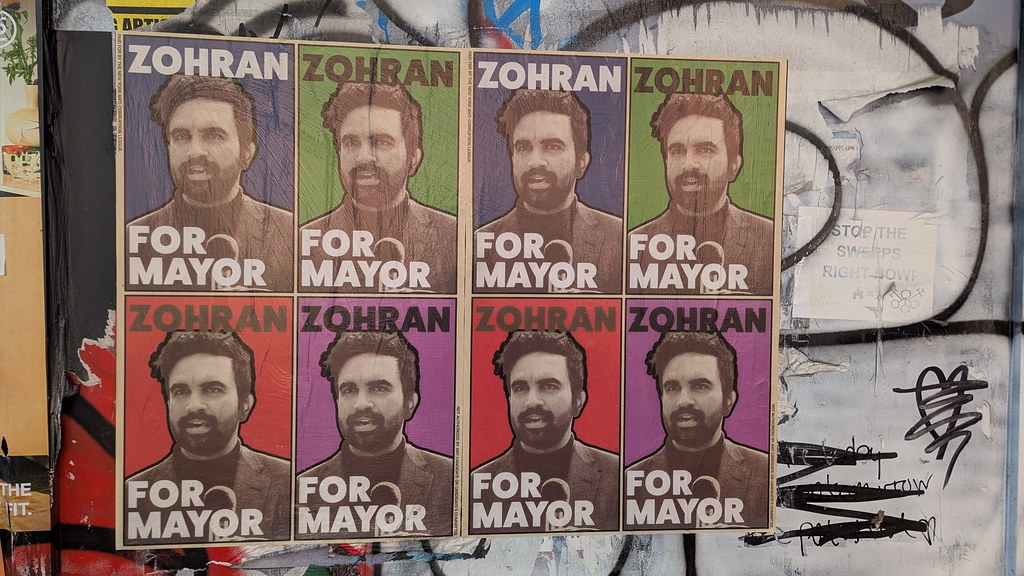
A year ago, I argued that Zohran Mamdani’s agenda would cause more problems for New York than it would solve. Now that he has been in office for ten months, it is time to revisit that argument and assess how his approach to policing, rent, and the city budget compares with my initial expectations. Keeping in mind the city’s 1975 fiscal crisis, has Mamdani’s first year put New York on steadier ground, or set it up for trouble later?
On October 29, 1975, President Gerald R. Ford stood before the National Press Club in Washington, D.C., and told New York City that it was on its own. The city was on the verge of bankruptcy after years of borrowing for its everyday expenses, and Ford made it clear that he would veto any federal assistance. The next morning, the Daily News ran a headline that many still remember: “Ford to City: Drop Dead.” The city survived, but not on its own terms. New York State stepped in, took control of its finances, and imposed cuts that became evident in the subways, schools, and streets. The lesson that generation took from 1975 was simple: a city can put off its bills for a long time, but not forever.
Fifty years later, in 2025, I wrote an article in Catalyst arguing that Zohran Mamdani’s agenda would cause more problems than it would solve. I closed by accusing him of having “a subpar understanding of economics.” I did not consider 1975 then, but a year later, I am. Despite my concerns, Mamdani won anyway. He took office on January 1, 2026, and has since governed the United States’ most populous city for ten months. This period is long enough to reflect on my predictions from last year. Some of it has held up, and some has not. And the gap between the two says more about how this mayor governs than either his critics or admirers want to admit.
Policing
I previously overreacted in my criticism of the mayor’s proposal to reduce the New York City Police Department (NYPD). I warned that shrinking the force would endanger a city of more than eight million people, and that laying off officers would put some New Yorkers out of work. Yet, none of that happened, and it was unlikely to. Mamdani’s earlier calls to defund the police during the height of the 2020 Black Lives Matter protests were real. However, he backed away from this viewpoint by 2025. Instead, he ran on a more moderate campaign to keep the police headcount flat. To his credit, he delivered. His first budget maintained NYPD funding near $6.4 billion. He kept Commissioner Jessica Tisch and, for the most part, allowed her to run the department as she sees fit. The final budget leaves the force’s numbers unchanged.
The proposed establishment of the “Department of Community Safety,” an idea that I previously praised, came in smaller than promised. The Department of Community Safety launched as a mayoral office—the “Mayor’s Office of Community Safety”—with $260 million and two employees, and not the $1.1 billion department that he campaigned on.
Overall, I argued against a mayor who existed largely in his opponents’ attack ads. This was unfair and worth recognizing. However, being wrong about what he would do is different from being wrong about what works. The NYPD reported record lows in murders and shootings for the first two months of the year. This trend has reportedly held. His supporters may be tempted to claim those numbers as proof that a progressive approach to public safety works. However, that conclusion would be inaccurate, as Mamdani’s approach was never actually implemented. The NYPD stayed intact, the commissioner stayed, and Mamdani’s alternative agency was dramatically scaled down. Thus, the statistical results more likely follow from continuity.
The Research
Nonetheless, last year, I wrote that correlation is not causation. That standard applies here too. The reported decline in violence in New York began before Mamdani took office. Notably, crime is also falling across many American cities. However, the NYPD is lowering crime with its smallest roster in years, which is awkward for anyone, myself included, who claims more officers are essential.
Still, some research points the other way. In a study of 242 American cities between 1960 and 2010, economists Justin McCrary and Aaron Chalfin found that more officers reduce violent crime, and concluded that American cities are, on average, under-policed. A 2024 replication using data up to 2019 found that the results were unchanged. Crucially, this research is not about New York in 2026, and it cannot tell us why crime fell in the city this year. What this suggests, however, is that the number of police officers still matters for public safety. Just because the city experienced one of its safest years on record does not mean that police staffing levels have no effect on crime.
Mamdani inherited a force that had been rebuilt after years of shrinking. He then dropped his predecessor’s plan to add 5,000 officers and declined a proposal for 580 more. If the research applies here, that choice carries a cost that the city may not see for years, and he may be spending down an inheritance. The objection did not come only from the police lobby. Council Speaker Julie Menin, a fellow Democrat, said she learned of the decision the night before and disagreed with it, noting that the force is now smaller than it was on 9/11 in a city that has grown since. The Sergeant’s Benevolent Association went further, calling flat headcount “a dangerous game.” I would not go that far. A more faithful reading of Mamdani’s first year in office is that New York City stayed safe, while its mayor governed like his commissioner rather than his campaign.
The Rent Freeze
In contrast, on housing, Mamdani did exactly what he said he would. He named six of the nine members of the Rent Guideline Board, and in June, the board voted 7-1 to freeze rents on about one million stabilized apartments. It was the first two-year freeze in the board’s history, and it took effect on October 1.
Last year, I argued that a freeze would help tenants in the short term, but damage the housing market in the long term. The first half is already true: about 2.4 million New Yorkers live in those apartments. The second half cannot be judged yet. A policy that is weeks old has no long-term consequences to measure.
What can be measured is the starting position, and it is not reassuring. The board’s own index found that the cost of running stabilized buildings rose 5.3 percent this year. Yet, rents in those buildings will not rise. One of the board’s landlord representatives resigned before the vote, saying the outcome had been settled during the campaign.
I also need to reconsider part of my earlier argument. I initially suggested that small, independent landlords would be the most affected by the rent freeze. However, critics point out that large property companies own the majority of rent-stabilized apartments. If so, my sympathy was misplaced, but my concern was not. The buildings in the worst financial shape are the older ones, where most units are regulated. A freeze does not differentiate between an owner who can absorb it and a building that cannot.
The Budget
Mamdani began his first budget cycle with a deficit of more than $12 billion inherited from his predecessor. He insisted that there were two ways out: raise property taxes or raise income and corporate taxes on the wealthy. In the end, he did neither at scale. Ultimately, financial support from the New York state government helped close the city’s budget gap. Governor Kathy Hochul amassed nearly $8 billion in support over two years, and Mamdani dropped his property tax plan. City agencies found $1.7 billion in savings of their own. However, not all of this financial relief represents a permanent solution. The state package included more than $3 billion in delayed pension payments, and the mayor’s plan stretches some pension contributions out by an additional 5 years. Buy now, pay later. Sound familiar?
To be fair, he did not create the hole. The final budget avoided significant property tax increases and partially restored the city’s reserves. New York in 2026 is also not New York in 1975. The city is nowhere near bankruptcy, and an aid package is not a takeover. But the city’s own fiscal watchdogs are not satisfied. The Citizens Budget Commission said the city closed this gap mainly with one-time fixes, short-term savings, and costs shifted onto future taxpayers. Comptroller Mark Levine warned that the deal gets the city through a hard year without resolving the structural problems ahead. A mayor who promised the wealthy would pay for his agenda ended up covering the basics with help from the governor and an “IOU” to the pension system.
Two Mayors?
So, the mayor I warned about turned out to be two mayors. On policing, where failure is immediate and visible, he chose caution. On housing and on the city budget, where the financial consequences may take years to emerge, he chose a path that pays off now. This pattern is not random. A spike in shootings would be blamed on him within weeks. A failing boiler in the Bronx in 2029 will be blamed on a landlord, and a pension shortfall will be blamed on whoever is mayor then. Politicians of every ideology take their risks where the bill comes due later, and Mamdani, despite his liberal arts education, is a more conventional politician than either side expected.
It also explains why almost nobody is completely satisfied. The New York Civil Liberties Union highlights that criminal summonses rose 29 percent in the first three months of his term, and that the protest unit he pledged to disband is still funded. Police supervisors claim he is stretching the department too thin. Small landlords have taken the rent board to court, arguing it ignored its own data. Only the tenants are celebrating, and their assumption is the one that will take the longest to test.
Looking Forward
When he shook hands on his first budget, Mamdani quoted Friedrich Hayek’s claim that if socialists understood economics, they would not be socialists, and asserted that his budget proved that they do. A year ago, I would have said that Hayek was most likely correct. Today, I temporarily revise that. Mamdani has shown more discipline as a politician than I gave him credit for. I was wrong to treat his loudest critics as a guide on how he would govern.
At the same time, this test has only been half-run. In 1975, New York’s demise arrived on a single morning, in the headlines of the Daily News. This year, the opposite happened: when the city asked for help, the governor said yes. That is a better outcome by any measure. However, it can also be how cities get into trouble. Nobody ran a headline when the pension payments were stretched out, or when the bill for a rent freeze was handed to buildings already running short. The costs of 1975 did not simply appear in 1975. They had been piling up quietly for a decade.
Ford never actually told New York to drop dead. A headline writer said it for him because, by then, the city had already spent a decade making the line believable. New York in 2026 is not on that path. But it has picked up the habit that started it.
Edited by Elin Kangarani.
This is an article written by a Staff Writer. Catalyst is a student-led platform that fosters engagement with global issues from a learning perspective. The opinions expressed above do not necessarily reflect the views of the publication.
