
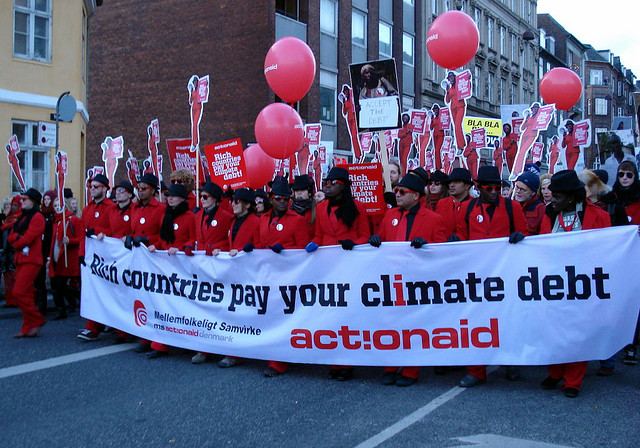
The Global South is currently facing what was once referred to as a “silent crisis” by the United Nations: an escalating debt emergency, with many countries struggling to pay off their debt obligations due to exorbitant interest rates, economic instability, and the aftereffects of the COVID-19 pandemic. In 2025, over two-thirds of low-income nations are in, or nearing, debt distress. Additionally, more than 3.4 billion people reside in countries that spend significantly more on interest payments than on health or education, which is 100 million more than last year.
This situation is having a profoundly negative impact on sustainable development and is deepening poverty and inequality, largely due to the structure and influence of institutions such as the IMF (International Monetary Fund) and the World Bank. Dominated by the Global North, the IMF and World Bank were initially established to promote global financial stability. However, their mission gradually shifted towards enforcing neoliberal economic reforms in the Global South.
This article focuses on the development of the IMF and World Bank as double-edged institutions that leverage debt as a modern form of colonial control, explores some resistance movements against them, and discusses strategies aimed at liberating the Global South from vicious cycles of dependency and poverty imposed by the Global North.
The Birth of the IMF and World Bank
The IMF and World Bank were established at the 1944 Bretton Woods Conference, with most colonized territories represented by colonial powers, to maintain global financial stability and crisis management.
During the 1980s, many countries across Africa, Latin America, and parts of Asia were facing economic crises marked by inflation, debt, commodity shocks, structural trade imbalances, corruption, and limited substantial participation in the global economy. All these factors are rooted in colonial extraction, uneven trade relationships, and the architecture of global finance that perpetuate postcolonial dependency, resulting in the “lost decade” for many nations.
Africa, Latin America, South Asia, Southeast Asia, and the Caribbean turned to the IMF and World Bank under financial duress, lacking other viable alternatives. This helped many nations avoid economic collapse, but often constrained national autonomy and undermined citizens’ welfare because of the rigid neoliberal policies promoted by institutions influenced by the “Chicago Boys”.
The “Chicago School”
The “Chicago Boys,” a group of Chilean economists, promoted a brand of free-market libertarianism that emphasized economic ideologies over economic ethics. Their model was adopted and enforced by international institutions that dismissed state responsibility for social justice and, as a result, enabled harmful industries like the arms trade, the drug trade, and human trafficking to function as integral parts of economic activity, so long as they served market capitalization.
Following Mexico’s 1982 debt default, the first major signal of the Global South’s growing debt crisis, IMF macroeconomic theorists influenced by the “Chicago School” responded by offering hard currency loans through “policy-based lending”.
Inflation control and macroeconomic stabilization were central to the appeal, which temporarily acted as safety nets for many struggling economies.
In exchange, Global South governments were required to implement strict economic “conditionalities” such as austerity measures, trade liberalization, and privatization. This intentionally transferred control over domestic policy to creditors in the Global North and deepened cycles of dependency.
Mexico became the testing ground for Structural Adjustment Programs (SAPs), setting a precedent for dozens of other countries across Latin America, Africa, and Asia.
Structural Adjustment Programs (SAPs)
This shift crystallized in Structural Adjustment Programs that prioritize creditor interests over national development, entrenching poverty and inequality across the Global South.
While countries formally consent to these loans, their precarious financial circumstances leave them little real choice, revealing postcolonial coercion more than genuine partnership.
These loans have assisted many countries to some extent, but fail to address the root issues of debt, leading to grave consequences for developing nations.
The Structural Adjustment Participatory Review International Network (SAPRIN) explains that IMF-imposed reforms triggered widespread social and economic disruption, dismantling local industries, eroding job security, privatizing essential services, and reducing access to healthcare and education.
As Burkina Faso’s emblematic Thomas Sankara declared: “Thus, each one of us becomes the financial slave, which is to say a true slave, of those who had been treacherous enough to put money in our countries with obligations for us to repay. ”
Debts as Neocolonial Bondage
Despite strong economic indicators, the Global South has faced disproportionately high borrowing costs due to biased risk assessments that ignore governance improvements and underestimate informal economies.
As of 2025, emerging economies in Africa, the Caribbean, and the Pacific carry a combined total of $29 trillion in public debt, accounting for approximately 30% of global public debt. Many African nations, especially in Sub-Saharan Africa, pay borrowing costs nearly 10 times higher than the US, which diverts funds from essential services like healthcare, education, and climate resilience.
A 2023 United Nations Development Programme (UNDP) study estimated that African countries lose over $70 billion annually in excess interest forgone lending due to subjective credit ratings.
Additionally, the United Nations Department of Economic and Social Affairs (UN DESA) assessed that developing countries face harsher penalties for negative credit signals, making public investments less achievable and costly.
A weighted voting system is used to enact the IMF policy decisions, giving the majority vote to the US and G7. This leaves developing countries little influence in the IMF voting system while being the primary recipients of IMF programs.
These inequities are far from accidental and portray the economic subjugation of the Global South to the Global North, designed mainly to extract, not consolidate.
Resistance Movements and Uprisings
The IMF‘s resistance to meaningful reform in the face of the global debt crisis, especially in the post-COVID-19 era, has sparked mounting frustration among civil societies, grassroots groups, and national actors across the Global South in multidimensional ways.
Recent uprisings across developing countries underscore growing resistance to externally dictated reforms. Kenya’s 2024 protests, led by a decentralized Gen-Z movement, successfully forced the withdrawal of an IMF-backed Finance Bill. The protests spread across the country and received support from global diaspora actions, which targeted tax hikes on basic goods and represented an intense opposition to foreign actors in national governance.
In 2025, a Malian court placed Barrick Gold’s Loulo-Gounkoto mine, one of the world’s largest gold mines, under provisional administration over unpaid taxes and transferred operational control from the Canadian company to a state-appointed administrator. While provisional, this move reflects a growing regional challenge towards unfair previous agreements with foreign agents long promoted by the IMF and World Bank.
Meanwhile, grassroots movements across the globe, such as the Asian Peoples’ Movement on Debt and Development and the Arab Watch Coalition, are demanding substantive inclusion in policy design and advocating for new, democratic financial institutions.
The excessive transfer of wealth from poorer to richer countries and the monopoly of foreign control over national affairs have been denounced by numerous academics, activists, and organizations, who consider the IMF and World Bank neocolonial institutions perpetuating global economic inequality.
How Can the Global South Move Forward?
Last year, UN Secretary-General António Guterres called out the IMF’s one-size-fits-all system as “entirely unfit,” for the modern world and the complexities of developing nations. This is due to the IMF and World Bank being created post-WWII with only 44 member states present, which no longer reflects the needs of the 193 recognized nations in today’s world.
While recent conferences like the UN’s fourth International Conference on Financing for Development in Seville expressed commitments to risk-informed investment and gender equity, they fall short on specifics or on addressing root injustices.
Structural transformations such as debt cancellations, climate reparations, fair access to concessional financing, and the creation of equitable financial institutions with fair voting rights are necessary to replace extractive lending. Developing countries are owed fair opportunities for growth and self-determination, especially given that their economic vulnerabilities originate from centuries of colonization, enslavement, genocide, and resource plundering by the Global North. Internally, countries must reclaim policy space for land reform, industrial protection, subsidies for local producers, and women-led enterprises. For this goal, it is imperative to nurture alliances, invest in national resources, focus on civilian welfare, and develop sustainable, equitable systems.
Dumebi Oluwole, a Pan-Africanist economist, highlights that some leaders shift blame onto the IMF while enacting its regressive policies. Thus, holding accountable some of the principal enablers of oppressive policies, being self-serving elites, is unavoidable.
Overall, as long as development is dictated by Washington and G7, the Global South will always remain stuck in a perpetual cycle of dependence, poverty, and violence, not for lack of resources but because of the system that is, in effect, “politically rigged and economically extractive.”
Edited by Lindsay Hayes
Disclaimer: This is an article written by a Staff Writer. Catalyst is a student-led platform that fosters engagement with global issues from a learning perspective. The opinions expressed above do not necessarily reflect the views of the publication.

Yasmine Mkaddam is in her third and final year at McGill University, currently pursuing a B.A. in Political Science with a minor in History. As this year’s Co-VP Events for McGill Students for UNICEF (MSFU) and Vice-Chair of DEI for the McGill Collective for Gender Equality (MCGE), she serves as a coordinator dedicated to promoting engagement and equity across campus initiatives. She is particularly interested in the politics of the Global South and the preservation of human rights, especially for marginalized communities.