
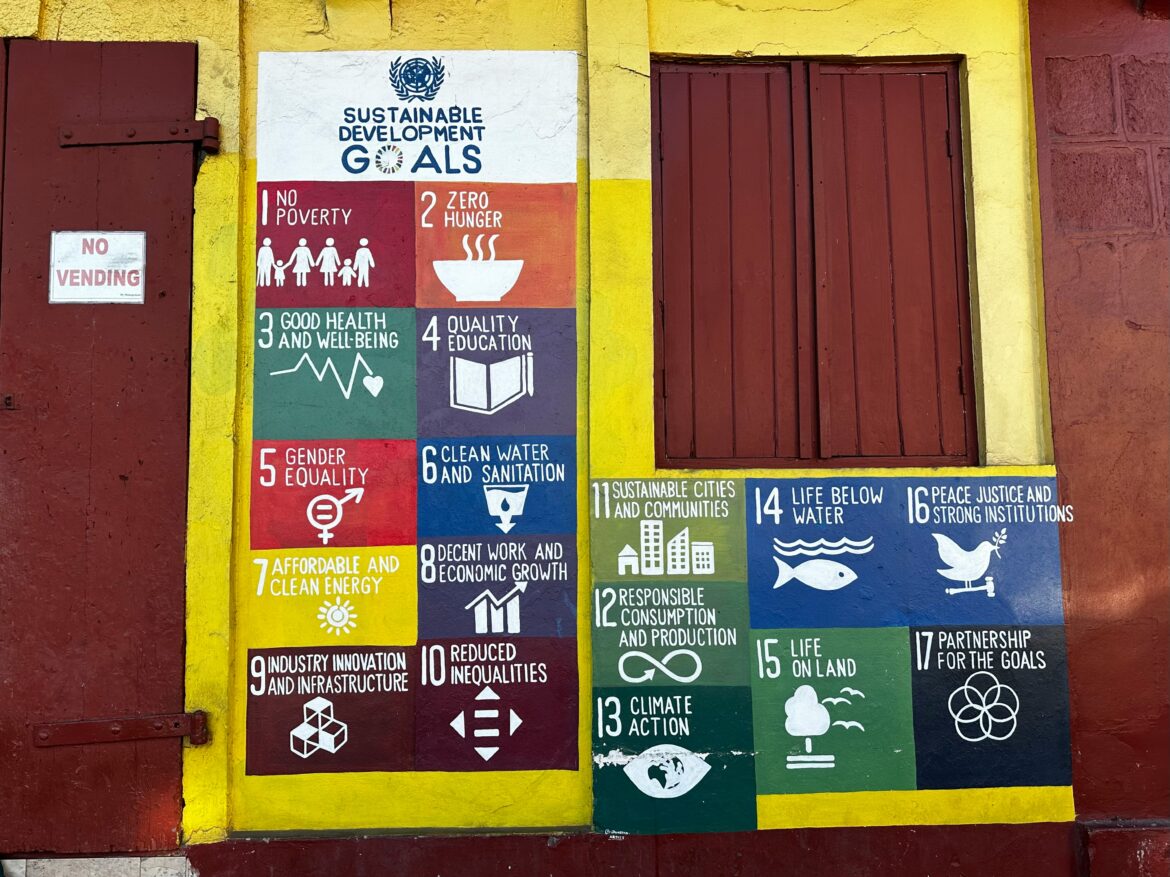
The 17 Sustainable Development Goals (SDGs) were adopted by all United Nations (UN) member states in 2015. The Goals serve as both a call to action and a blueprint to achieve shared peace and prosperity for all people and the planet. The Goals provide a helpful framework for viewing global problems, urging people and nations to understand problems in terms of how solutions may be synergistic or hinder progress. However, some goals contain internal contradictions. SDG 8 in particular calls for decent work and economic growth. I take issue with this goal not because either aspiration is inherently bad, but because economic growth is not sustainable at its core. While a shared sustainable future is indeed a sound goal, I contend that economic growth is not a productive step toward desired prosperity.
SDG 8 contains various targets that specify its desired outcome. Among them, the goal does acknowledge sustainability, calling for “sustained, inclusive, and sustainable economic growth” in addition to employment and decent work. Still, economic growth overall leads to outcomes that contradict the desire for a sustainable future. Regarding economic growth, SDG 8 emphasizes decoupling economic growth from environmental degradation, desiring gross domestic product (GDP) growth without environmental harm (Target 8.4). Economic growth overall is measured using GDP per capita (Target 8.1). The goal also calls for increased capacity of and access to domestic financial institutions such as banks and insurance (Target 8.10).
In setting SDG 8 and its targets, the UN is advocating for green growth, by which the fuel for economic growth is absolutely decoupled from carbon-based industrial development. Here, the UN is calling for active GDP growth and emission reduction; one’s growth rate should be positive, the other negative. Executing this would require a total decarbonization of the global economy. While not theoretically impossible, achieving this by 2030 is highly unlikely. The degree to which vested interests have protected and will continue to protect the fossil fuel industry is too great. As explained by Thomas Homer-Dixon in his novel, Commanding Hope, these groups, including private investors, organizations, and even certain governments, use every resource available to defend the benefits they derive from the current system. An additional factor at play is that growth as we (in the West) know it entails the abuse of natural resources, unsustainable production and consumption habits, and environmental and social harm. Indeed, growth and environmental harm are tightly linked.
When we talk about economic growth, we mean GDP in language, but consumption and production in practice. People do not want higher GDPs because this abstract value will suddenly make them happier. In many cases, growth increases living standards in a country, which ultimately improves quality of life.
Singapore makes a strong case for a link between growth, living standards, and quality of life. In 1965, the nation declared independence and began implementing a series of growth policies, including a mandated savings program for workers, that resulted in a substantially increased standard of living: GDP per capita increased from $4,215 USD in 1965 to $59,176 USD in 2020. However, this growth also required a substantial increase in carbon dioxide (CO2) emissions. In 1965, Singapore’s emissions sat at 2.34 million tonnes of CO2 annually; today, the country emits 53.92 million tonnes annually. This case shows that, at least historically, emission growth has been a prerequisite for economic growth and for higher living standards and quality of life. The current system does not allow for one without the other. And this is ultimately the problem with SDG 8: it proposes a solution (absolute decoupling) to the problem (emission growth), but the solution still operates within the dominant system that drives harm in the first place (one which centers growth as both a goal and problem-solving tool).
There are many alternatives to decoupling, including degrowth. This entails a planned reduction in energy and resource use to slow economic activity and balance it with ecological limits. Degrowth is not the opposite of growth. It does not entail reducing GDP, but “material and energy throughput.” The problem with degrowth is that growth still occurs, just at a slower rate. This, as already established, requires unsustainable production and consumption.
It is here that I ask a critical question: why must economic growth be the goal at all? The UN must consider approaches that do not center around growth, for a high quality of life does not require the levels of production and consumption we are accustomed to. Degrowth, while it does hold space for economic growth, emphasizes several helpful principles we can use to shift our thinking about growth and what it means to live well.
In their 2022 paper on real-existing degrowth in the Mediterranean, Giorgos Kallis, Angelos Varvarousis, and Panos Petridis examine the Greek islands of Ikaria and Gavdos. These cases reveal what it looks like to slow down. In Ikaria, locals actively resist conventional growth models, striving instead for self-sufficiency and happiness. Modernization projects are resisted, residents are uninterested in financial “success,” and there are very few places where privatization and/or commodification can be found. Communalism, not individualism, is embraced and fostered. Gavdos is a similar case. There, monetary incomes are low, industrial infrastructure is lacking, and slowness is emphasized in daily life. On both islands, production and consumption are far from top priorities, yet residents still thrive.
As we continue grappling with the climate crisis, we need to acknowledge that the current system is no longer viable, and substantial changes must be made to practices currently intrinsic to everyday life. I am not arguing that, as a planet, we must suddenly dismantle our way of life as we know it; however, my claim does not stray far. Economic growth presents a complicated tradeoff between societal and environmental prosperity; under the growth paradigm, only one can dominate. However, if we stay on this course, as SDG 8 urges us to, there will be no more resources left to fuel prosperity of any kind, for anyone. To truly work towards a sustainable future, we must consider one where growth is no longer part of the equation.
Edited by Gita Kerwin
This is an article written by a Staff Writer. Catalyst is a student-led platform that fosters engagement with global issues from a learning perspective. The opinions expressed above do not necessarily reflect the views of the publication.
