
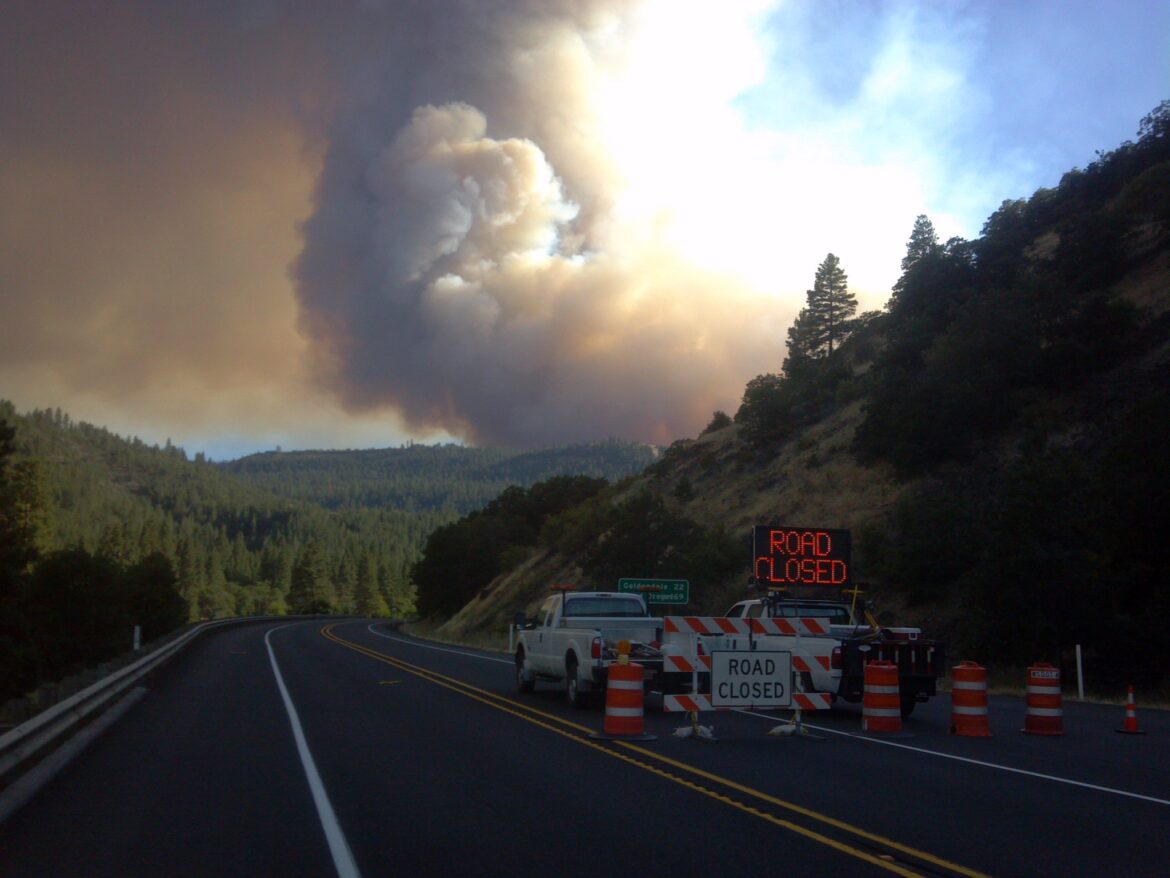
It’s the middle of the week, and despite it being midday, cars are bumper to bumper. Thousands of brake lights burn red, mirroring the sun, dimmed and distorted by a sky choked with smoke. Flames lick the treetops on either side of the road, rising higher than the tallest stack of suitcases strapped to a car roof. It’s wildfire season. This image, of a burning red sun and dark midday sky, has become emblematic of summers in the age of climate change.
As the fire season grows longer and more severe due to increased drought and high temperatures, scenes like this have become a global occurrence. In 2025, the world has seen some of the hottest temperatures on record: and with them some of the most scorching wildfires in recent memory. Canada experienced one of its most intense early wildfire seasons, the second-highest ever recorded according to the EU-funded Copernicus Atmospheric Monitoring Services (CAMS). In Russia, over one million hectares have been affected by fires, and smoke has drifted over Eastern China and Japan. Additionally, areas usually not prone to early fires –the UK, Germany, and Ireland– have also seen record burns, causing “the second-highest fire-related carbon emissions for the UK and Ireland since 2003.”
The warmer and drier conditions brought by climate change increase drought and extend the fire season. This means that once a fire starts, it spreads faster and farther, and is more difficult to extinguish. While wildfires are a normal part of the Earth’s natural cycle, many are the result of human activity. In the U.S., 84 percent of wildfires –1.2 million out of 1.5 million blazes in the U.S. Forest Service Fire-Occurrence database– were caused by humans. Paired with the fire-prone climate, human activity has extended the average fire season over the past 21 years from 46 to 154 days.
Amid the rising incidence and severity of wildfires due to climate change, cross-border cooperation in firefighting is no longer just a logical necessity; it’s becoming a form of climate diplomacy. This July, as fires rage on the Island of Cyprus –long divided between Turkish and Greek communities –the Turkish Republic of Northern Cyprus offered wildfire assistance to the Greek Cypriot administration through UN peacekeepers, a rare gesture of cooperation during ongoing political tensions. Actions like these can cool tensions, build trust, and open channels for broader cooperation. Disasters like wildfires provide a neutral opportunity for the extension of an olive branch. Disaster aid is necessary, rapidly deployed, and carries relatively little political baggage. Multi-nation wildfire management fosters a shared sense of responsibility and risk, as wildfires and other disasters often cross borders to become international disasters, a major concern in the divided island of Cyprus.
This sense of shared responsibility is especially relevant for regional organisations and agreements. In the European Union, the EU Civil Protection Mechanism (UCPM) allows any wildfire-affected country, whether an EU member or not, to request assistance. The mechanism was activated roughly 19 times for wildfires in the first eight months of 2024, out of the total 29 activations. For the 2025 wildfire season, the EU has put firefighting teams on standby, strategically deploying these teams to priority regions to ensure faster response times. These initiatives powerfully display solidarity and the value of inter-regional cooperation. The UCPM makes the EU seem responsive and relevant, showing that the Union is a shared safety net, not just a shared market. Politically, wildfires make climate change tangible to voters –and firefighting cooperation helps frame climate adaptation as security policy, not just environmentalism.
However, initiatives like the UCPM are not without strain. Simultaneous fire seasons, sovereignty concerns, and disparities in preparedness and infrastructure pose practical and political challenges for the effectiveness and scalability of this form of climate diplomacy.
Concurrent fires limit aid availability and strain protection mechanisms. In 2022, Europe faced fire outbreaks in Spain, France, and Greece, forcing the UCPM to triage deployments based on urgency. This competition for resources during concurrent disasters highlights a key tension in climate-driven cooperation: it depends on a capacity surplus, one that is rapidly shrinking as climate change accelerates the scale and frequency of disasters.
Cooperation also bumps up against national sovereignty concerns, especially in regions with less integrated institutions. In Southeast Asia, the ASEAN Agreement on Transboundary Haze Pollution, signed in 2002, aimed to address smoke and wildfires largely caused by slash-and-burn agriculture. Enforcement of the agreement has been weak, due to lack of supranational enforcement and different land-use policies. Indonesia’s fires still regularly impact Singapore, Malaysia, and Thailand, leading to recurring diplomatic tension despite the agreement on paper. Indonesia lacks comprehensive concession maps, which identify the boundaries and locations of resource extraction efforts like controlled burns, which are often the source of transboundary haze. For climate change-fighting efforts to be effective, they need to be enforced, which can be difficult across borders.
Some countries are far better equipped to receive and coordinate international aid than others. Effective cooperation requires shared communication systems, training standards, and facilities. Wealthier nations, which have the capacity to receive and distribute aid, tend to benefit more from international help, while low-income or conflict-affected states may struggle to absorb or coordinate support efficiently, making equitable cooperation harder. A strong example of this disparity can be seen in Greece versus Syria. Greece has repeatedly received international wildfire assistance through the UCPM, which was integrated quickly and effectively due to strong international and domestic disaster management institutions. In contrast, Syria, which has suffered significant wildfires in regions like Latakia, has struggled to benefit from similar international aid. A lack of formal agreements with neighbouring countries and international institutions, damaged infrastructure, and limited state control over swaths of the country mean that even when regional actors –like Turkey and Qatar– have stepped in, coordination can be slow and efforts ineffective. Greece’s ability to integrate into cooperative mechanisms like the UCPM has made it a model recipient of wildfire aid. Syria’s situation, by contrast, shows how conflict and geopolitical tensions can prevent effective support, even when the need is urgent.
As smoke-darkened skies become fixtures of summer, wildfires evolve from environmental tragedy to geopolitical stress tests. In an era of climate volatility, wildfire cooperation has emerged as a case of climate diplomacy in action. It provides states with low-risk opportunities to build trust, demonstrate soft power, and reframes climate adaptation as shared security. Yet this form of cooperation remains structurally unequal and politically contingent. States with strong institutions benefit most, while low-capacity states may fall through the cracks. As the climate crisis intensifies and fire seasons lengthen, the limits of voluntary, ad-hoc aid systems will become increasingly apparent. The future of wildfire cooperation —and climate security more broadly— depends not only on technical readiness, but on the political will to institutionalize equitable, enforceable frameworks for transboundary risk.
Edited by Alex Ritch
This is an article written by a Staff Writer. Catalyst is a student-led platform that fosters engagement with global issues from a learning perspective. The opinions expressed above do not necessarily reflect the views of the publication.

I’m a writer for Catalyst and the McGill Journal of Political Science. I am passionate about topics such as politics, sustainability and geography!