
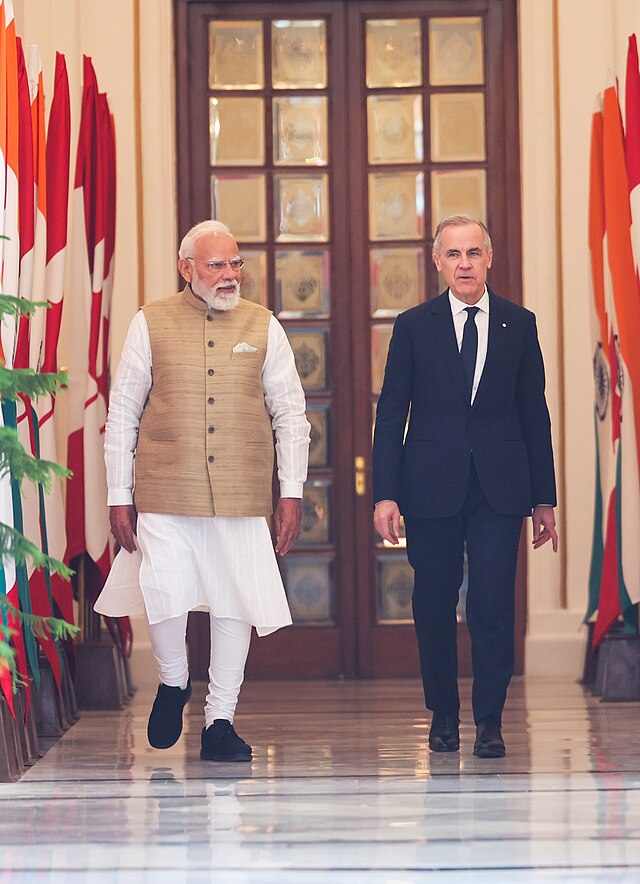
Since the beginning of 2026, Canada has signed several trade agreements, most notably with India and China. Prime Minister Mark Carney has emphasized his goal of diversifying the Canadian economy and increasing economic relations with countries other than the US, especially following frequent comments made by President Trump of annexing Canada as the 51st state, accompanied by the imposition of multiple punitive tariffs.
Economic partnerships with rising global powers such as India also present an opportunity for amelioration in India-Canada relations. A new formal trade partnership between Canada and India would solidify progress in the countries’ efforts to rebuild relations. As the nation with the highest rate of GDP growth, India represents a valuable economic partner for Canada. Both countries are seeking to bolster their economies and develop their industries, such as nuclear energy generation.
Canada is home to the largest diaspora of Indians, and additionally has the largest diaspora population of Sikhs. Within the South Asian continent, a portion of this community has historically and still currently fights for their own independent state, Khalistan. As such, pro-Khalistani groups continue to operate in Canada, yet the government has limited their activity as the House of Commons approved a motion on March 27, 2026, banning pro-Khalistan symbols and messages deemed hateful. This move aligns with Delhi’s politics as India themselves combat the movement from gaining traction.
In 2023, diplomatic and business ties became strained and were severed following the death of Sikh leader Hardeep Najir Singh in Surrey, British Columbia. The ensuing diplomatic battle resulted in Prime Minister Narendra Modi and former Prime Minister Justin Trudeau recalling their foreign diplomats and discontinuing trade agreement negotiations.
However, both nations reopened trade discussions earlier this year amidst a chaotic political environment fuelled by President Trump’s threats of heavy tariffs on Canadian goods and the start of the war in Iran in early March. Carney has established an agenda of moving away from dependence on the United States as amicable relations have become stiff.
As such, India and Canada’s new partnership is promising and symbolizes Canada’s shift to seeking stronger allies outside North America. A series of agreements signed earlier this month includes deals on natural resources, defense, education, and working towards a bilateral economic pact. As both India and Canada are affected by American tariffs, the two nations announced their new bilateral Comprehensive Economic Partnership Agreement (CEPA). The finalized agreement would outline an economic plan to reach the goal of increasing bilateral trade profits to $50 billion CAD. This partnership also secures a $2.6 billion deal in uranium between India and the Canadian company Cameco.
At the 2026 World Economic Forum, Carney expressed his economic interests for Canada. His special address called upon nations around the globe to come to terms with the fact that they cannot rely on the US anymore as a stable hegemon and ally. They should focus on building themselves up domestically and forge partnerships with like-minded nations in this unstable and changing world order. As such, Carney’s domestic economic plan focuses on bolstering industries and investing billions in housing, defense, and infrastructure. The speech also outlined how nations must instead look to forge international agreements and use soft power to undermine the US and propel their ambitions. More specifically, Carney called upon middle powers to fight economic intimidation by creating agreements they believe in with other allies, leaving the US behind. This call to action worked, as heads of state such as Mexican President Claudia Sheinbaum applauded the Prime Minister’s speech. The two North American countries have been working to bolster bilateral trade with the end of the Canada-US-Mexico Agreement looming and re-negotiations set for this summer.
Additionally, Carney has stuck to this rhetoric by signing a trade agreement with China in January, negotiating an end to Chinese canola oil tariffs in exchange for Canada lifting electric vehicle tariffs. While it is not a multifaceted economic agreement, this deal is significant because it turns a new leaf and opens up possible future deals between the two states.
Canada’s steps to forge economic relations with other middle and rising powers show its drive to assert itself on the world stage. Presenting themselves as an ally, evidently opposed to Trump, has garnered support, which may hopefully become the beginning of meaningful partnerships. While Canadians have not seen the full effects of these developments, they may nonetheless be optimistic and hopeful for the future.
Edited by Alexandria Alikakos
This is an article written by a Staff Writer. Catalyst is a student-led platform that fosters engagement with global issues from a learning perspective. The opinions expressed above do not necessarily reflect the views of the publication.

Sonia Modha is in her first year at McGill, pursuing a B.A. in International Development and a minor in Anthropology. She is interested in international political theory and public policy. Sonia is excited for her first term as a writer on Catalyst.