
The War’s Impact on Energy
February 28, 2026, marked the shift into a new geopolitical era when the United States and Israel launched strikes on Iran, killing Ayatollah Ali Khamenei and ending his 37-year reign. This resulted in retaliation by the Iranian military, striking American and their allies’ interests in the region. Most importantly, this resulted in the effective closure of the Strait of Hormuz by Iran, through which 20 percent of the world’s oil and liquefied natural gas (LNG) passes daily. This reduced access to oil and gas, which drove up prices worldwide. Europe is amongst the many victims that have seen electricity, oil, and many other goods increase significantly in price. The blockage of the strait thus serves as a reminder to European nations that those who control energy production and transport have leverage over them. To manage this vulnerability long term, Europe should transition towards nuclear power as its preferred energy source, reserving oil and gas for use in sectors in which they are irreplaceable. This would make Europe less susceptible to energy disruptions in the future, allow for a more efficient and sustainable energy sector, and increase European independence during a time of skepticism regarding the integrity of established Western-NATO relationships.
Impacts
The blockage of the Strait of Hormuz caused a 21.2 percent increase in gas prices in the United States, and prices of Brent Crude (a standard oil benchmark) rose from $72–$73 per barrel before the war to nearly $120 at the peak of the price surge in March. As a result, European countries have rushed to secure other resources. Italy is seeking more gas supplies from Algeria, while Belgium’s transmission operator Fluxys is exploring alternative LNG sources, such as the United States and Nigeria. Other nations have adapted policies to reduce fuel consumption, as Slovenia has introduced fuel rationing, and Austria has cut fuel taxes and imposed limits on retailer profit margins. These immediate changes may be effective, but to pursue its own long-term stability, the EU needs to go one step further. They must take actions that will mitigate future energy disruptions, which requires a shift to nuclear power.
Europe’s Energy Vulnerabilities
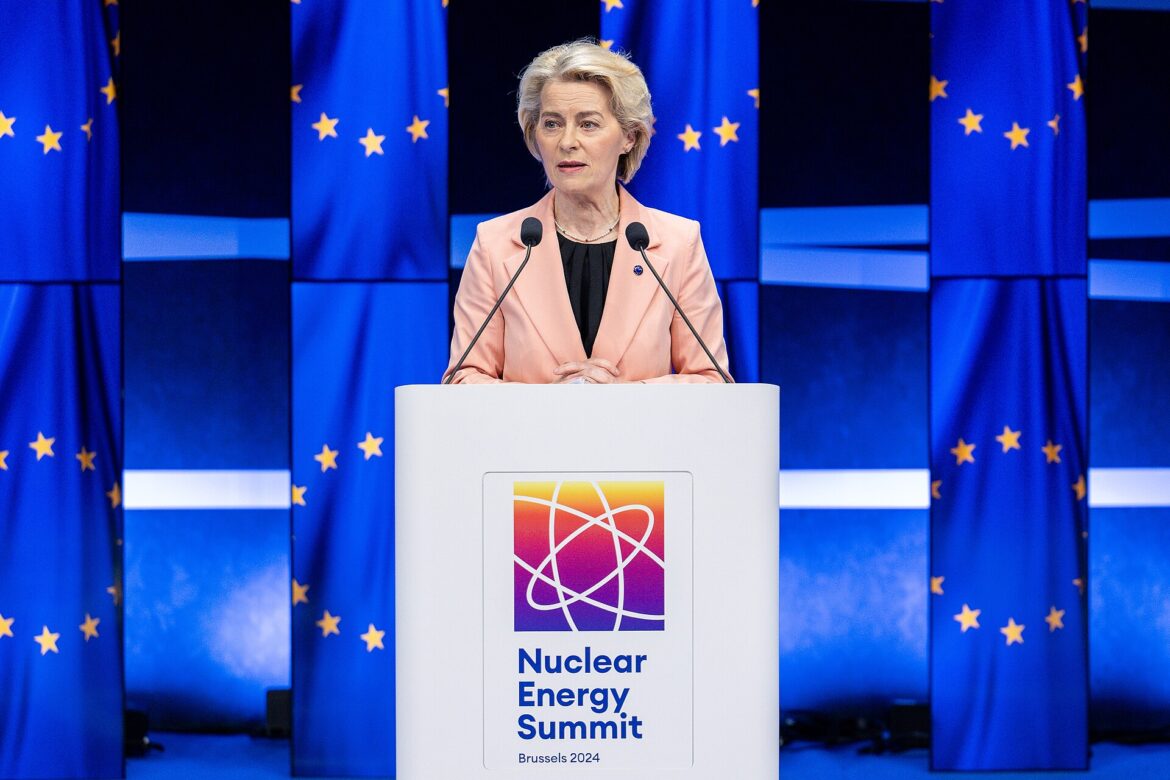
These events expose a key European weakness – that it is too vulnerable to instability in the energy sector, thus allowing producers to have leverage and power over Europe and its economy. Analysts and policymakers have also noted this weakness. Baird Langenbrunner, a research analyst at Global Energy Monitor, said that “this is yet another opportunity for Europe to get more serious about electrification and renewables. Exposure to these geopolitical shocks will continue until it is less dependent on gas”. In addition, even European Commission President Ursula von der Leyen said herself, considering that the EU is not a significant oil and gas producer, that “the current Middle East crisis gives a stark reminder of the vulnerabilities [fuel importing] creates”. Von der Leyen added that “In 1990 one-third of Europe’s electricity came from nuclear, [and] today it is only close to 15%. This reduction in the share of nuclear was a choice. I believe that it was a strategic mistake for Europe to turn its back on a reliable, affordable source of low-emissions power.” Her words are especially impactful as they highlight Europe’s key contemporary weakness.
Former Warnings and Responses
Russia’s invasion of Ukraine in February 2022 caused a similar European energy crisis that peaked in August 2022 when energy prices reached record highs. The EU made some effective efforts to mitigate this vulnerability, including energy diversification, fuel reserve quotas, and cutting energy bills, facilitated through the REPowerEU plan. Most significantly, this effort began phasing out Russian fuel imports and moving to imports from the United States, Norway, Algeria, and Australia. However, Dan Marks, a specialist in energy security at the Royal United Services Institute, said that “this choice between Russian energy and global market volatility is a very bad choice for Europe” and that “reduce or reorganize energy consumption to attain more control over sudden supply changes”. This means that although the source of resources changed, the underlying vulnerability of energy dependence on foreign states remained. The reorganization and reduction that he mentions is thus what seems to be the best path forward for European energy independence. After the 2022 energy crisis, Europe overall has simply shifted its dependency on pipeline gas from Russia to dependency on LNG from other trade partners. At this point, the European community required a short-term fix to shift away from Russian resources with the goal of reducing – ideally eradicating – dependency on Russian resources, due to Russia’s instability as a supplier, and in objection to Russia’s invasion of Ukraine. This meant that long-term projects such as nuclear power plants or large scale domestic energy production projects were out of the picture at the time, since the main focus turned to quickly reducing the use of Russian resources, driving the decision to primarily move to other trade partners.
The Answer is Nuclear
What is the solution to Europe’s energy impasse, then? What action could be taken to reduce energy dependence and simultaneously make its energy sector more efficient? An effective answer is transitioning towards nuclear power in place of fossil fuels as much as possible. Some sectors naturally cannot function without oil and gas, such as aviation, shipping, and heavy industry. However, minimizing the use of oil and gas in sectors that could use nuclear or renewable energy sources would afford Europe a reduced and more efficient use of oil and gas, simultaneously mitigating vulnerability. For example, France generates about 70 percent of its electricity from nuclear energy, and is the world’s largest net exporter of electricity due to its very low cost of generation, thereby gaining over €3 billion per year. Overall, France’s nuclear energy system has enabled it to mitigate the damage of the Hormuz closure in the electricity market better than countries that rely mainly on oil and gas for energy production. France’s electricity prices are amongst the lowest in the EU, sitting as of April 10th at roughly €41 per megawatt hour (MW/h), whilst Germany is at €89 MW/h, Belgium at €117, Italy at €135, and Ireland at €181. The differences in electricity prices illustrate that fossil fuel-dependent countries such as Germany and Italy have prices that more than double, even triple or quadruple, those of France. Importantly, the EU has made progress in reducing imported fossil fuel use, and imports of gas and LNGs saw a 18% decline from 2021 to 2024; however, the downward trend reversed itself in 2025.
Logistics of Nuclear
While nuclear power is promising for the future, its downside is undoubtedly the time and investment that it requires to build and install. The average time globally to build a nuclear reactor is roughly six to eight years; however, it has been done in three to five years, meaning that a nuclear investment wave will likely take five years to a decade to complete, with additional time added on for planning, regulation, and permitting. Given this, the EU has a solid nuclear foundation already, with 98 nuclear power reactors operating in 13 of the 27 EU member states, accounting for about one-quarter of the electricity generated in the EU, with over half of the EU’s nuclear electricity being produced in only one country, France. However, considering the current energy prices, it is obvious that the EU is still highly vulnerable to disruptions in the energy market, meaning that more investment in nuclear power – the most efficient energy source on earth – is undoubtedly a positive move for the future.
Conclusion
Overall, the Strait of Hormuz fuel crisis doesn’t expose the failure of any one energy source, but exposes the risk of reliance on oil and gas. Sectors in which oil and gas use could be heavily avoided – such as heating and electricity – should shift towards nuclear, as it is the most efficient low-emissions energy source that is least vulnerable to geopolitical developments. Finally, this would free up oil and gas from sectors that don’t necessarily require them and allow them to be more effectively distributed to sectors that do require them, such as aviation, shipping, and heavy industry, mitigating the impacts of future crises and making Europe more independent.
Edited by Alexandria Alikakos
This is an article written by a Staff Writer. Catalyst is a student-led platform that fosters engagement with global issues from a learning perspective. The opinions expressed above do not necessarily reflect the views of the publication.

Owen Roberts is a first-year student at McGill Unviersity pursuing a B.A. in Political Science. Originally from the United States, he has lived most of his life in Australia and Toronto, Canada. As a writer, he is interested in international relations, American and European politics, and political culture.