
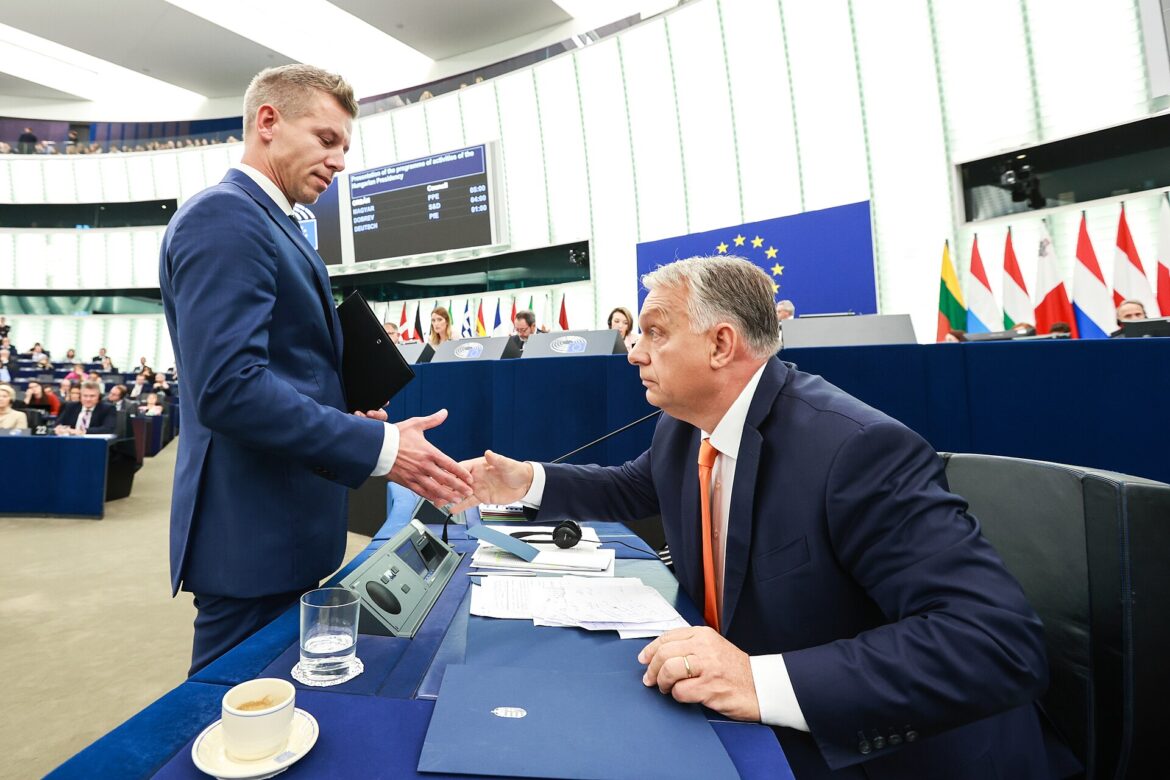
The Election
Viktor Orbán, leader of the far-right party Fidesz, was Hungary’s Prime Minister for 16 years. However, as of April 12th, he has conceded defeat in Hungary’s election, in which 77.8 percent of the electorate voted according to the National Election Commission, the highest voter turnout in Hungarian history. Orbán’s challenger and incoming Prime Minister, Peter Magyar, led a grassroots campaign alongside his Tisza party after splitting away from Fidesz, with his party now holding a parliamentary supermajority with 138 out of 199 seats. Orbán’s loss serves as a beacon of hope that people will still act, vote, and mobilize to combat authoritarianism and democratic backsliding, an extremely important struggle, given that democratic backsliding is a rising global trend. The governments of Bulgaria, Slovakia, Italy, Croatia, and Hungary have been described as enacting democratic backsliding by the Civil Liberties Union for Europe, and according to McKenzie Carter and Thomas Caruthers in the Carnegie Endowment Journal, the United States has begun backsliding. Overall, Magyar’s victory signals a more unified and thus effective European Union in the coming years, and a win against democratic backsliding.
Who is Peter Magyar?
Although Magyar was Orbán’s political opponent, Magyar is not a political antithesis to Orbán. Magyar was a member of the Fidesz party until 2024, and even had a picture of Orbán on his wall as a child while Orbán was leading the Hungarian democracy movement in the 1980s, stating on the Fokuszcsoport podcast last year that “there was a surge of energy around the regime change that swept me up as a child”. Magyar ran on a center-right platform of fervent anti-corruption, press freedom, and EU cooperation, citing unblocking the €18 billion of EU funds for democratic backsliding violations, the removal of Orbán-era reforms, ending dependence on Russian oil by 2035, and an overhaul of the media as core policy changes. Simultaneously, Magyar shares various policy positions with Orbán, such as opposing EU immigration quotas, keeping a border fence to deter illegal migrants, and – extending beyond Orbán’s policy – planning to remove Hungary’s guest worker program. Magyar is also opposed to fast-tracked EU entry for Ukraine, although he does not deny their right to join later in the future. In sum, the true differentiating factors of Magyar from Orbán are his collaborative and relatively pro-EU stance and his anti-corruption agenda.
Orban’s Authoritarianism
Orbán led the Hungarian democracy movement in the 1980s, and has reduced Hungary to what the European Parliament now terms a “hybrid regime of electoral autocracy” by the European Parliament. In addition, Orbán’s Hungary has also become one of the most corrupt countries in Europe, ranking among the seven most corrupt countries in Europe and the most corrupt country in the European Union according to EU data. Instrumental in Orbán’s democratic backsliding was his use of Hungary’s constitution, which can be amended with a two-thirds supermajority in parliament, leaving institutions vulnerable to reforms at the will of Orbán. Orbán won a supermajority in 2010 and used it to consolidate control of the judiciary into the hands of the government, adding four new Fidesz-chosen appointees to Hungary’s constitutional court, and in another change, transferred the power to elect the chief judge from the court itself to the parliament, effectively giving Fidesz the choice over who is in charge of the judiciary.
In addition, Orbán completely undermined press freedom during his time in power, with his government taking direct control of public service media and imposing uniform control of content on six television channels and six radio stations. As a result, hundreds of editors and journalists were fired and replaced by Orbán loyalists. For example, during the 2018 election campaign, 61 percent of state media stories covered the government, and 96 percent of those stories cast it in a positive light. In contrast, 82 percent of stories covering the opposition were negative. Moreover, the loyal media received a budget of almost €300 million to promote a pro-government agenda in 2020, and during the 2022 campaign, the opposition candidate for prime minister received just five minutes of airtime in total. Furthermore, Fidesz’s reach extends past the public media, because since 2010, allies with close ties to Orbán have bought 80% of the country’s media, effectively consolidating it into Orbán’s control. The independent media exists mostly through digital sources, such as the RTL Klub television network, the YouTube channel Partizán, the daily Népszava, the weekly HVG, and the 24.hu, 444.hu, and Telex news sites.
The free press faces the constant threat of shutdown from the weaponized regulatory agencies of the Fidesz government, as happened in 2021, when the agencies arbitrarily banned the last major independent radio station, Klubradio. The stark contrast between the funding, freedom, and availability of the public versus the independent press in Hungary shows how Orbán’s government has consolidated power over the media.
Finally, one major point of tension between Orbán and the EU was his veto of €90bn in aid to Ukraine, which he had previously agreed to, but refused to support when it was time to put the agreement into action. Part of his reasoning for this is the claim that Ukraine has been stalling on repairs of the Soviet-era Druzhba pipeline, which brings oil to Slovakia and Hungary, which Ukraine stated had been damaged in a Russian air attack. This angered his European partners, with Germany’s chancellor, Friedrich Merz, calling Orbán’s actions “a gross act of disloyalty within the European Union”.
The Kremlin Club – Orban, Trump, and Putin
Orbán’s ties to Russia are no secret. A unit of Russia’s foreign intelligence service created an internal report, The Gamechanger, which was obtained and authenticated by a European intelligence service and reviewed by The Washington Post. The Russian operatives proposed a way to “fundamentally alter the entire paradigm of the election campaign”, which would be “the staging of an assassination attempt on Viktor Orbán”. This comes as no surprise. Orbán has positioned himself as Russia’s foremost ally within the EU, striking down sanction packages and various aid packages to Ukraine, including the previously mentioned €90 aid package, a severe obstacle for Ukraine, which is seeing financial difficulties, and a win for the Russian war effort. This made Viktor Orbán a valuable Russian asset and a bulwark against EU efforts to support Ukraine.
The Trump administration has even allied itself with Orbán, and by extension, the Kremlin, with Secretary of State Marco Rubio visiting Budapest in February, telling Orbàn that “your success is our success”. Furthermore, on April 7, Vice President JD Vance visited Budapest and delivered remarks with Orbán. Vance accused the EU of committing “one of the worst examples of foreign election interference that I have ever seen or ever even read about… because they hate this guy” in reference to frozen EU funds originally destined for Hungary. This claim is unproven, since the funds were frozen in response to democratic backsliding conditions. A deputy spokesperson for the German government, Sebastian Hille, responded in a press conference that “We reject the accusation made by U.S. Vice President JD Vance”, and added that “the U.S. Vice President was in Hungary just a few days before the election. This fact alone speaks for itself as to who is interfering”. Trump himself sponsored Orbán with a Truth Social post in March, saying “I was proud to ENDORSE Viktor for Re-Election in 2022, and am honored to do so again”. Considering Hungary’s position as a proponent of Russian interests in the EU, the support of the Trump administration also signals a complicity with or even support of these interests as well, a severely alarming prospect coming from the world’s foremost economic power, which traditionally would be opposed to Russian interests.
Now What?
One of the most significant shifts in policy will be Magyar’s commitment to cooperation with the EU. He aims to unblock the €17 billion of EU funding that Hungary had been denied for Hungary’s democratic backsliding – no small feat – considering that Hungary must meet 27 EU demands to unblock the funds, which requires new legislation, cooperation, and time. In addition, the day after the election, Magyar signaled that he likely will end Hungary’s aforementioned blockage of the EU’s €90 billion loan to Ukraine, saying in a press conference in Budapest that the EU decision on the loan was “already made in December” and that the incoming Tisza administration “would like to be coherent” with previous commitments, meaning that he would uphold Orbán’s initial agreement to the loan.
The Future
Peter Magyar’s election victory ushers in a new era for Hungary and signals a future of improved and constructive EU-Hungary relations. Granted, Magyar disagrees with EU positions in some core areas, such as immigration and the Russo-Ukrainian war, but he has stated that he plans to work with the EU to unblock funding and reverse democratic backsliding, which likely will restore Hungary’s place as a constructive, more democratic partner within Europe. Overall, Magyar’s victory serves as a light of hope that authoritarianism can be fought against and removed when it arises, and that people are still willing to work together to protect democracy.
Edited by Alexandria Alikakos
This is an article written by a Staff Writer. Catalyst is a student-led platform that fosters engagement with global issues from a learning perspective. The opinions expressed above do not necessarily reflect the views of the publication.

Owen Roberts is a first-year student at McGill Unviersity pursuing a B.A. in Political Science. Originally from the United States, he has lived most of his life in Australia and Toronto, Canada. As a writer, he is interested in international relations, American and European politics, and political culture.