
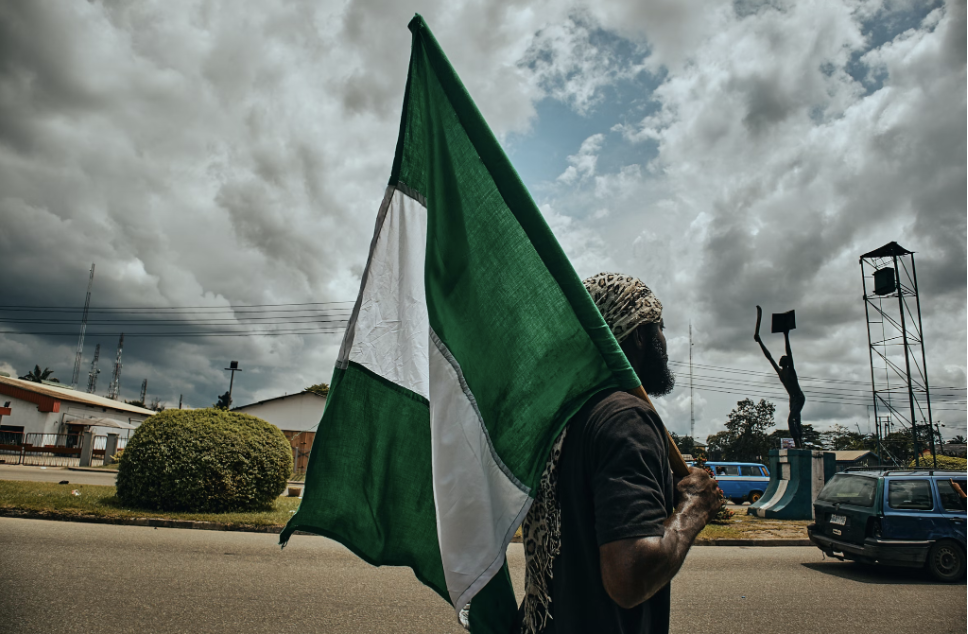
Nigeria has a long and tumultuous history of religious conflict, noted even before the nation gained independence in 1960. Despite attempts to contain the violence, even countering it with purchased US air force weapons, the Nigerian government has repeatedly come up short. The Office of the National Security Advisor, the Department of State Security, the Nigeria Security and Civil Defense Corps along with other designated federal positions have been delegated distinct roles in security towards anti-terrorism efforts, but tangible progress remains to be seen.
Nigeria has a unique demographic with a near split between practicing Muslims and Christians, occupying the north and south as majorities, respectively. Northern and Central Nigeria have received some media attention over the past few decades as being epicentres of large-scale Islamist Jihad violence against Christians, though coverage is not proportional to the impact Nigerians feel day to day. Tensions have only been exacerbated in recent years, with 3,490 Christian deaths from Islamist violence being recorded in 2026 thus far.
Islamist terrorist organizations “Boko Haram” and “Fulani Militants” are two of the most apparent threats in the region. Boko Haram follows Jihad, the belief in the human struggle for promoting their ideal of ethics. This manifests in the desire to establish an Islamic state in Nigeria, a nation wholly encompassed by governance through Sharia law. This group’s training has ties to the major Islamist terrorist group, Al Qaida, and often employs tactics it utilizes such as suicide bombing and mass kidnapping. Fulani Militants have a less clear relationship to Jihad ideology, and differ from Boko Haram in that they often initiate “land-based community attacks” on Christian farm settlements. Such attacks occur often, but generally result in fewer casualties than mass attacks initiated by Boko Haram. Consequently the Fulani Militants receive less media coverage despite being responsible for 47 percent of the nearly 67,000 casualties in the period from 2019 to 2024.
The past two decades have provided an unfortunate wealth of examples of demonstrated violence by these extremist groups that show clear correlation to an anti-Christian agenda. Christian places of worship and schools have been consistently targeted throughout this timeline. In 2011, Boko Haram initiated a Christian church bombing on Christmas Day claiming the lives of 37. In 2014, the mass kidnapping of almost 300 school girls caught media attention as Boko Haram threatened to sell the victims into slavery. Though the school was not religiously affiliated, its location in a predominantly Christian village signifies religious-based targeting. As recently as January 2026, Fulani Militants kidnapped over 150 Christians who were attending church and led them away at gunpoint. The police force first denied the occurrence of the incident before changing course as more details emerged. While the threat these terrorist organizations pose spares no group, the apparent and repeated targeting Christians is a significant piece of the picture that must be accounted for when determining the best course of action to minimize civilian harm.
The global attention that Nigeria attracted over the next decade led to the declaration of Nigeria as a place of concern during first Trump Administration. This designation was later removed by the Biden Administration. In 2025, the nation ranked 6th on the Global Terrorism Index, displaying the gravity of the situation on a global scale. The second Trump administration reinstated the label. The Canadian Parliament issued a statement in late 2025 promoting suggestions for the Nigerian government to tackle the threat, calling for support of NGOs taking in displaced Christians and strengthening the police forces on the frontlines. The EU also implemented an initiative by appointing a “New Special Envoy” for freedom of religion in light of the developments after a period of vacancy from the commitment. China has vocalized its support for the Nigerian government’s handling of the threat, but staunchly opposed international military involvement, specifically from the United States. President Trump threatened US intervention under the premise of the apparent “Christian genocide,” a term which has been rejected by the Nigerian government. China condemns the notion that religious motivations be the impetus for intercession, but supports the cause for a domestic secular solution.
Despite not having a state religion, Nigeria is a member of the Organization for Islamic Cooperation, denoting it as having a population strongly affiliated with the faith. A crucial distinction must be made when interpreting this affiliation, which is the difference between Islamism and Islam. Islam is the faith followed by muslims around the world, based on devotion to Allah and the Prophet Muhammad, with a foundational five pillars. Islamism is an extremist interpretation of Islam, and while this does not always imply violence, all Islamist terrorism stems from extremist points of view. These groups attempt to gain a sense of legitimacy by claiming relation to the faith of Islam, but have proven this not to be the case with instances of changing Quranic translation to fit their agenda.
The Islamist terrorists in Northern Nigeria follow an agenda intended to instill their beliefs into the government. Sharia law implies an interconnected relationship between the faith and the political state. Different groups of muslims believe in this integration to varying degrees, but extreme Islamists believe that the connection should be so interwoven that no other faith should be permitted as their presence posed a threat of a dangerous infiltration of the state.
These terrorist organizations present in Nigeria have attempted to limit the spread of Christianity by destroying monuments resembling the cross and initiating mass attacks on areas where they believe Christians stand opposed to their agenda. The name Boko Haram translates the “Western Education is Forbidden,” highlighting the extremity of their views and the totality they feel their state must achieve to be “pure”. Islam never originally existed in the western context that Christianity did, and has fundamental differences that are the basis of Jihad extremist rejection of the Christian faith. The close intertwining relationship between faith and politics is something unique to Islam, so extreme views see that any interjection to the system from an outside faith weakens the solidity. The concentration of violence in the North of Nigeria can hence be explained by the fact that it is where Christians serve as the minority faith.
Some attempt to debate the fact that the terrorist violence can be characterized as a genocide due to the multifaceted problems that have occurred in Nigeria, such as land disputes and criminal tensions. The deaths of many muslims have also made people question the characterization of these events as targeting Christians, because they often do not receive the same media coverage. One source notes that Christians have been murdered 5.2 times more frequently than muslims, and while no violence can be condoned, the correlation is evident that there is mass persecution against those of the Christian faith. Most recently, an attack on an Easter Service resulted in at least five deaths, highlighting the unceasing threat present to Nigerian Christians.
Nigeria’s military has received training from US forces in an attempt to better equip it with strategies for terrorist de-escalation. Nigeria will need to continue to take such measures to stabilize the nation and promote the peace it desires.
Edited by Olivia Moore
Disclaimer: This is an article written by a Staff Writer. Catalyst is a student-led platform that fosters engagement with global issues from a learning perspective. The opinions expressed above do not necessarily reflect the views of the publication.

Catherine Hearle is in her second year at McGill studying Philosophy and Economics. She has been a staff writer for Catalyst since February 2026, and is particularly interested in the intersection between religion and politics.