
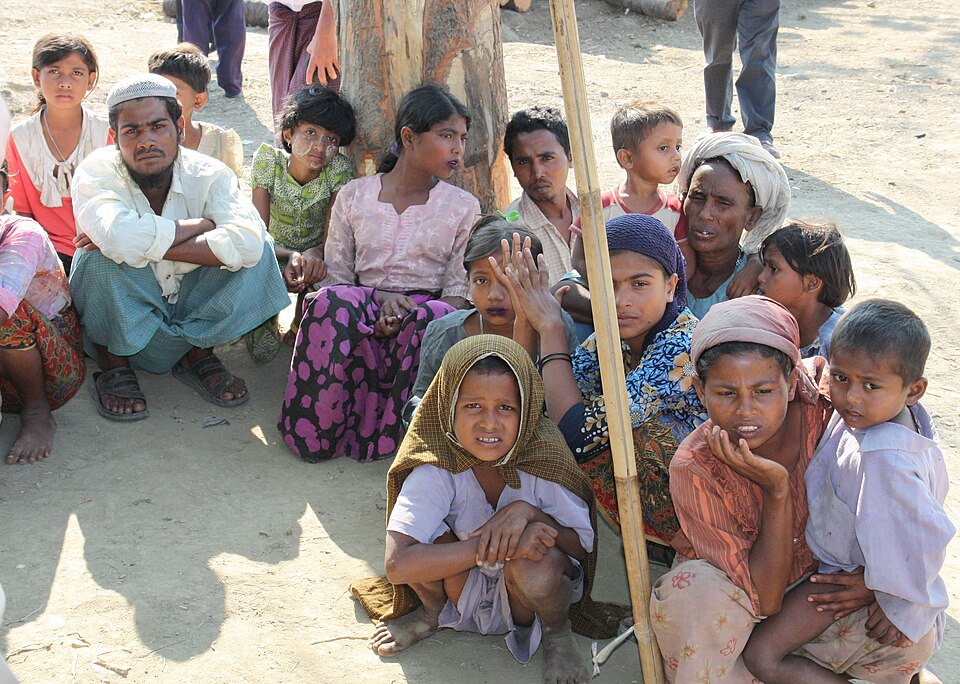
Decades of targeted tyranny by the Myanmar government have left the Rohingya people no choice but to flee their homes, only to still be perceived and treated as second-class citizens by neighbouring nations.
The Rohingya people make up the world’s largest stateless population due to decades of persecution and abuse. Over 1.2 million of the Rohingya have been displaced due to targeted violence campaigns that have forced them to seek refuge in numerous Southeast Asia nations. . These refugees are victims of horrific human rights abuses as they are forced to live in overcrowded shelters, refugees are vulnerable to disease and lack access to basic rights and services.
The Rohingya are a Muslim ethnic minority group that have resided in Myanmar for centuries and been the subject of oppression by Myanmar’s government. In 1982, the Citizenship Law was introduced and stripped the Rohingya of their citizenship, refusing to acknowledge them as an official ethnic group.
While issues between the Rohingya and Myanmar’s government have been ongoing for decades, the recent crisis began in August 2017 when a massive campaign by the Myanmar military forced hundreds of thousands of Rohingya to flee. The campaign included the burning of entire villages and armed attacks, permanently destroying thousands of homes and separating families.
Many Rohingya sought safety in Bangladesh, undertaking a perilous journey to reach a refugee camp in the Cox Bazar region. Over 900 000 individuals reside in this camp, with approximately half of them being children. The extreme density of these camps brings about terrible conditions.
Even once the Rohingya are able to make it to a refugee camp, they are still dependent on humanitarian aid. The Bangladesh refugee camp provides limited education or work opportunities, making it nearly impossible for a Rohingya person to have a livelihood.
The camp has a lack of infrastructure and access to medicine, creating a premium environment for diseases to spread. Additionally, the camp lacks vaccines, preventing residents from combatting common diseases.
Bangladesh does not recognize the Rohingya as official refugees, meaning that they remain stateless. With no way of being able to safely return Myanmar, the refugees have no legal protection and are especially vulnerable to abuse and exploitation. This means they are susceptible to forced labour, violence, and human trafficking.
Those conditions of the camps in Bangladesh and Malaysia are inhumane and those living in the camps face incredibly oppressive circumstances with one refugee saying, “‘I’m saying to the world, we are just as human as you. We are requesting the world to help us live as humans.”
They are kept encolsed with their every move restricted under supervision and only able to work dangerous jobs that are not considered legal. These jobs are instead referred to as “3D” jobs due to being dangerous, difficult, and dirty.
Another Rohingya refugee describes what it feels like to be stripped of all rights and protections, “We are nothing but a walking corpse. The world is made for everyone to live. Today we have no country of our own, despite being human.”
With the lack of formal support, many organizations such as Doctors Without Borders and the UNCHR are working to support and provide assistance to the Rohingya refugees. Doctors Without Borders leads vaccination campaigns, provides mental health support, and treats injuries and disease. Many refugees arrive at camp having been injured from the journey as they fled, or ill with diseases they are unable to be treated for in Myanmar.
“My family and I fled our homes…I stepped on two landmines—the first time I was unharmed, but the second explosion blew my foot off,” said an escapee that didn’t receive treatment until 9 days after their initial injury.
The UNHCR partners with government agencies to provide relief to the refugees. The organization works to give the refugees legal protection, prevent violence based on gender, and ensure access to basic rights such as food, water, healthcare, and shelter.
In 2020, the UNHCR started an initiative to allow refugees to earn a small income in exchange for repairing areas of the camps that had fallen into disarray due to weather and neglect. Recent funding cuts have drastically reduced the number of refugees that could be supported while creating more hazards due to the poor infrastructure.
With humanitarian aid shrinking and many Rohingya still fleeing Myanmar to seek shelter at these overcrowded refugee camps, the situation remains critical.
Edited by Noah Bornstein.
This is an article written by a Staff Writer. Catalyst is a student-led platform that fosters engagement with global issues from a learning perspective. The opinions expressed above do not necessarily reflect the views of the publication.
