
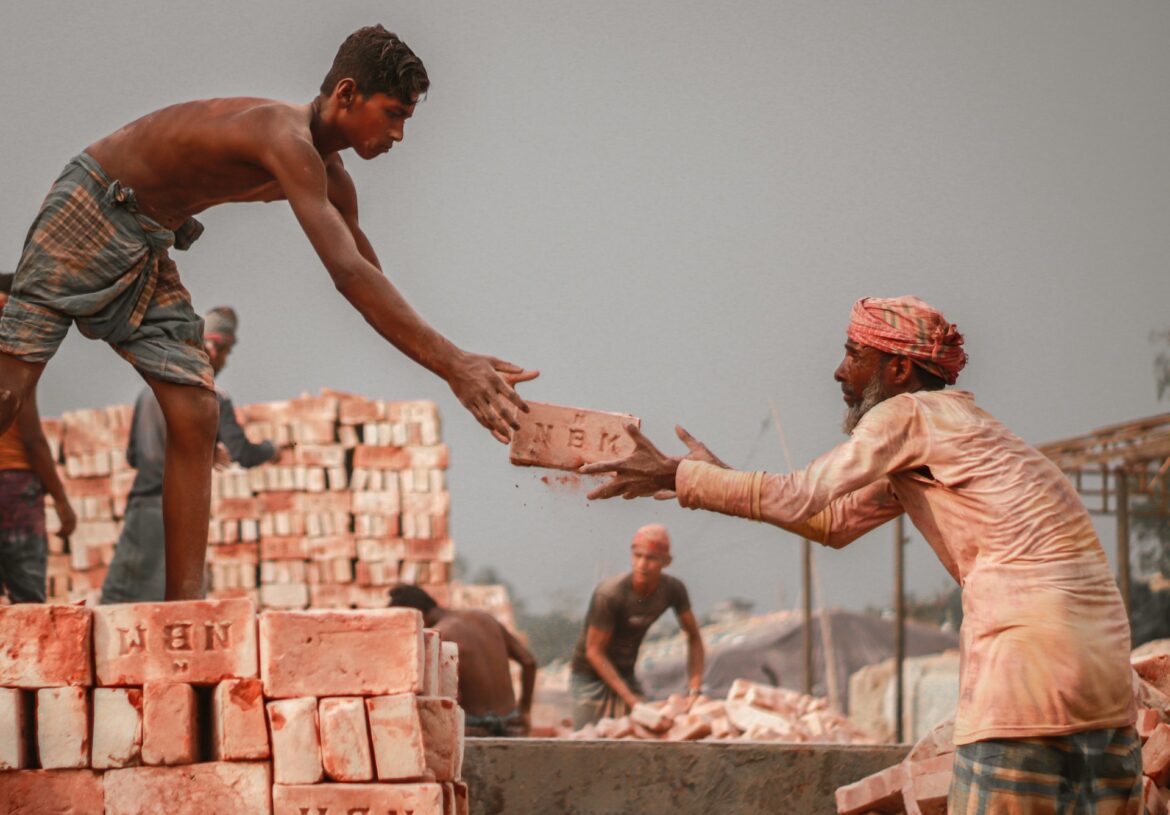
We often perceive slavery as a colonial object of the past. This belief is also localized, based on the history textbooks read in school. However, slavery is not a static concept. It fluctuates and evolves, adapting to the modern era. While this may seem obvious to students of International Development, others might not believe it exists, or that it only does in a faraway land. Unfortunately, modern slavery is still present in various forms. The Slavery Convention of 1926 defines slavery as “the status or condition of a person over whom any or all the powers attaching to the right of ownership are exercised.” Two radically different countries illustrate the scope of modern feudal systems: first, brick kilns in Pakistan; second, prison labour in the United States.
Roots Dug Deep: The Modern Remnants of the Past
Pakistan
In Pakistan, debt bondage is a centuries-old practice rooted in social and religious hierarchies. It is associated with agriculture, carpet weaving, and, especially, brick kilns. Essentially, landless labourers work for wealthier Pakistanis under the peshgi system. Workers receive an advance loan, but due to high illiteracy rates and predatory contracts, they become trapped in an endless forced-labour contract. If they are unable to repay the high-interest loan, the indebted person and their entire family are forced to work for the “debtor.”
Brick kilns, usually located on the outskirts of cities, far out of reach of inspectors, run almost exclusively on this kind of forced labour. When a worker seeks a loan, they usually turn to the owner of one of Pakistan’s 20,000 brick kilns. If they are unable to repay the loan due to hidden fees or inflation-adjusted returns, their entire family becomes bonded to the owner, with only a meagre wage given to the pater familias. Brick kiln owners also force families to live on-site, compelling them to take out additional loans to survive and ensuring that owners benefit from free labour indefinitely. One worker, Yasmin, who took a loan for her husband’s medication, described these dubious practices: “If I get sick or pregnant and am unable to work, they add those days lost to the advance I’ve taken. If I borrow another 500 rupees ($3.1), they will write down 1,000 rupees ($6.2).” This vicious cycle of indebted servitude persists without legal recourse.
Working conditions are extremely hazardous. Nasreen Azhar, the Chairperson of the Human Rights Commission of Pakistan (HRCP), reported that approximately 35 percent of female brick kiln workers are harassed or tortured by their male bosses. Additionally, the coal used to heat the kilns increases the risk of tuberculosis, the site’s water is undrinkable, and there are no proper washrooms. Meanwhile, 70 percent of bonded labourers in Pakistan are children. They are not only denied the fundamental right to education, but many also inherit their parents’ debt.
United States
In this modern epoch, the United States is often referred to as a “beacon of democracy” and the so-called “protector of the ‘free’ world.” Its image strayed from the days of legalized slavery, when approximately 500,000 Africans were forcibly carried over to mainland North America to work on plantations for colonists. And yet, when zooming in on the state of Louisiana, and closer to the State Penitentiary, a whole different picture emerges.
On the site of a former plantation, the Louisiana State Penitentiary, also known as “Angola Prison,” is the largest maximum-security prison in the US. Its incarcerated population of 5,000 is mostly comprised of black men. These men are forced to labour in fields without agricultural tools or shade for mere pennies an hour, while white guards armed with AR-15s and pistols patrol them, echoing America’s grim plantation past. Inmates noted that everyone had to perform hard manual labour outside regardless of age, health conditions, or disabilities. Those who refuse to work are punished. Inmate Patrick Jones testified in a federal courtroom in April of 2025: “It is the only job that you are forced to have a gun pointed at you. […] You are forced to be talked to like you are less than a human being.”
It is difficult to believe that this is actually happening in 2026, 163 years after the Emancipation Proclamation. However, involuntary servitude still remains legal as a form of criminal punishment under the 13th Amendment of the US Constitution.
Birds of a Feather: Similar Circumstances
Pakistan and the United States could not be more different. Yet, within their borders, slave labourers toil without the state’s enforcement of proper protection mechanisms. In both countries, marginalized communities are most at risk of being used as expendable labour. In Pakistan, religious minorities disproportionately work the kilns, especially caste Hindus, Christians, and Muslim Shaikhs. Although accounting for a small percentage of the population, it is estimated that up to 50% of workers are from these marginalized religious groups. The Pakistani government also has a history of targeting minorities who do not profess Islam, the official state religion. Such discrimination entrenches the socio-economic conditions that leave these communities vulnerable to debt bondage. In the US, Black men are especially likely to be imprisoned. Despite making up only 12% of the adult population, they represented 33% of inmates in 2018, making them the most incarcerated group. This overrepresentation makes Black Americans especially vulnerable to exploitation through prison labour, especially in areas with strong legacies of slavery. Such inequalities are a legacy of the United States’ slave-owning past and the laws and beliefs that continue to permeate society today.
In both case studies, state and local governments are equally complicit in this modern slavery agenda. In Pakistan, there is an oversight of child labour, abysmal working conditions, and the active introduction of legislation that prohibits workers from unionizing. The Human Rights Commission of Pakistan found that “influential politicians and their relatives owned most of these brick kilns.” These affluent politicians use the accumulated wealth from unpaid debt-workers to corrupt local police and evade sanctions. In the US, the crops grown at Angola prison are sold on the open market, which, according to the state, is “a positive process of offsetting the cost of incarceration.” In reality, the government treasuries are filled by the forced labour of inmates who work for 0.02 cents an hour and who plow through fertile land.
Ultimately, these vicious cycles continue without consequence. Be it in 1666 or in 2026, vulnerable communities are still being utilized to profit the rich.
Edited by Abigail George
This is an article written by a Staff Writer. Catalyst is a student-led platform that fosters engagement with global issues from a learning perspective. The opinions expressed above do not necessarily reflect the views of the publication.

Maia Sunnberg is a U3 student at McGill University. She is currently pursuing a joint-honours degree in International Development and Political Science, with a minor in German. Human rights, specifically labour and minority rights, as well as ethics in an era of globalized trade, are her particular fields of interest.